
How to create a perfect Python Resume – Let your resume speak!
Master Python with 70+ Hands-on Projects and Get Job-ready - Learn Python
Python Resume – Not just a piece of paper, but a way to stand out from other candidates.
When I created my resume for a Python job, I remember that I was not able to figure out what skills to add and what certifications to mention. And, after checking 4-5 websites on Google, I somehow found an appropriate article that helped me in creating my first Python resume.
You don’t need to scroll through so many websites. DataFlair is here for your rescue. I have collected all the essential points and strategies that you need to follow while creating your Python resume. Make sure to read till the last, as without knowing the last point, you won’t be able to get interview calls.
So, why wait? Let’s unlock your door to success in Python programming.
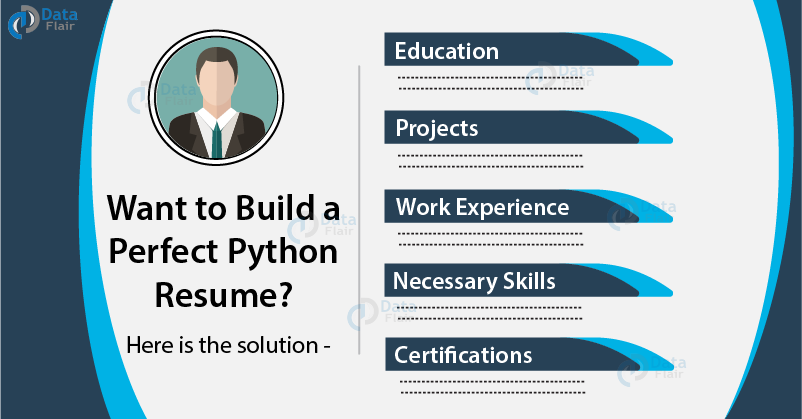
How to put Python in your Resume?
Follow the steps below to build a Python resume for a fresher as well as an experienced:
1. Keep It Brief
The very first important thing you should strive for in a Python resume is – keeping it short and sweet! It should not be any longer than a page unless you are an experienced holder of 12-15+ years. On average, the recruiters have about 30 seconds to go through the resume and make a decision, so it should be very clear. Jot your experience down to the most important points and make it easily scannable.
2. Customize the Resume according to the Python Job description
Add or subtract small details in your resume for each application you submit instead of giving out a single resume to every job. You may also want to have a look at the company’s website to try to get an idea of what style, tone, and writing adjustments they will prefer and change your resume for Python job accordingly.
“The most important tool you have on a resume is language.”
– Jay Samit
3. Choose Proper Templates
While all the resume involves information like work experience, skills, contact information, etc but, it should be unique to you. It can also be accomplished by changing the look or design of the resume. For example, if you are applying for companies with a traditional feel, aim for a classic or subdued style for a resume, whereas more colors can be added for startup vibe companies. Even though you start with a template, take time to personalize it.
4. Contact Information
This piece of information should be kept in a very approachable position. In case the recruiter decides to contact you based on your resume for Python, you don’t want them to search through the whole resume. Double-check all the information to ensure that they are right.
Make sure your headline reflects what you are aiming for through the job and not the one you currently have. If you are trying to become a Python Developer, your heading should be “Python Developer” even if you are working as a marketing intern.

5. Work Experience
The most recent job should be listed on top, with a job below that, and so on in chronological order. Each entry written in this section should include the job title, the company, the period of time you held the position, and your accomplishments. Employers want to see what you actually did, not just what you were assigned.
Frame your Python accomplishments in the context of business metrics to show that you are aware of the bigger picture and can translate your work results into real-world outcomes.
6. Education
The things you should list here are post-secondary degrees (i.e. community college, college, and graduate degrees). If your degree is not relevant to the job you are applying for, still list it. Many Python developers are from a variety of fields that do not have a computer science background. Don’t list your micro-degrees here, like certifications or professional training. We will list them later.
Think of your degree as proof that you know how to learn, which is the most important skill for any programmer. Your unique background actually helps you stand out and shows you have a well-rounded set of skills.
7. Skills and Certifications
For technical positions, the skills section is not optional but a necessity. You want to make sure that terms like Python, Data Science, or Machine Learning are highlighted. Also, list your soft skills, like communication or leadership, here. Don’t rank your skills; it can lead to overpromising or selling yourself short. You can list skills you are strongest at first and weakest later, but do not overload this section with unnecessary details.
Here you can specify your professional training or Python online certifications. Coding-based hackathons are a huge plus point in resumes. Shows your healthy competitive spirit and confidence in your skills.
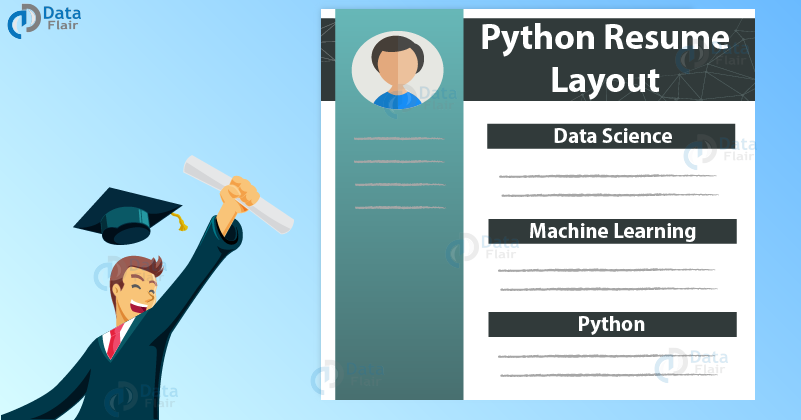
8. Add Python Projects and Applications
The main thing that you have to highlight is what you have created. For Python developers, this could be Data Science projects, machine learning projects, Web development projects, published scientific articles, or coding tutorials.
The companies are actually looking for what you actually do with your skills instead of what skills you have. They don’t aim to see whether the solution was “cool” or not, or how technically difficult the challenge you took. It is all about whether you were able to solve the problem or not with your skill set.
Hence, definitely include projects in your resume, but their description should be very specific, including all main tools and technologies you used and how you created it i.e., individual contribution.
WORRIED? Not done any Python Projects yet? Don’t worry, DataFlair is here to resolve this problem. Check out 5 Python Projects from our Certified Python Training Course
Summary
Open with a sharp headline: “Entry-level Python developer skilled in Flask and Pandas.” Avoid vague phrases like “team player” or “hard-working”; instead, show proof through projects.
List skills in logical groups: Languages, Frameworks, Tools, Databases. Under each job or project, use action verbs plus numbers—“Reduced ETL run time by 40 % using multiprocessing.”
Keep the document to one clean page. Use consistent fonts, enough white space, and no spelling errors. Finish with clickable links to GitHub, LinkedIn, and live demos so hiring teams can verify your abilities in seconds.
Now, it is the right time to prepare yourself for Python interviews. Here are the Python Interview Questions and Answers that were asked of me.
Practice these questions. Don’t forget to share your valuable feedback with us.
Happy learning 😊
Did you like this article? If Yes, please give DataFlair 5 Stars on Google





