
Top Python Math Libraries – Solve your math problems quickly
Master Python with 70+ Hands-on Projects and Get Job-ready - Learn Python
Are you afraid of maths? Have you ever tried to solve your mathematics problems with the help of technology?
I am sure your answer will be NO! Don’t be shocked, now it is possible to solve all your mathematics problems with the help of Python technology.
So, today, DataFlair came with a Python math article. In this, we will discuss how Python can be used for implementing various mathematical operations.
Python is a versatile language that has various applications in the field of data science, web development, and scientific computing.
We will see how Python has impacted scientific computing with its robust mathematical libraries. So, let’s start the tutorial and explore the top Python math libraries.
What is Maths for Python?
Python has become highly popular due to its abundance of libraries. Each Python library is application-oriented and was developed to address problems.
Mathematical operations are most preferably carried out in Python due to its focus on utility and minimal programming jargon.
Several libraries can be used to carry out mathematical operations with Python.
Features of using Math in Python:
- It provides a built-in function to operate some complex operations like square roots, trigonometry, power etc.
- The constants like pi and e are very useful in scientific and engineering calculations.
- It helps in performing the algorithm and exponential operations easily.
- It supports real-life applications in physics, finance, geometry, and stats.
What is the Python Math Library?
The following are several Python math libraries –
1. Math in Python
This is the most basic math module that is available in Python. It covers basic mathematical operations like sum, exponential, modulus, etc.
This library is not useful when dealing with complex mathematical operations like the multiplication of matrices. The calculations performed with the functions of the Python math library are also much slower.
However, this library is adequate when you have to carry out basic mathematical operations.
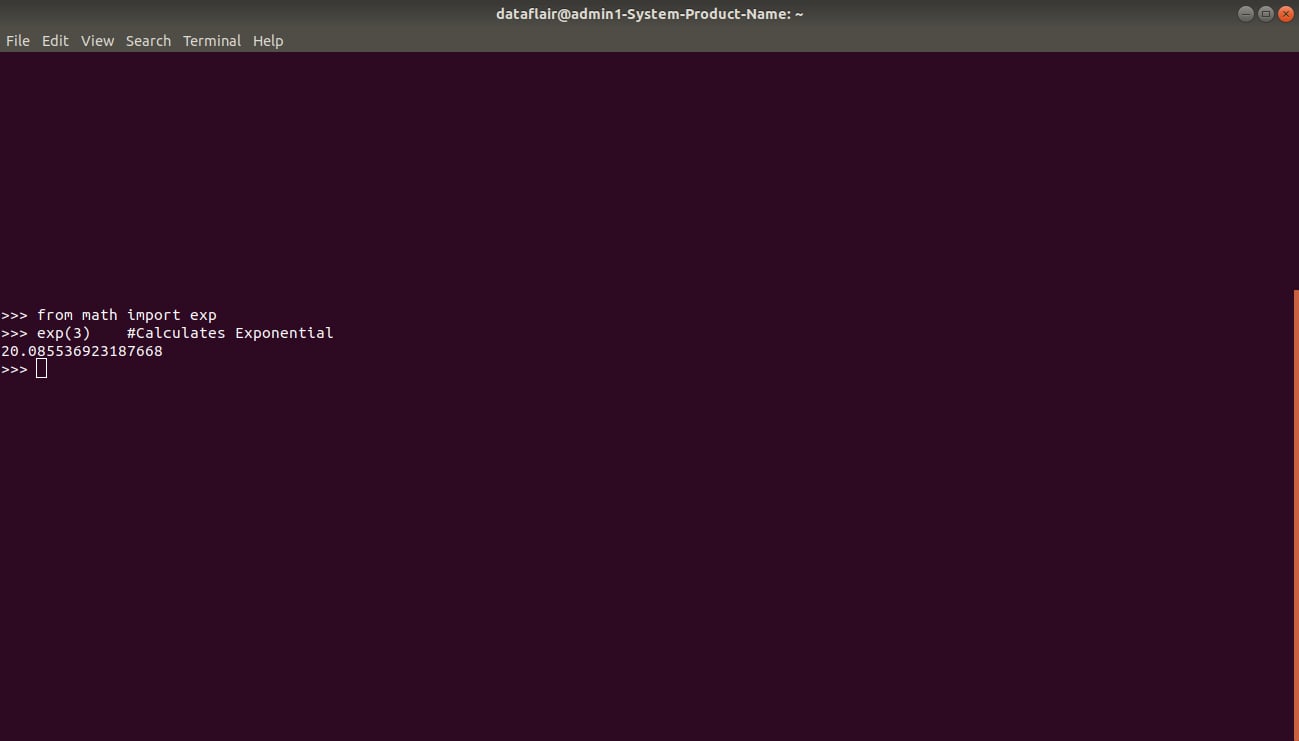
For example: You can carry out the exponential of 3 using the exp() function of the Python math library as follows:
>>> from math import exp
>>> exp(3) #Calculates Exponential
Output
2. Numpy in Python
The numpy library in Python is most widely used for carrying out mathematical operations that involve matrices.
The most important feature of numpy that sets it apart from other libraries is its ability to perform lightning-speed calculations. This is possible due to the C-API that allows the user to obtain fast results.
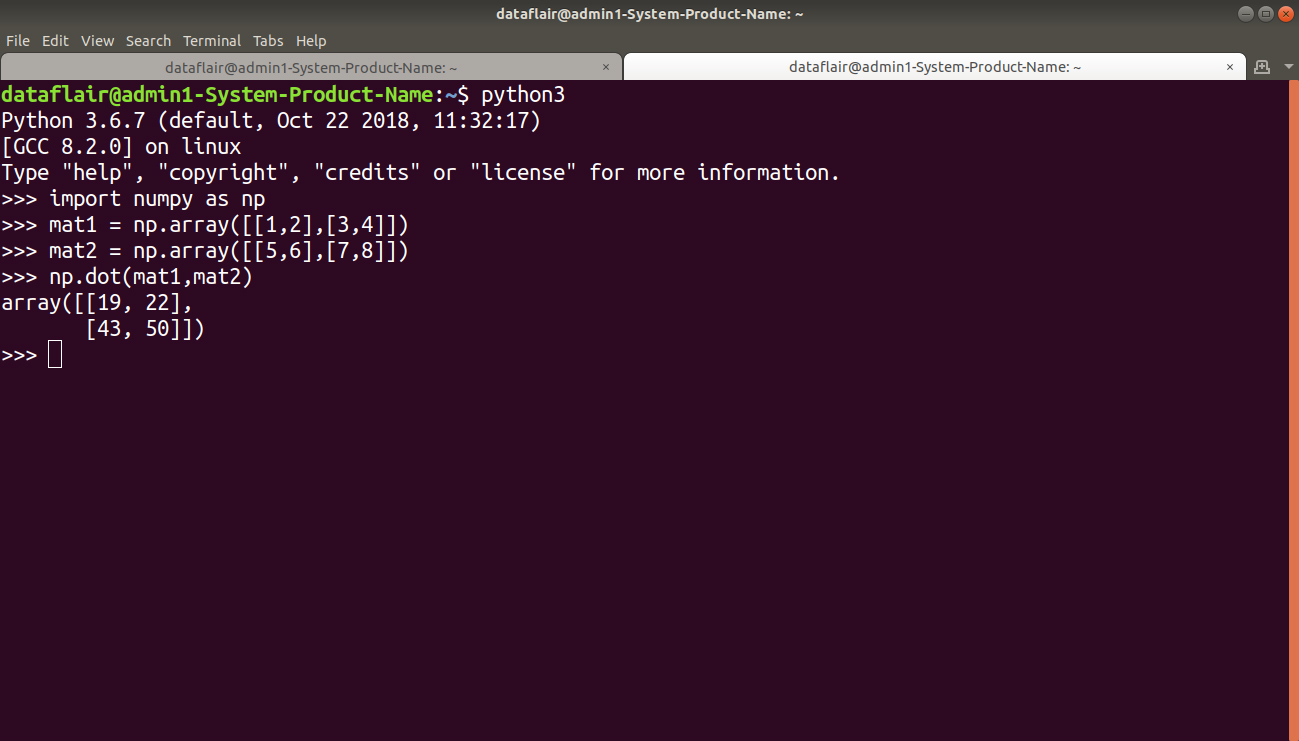
For example, you can implement the dot product of two matrices as follows –
>>> import numpy as np
>>> mat1 = np.array([[1,2],[3,4]])
>>> mat2 = np.array([[5,6],[7,8]])
>>> np.dot(mat1,mat2)
array([[19, 22],
       [43, 50]])
Output
3. SciPy in Python
This Python math library provides all the scientific tools for Python. It contains various models for mathematical optimization, linear algebra, Fourier Transforms, etc.
The numpy module provides the basic data structure of an array to the SciPy library.
For example:
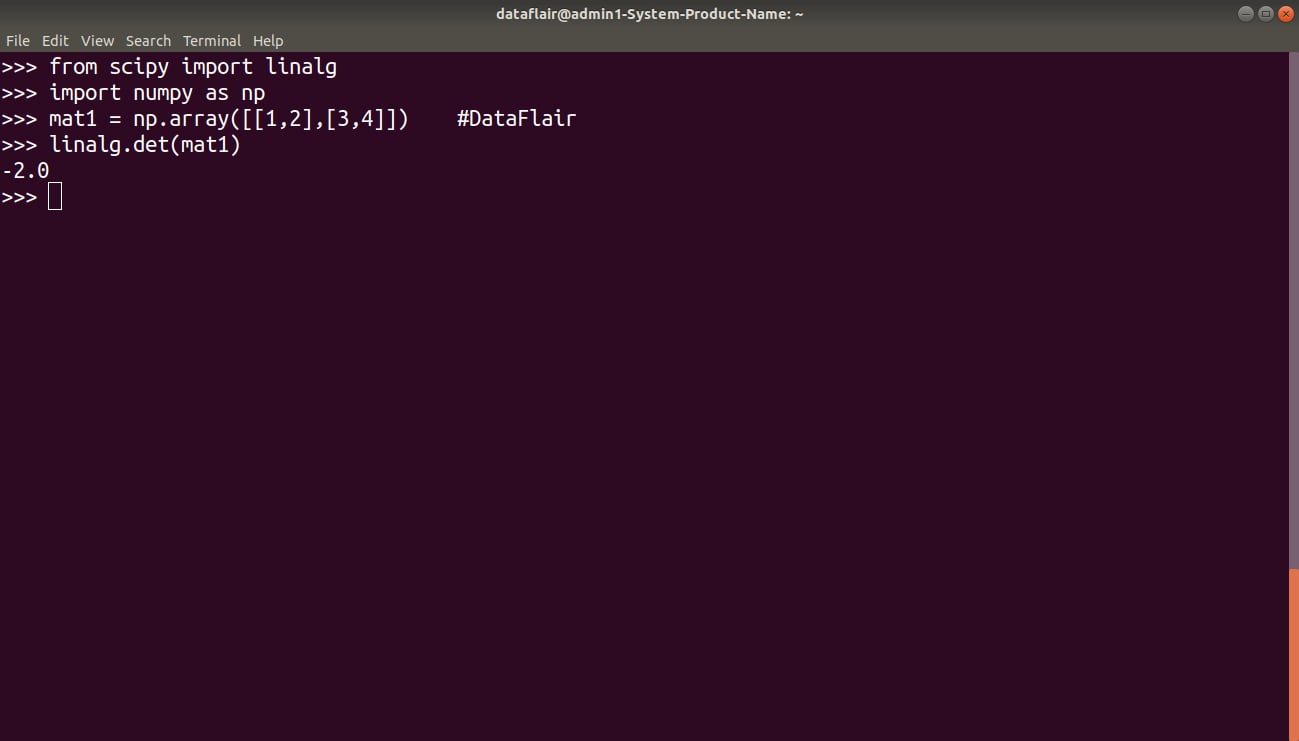
We will use the linalg() function provided to us by the SciPy library to calculate the determinant of a square matrix.
>>> from scipy import linalg
>>> import numpy as np
>>> mat1 = np.array([[1,2],[3,4]]) #DataFlair
>>> linalg.det(mat1)
-2.0
Output
4. Statsmodel in Python
With the help of this package, you can carry out statistical computations that involve descriptive statistics, inference as well as estimation for the various statistical models.
It facilitates efficient statistical exploration of data.
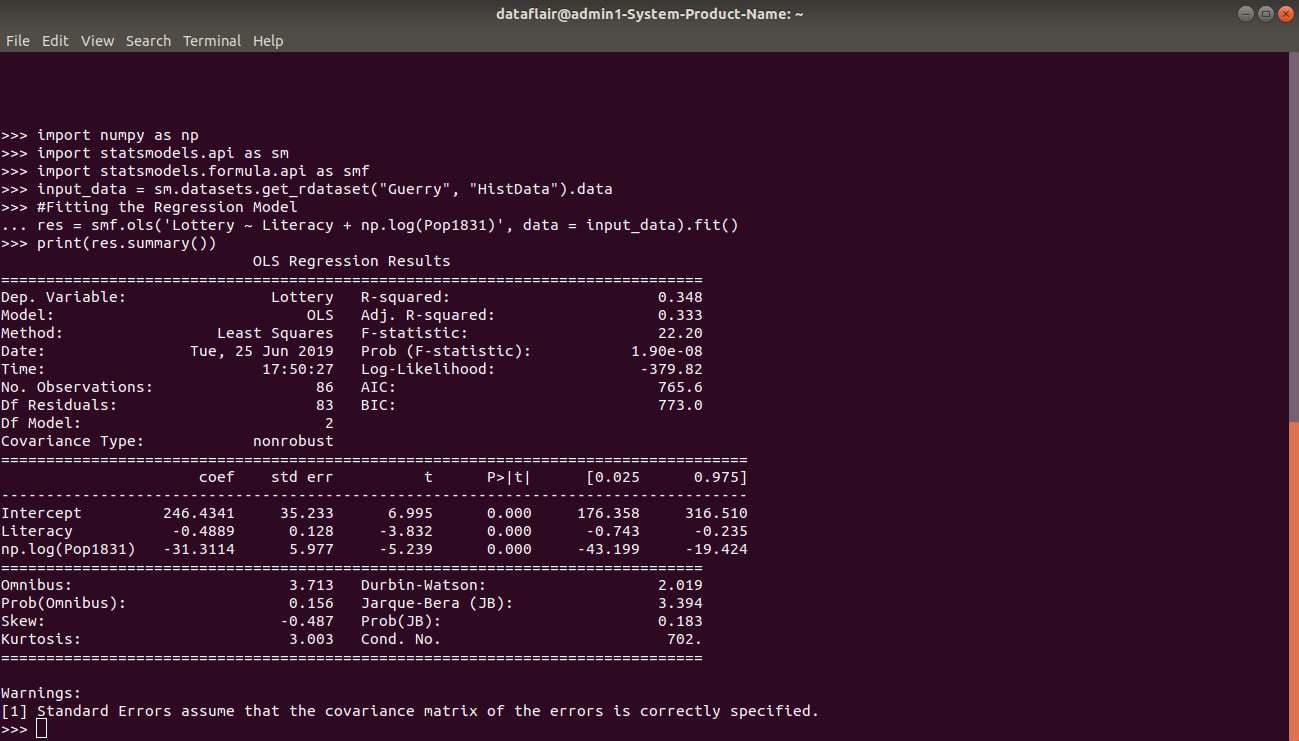
Following is an example of the implementation of the Statsmodel library in Python –
>>> import numpy as np
>>> import statsmodels.api as sm
>>> import statsmodels.formula.api as smf
>>> input_data = sm.datasets.get_rdataset("Guerry", "HistData").data
>>> #Fitting the Regression Model
... res = smf.ols('Lottery ~ Literacy + np.log(Pop1831)', data = input_data).fit()
>>> print(res.summary())
Output
5. Scikit-learn in Python
Machine Learning is an important Mathematical aspect of Data Science. Using the various machine learning tools, you can easily classify data and predict the outcomes.
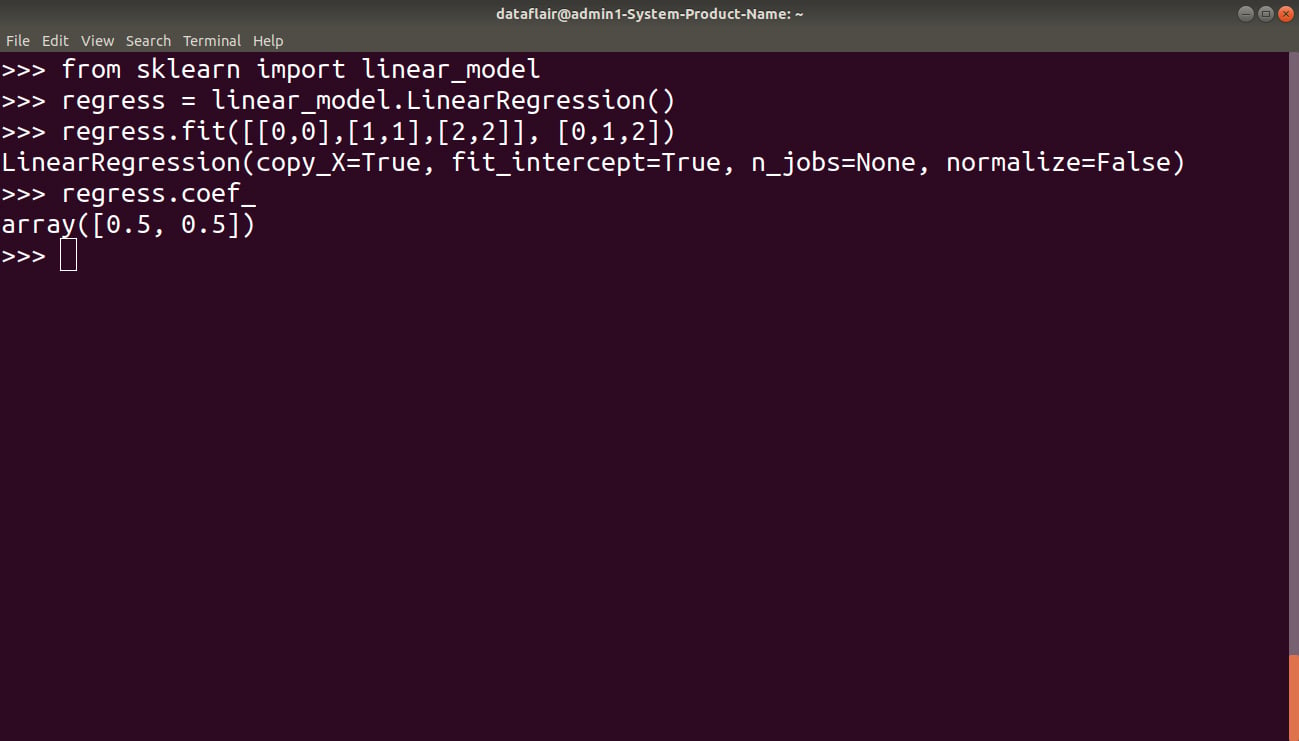
For this purpose, Scikit-learn offers various functions to facilitate easy classification, regression, and clustering techniques.
>>> from sklearn import linear_model
>>> regress = linear_model.LinearRegression()
>>> regress.fit([[0,0],[1,1],[2,2]], [0,1,2])
LinearRegression(copy_X=True, fit_intercept=True, n_jobs=None, normalize=False)
>>> regress.coef_
array([0.5, 0.5])
Output
Python Interview Questions on Math Library
- What is the Math Library in Python?
- How do you access the Math library in Python?
- Is the Math library a built-in library in Python?
- What is the purpose of using the Python math library?
- Name several math libraries for Python.
Conclusion
In this Python math article, we had a look at some of the important Python math library. We went through the basic Python math library, NumPy, SciPy, statsmodels, and scikit-learn.
There are many more libraries for Mathematical operations in Python, and many more are under development. We hope that you enjoyed reading this article and are ready to implement these concepts for your math problems.
Try to apply the above Python math concepts in the project. Here are the top Python projects that you can practice for free.
Waiting for your feedback in the comment section.
Your 15 seconds will encourage us to work even harder
Please share your happy experience on Google






its realy helpull for me
Hello Govinda,
We are happy to help you. Refer to our sidebar for more Python tutorials.
Thankyou dataflair
thanks.it is a very nice article .