
What are the Reasons behind Increasing Demand for Python?
Master Python with 70+ Hands-on Projects and Get Job-ready - Learn Python
With every inch of time, we move forward, we can observe that Artificial Intelligence and Machine Learning are becoming the shine in the eyes of every developer. Which is why, beginner or expert, all are driving the “popularity traffic” towards Python. This is the reason for the increase in Python demand.
Claimed by some old school coders/working professionals, there are some negative conceptions concerning the “non-serious” nature of Python. Yet still, the increasing demand for Python programmers seems to be at odds with this idea. To prove the same, DataFlair has set down some key points.
Why is the demand for Python high?
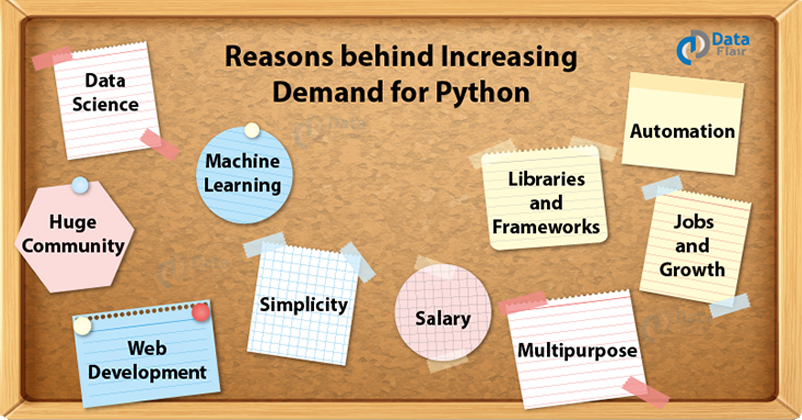
Below are the reasons for the increase in demand for Python –
1. Data Science
Python holds a special place in the hearts of Data Scientists compared to any available language, such as R or C++. Data Science is all about dealing with data at huge amounts (Big Data). Hence, with simple usage and a large set of libraries and frameworks, Python has become the most promising option to handle it! e.g., PyBrain, PyMySQL, and NumPy are among the big reasons.
Another step forward is because of Python’s easy integration with other programming languages, making it more scalable and future-oriented.
You must learn everything about Data Science through the FREE 370+ Data Science Tutorials
2. Machine Learning
Python, being an interpreted language, makes it comprehensive enough for the language to be interpreted by a virtual machine, against any other machine language, which is what the hardware understands. It can even be used in complicated scenarios by making use of variables, objects, complex arithmetic or boolean expressions, and other concepts to increase its demand and usability exponentially. Even the growth of machine learning has been phenomenal in the last couple of years and is rapidly changing everything around us.
Algorithms are becoming sophisticated every day. Examples are: Google’s search algorithms and Uber are completely driven by algorithms. The machine learning libraries, compared to Java, found more content around Python as the current preference of the developer community is Python over anything else for machine learning.
3. Web Development
While concerning backend development, Python is chosen by 2 out of 3 developers who initially worked with PHP. Python’s trend has been witnessing a steep upward trend in the past two years as it is serving as a better alternative. It offers so many good libraries and frameworks, e.g., Flask and Django, which make web development easy.
After adopting Python, some of the product-based platforms have become the biggest names – YouTube, Instagram, Facebook, Google, Netflix, and Spotify. Considering the general perception towards Python, in web development, Python creates more robust code that can be used to form versatile use cases.
4. Simplicity
Single is yet the biggest reason for beginners to learn Python. Whenever you decide to start learning programming and coding, you don’t want to start with a programming language that is complex in syntax and tough with rules. Python is readable as well as simple. It’s even easier to set up Python.
There’s nothing like classpath problems like that in Java, and compiler issues present in C++. Just install it and run it! Whenever you write something in Python, you will want to show off to others, as it is so elegant to look at, not generally the case with typically written languages.
5. Huge Community
Mostly decision are community-influenced, and when to learn something new, you need a community and friends, which serve as your biggest asset. Thanks to Google, many solutions to single Python-related problems can be found in minutes. With the progression of time, learning Python has become the new “cool” in the programming community.
As Python has such vast use cases like development, scientific applications, scripting, and so on, it brings many Python experts together. The more the merrier!
6. Libraries and Frameworks
Not just a framework, but it has a “superior framework”. Django is the clear winner when Python’s frameworks are considered. Frameworks are easy to use, secure, and fast. Most developers prefer these frameworks, as their use results in shorter development time and ease of setup.
Companies love fast delivery. Python’s huge library set—Pandas for data, Django for web, Selenium for testing—lets teams ship features quickly. Less time on boilerplate means more time on business goals.
Data rules today’s world, and Python owns the data stack. Tools like NumPy, Matplotlib, and TensorFlow make it the default language for analysis and AI. Firms racing to unlock insights from big datasets need Python pros to build and maintain these tools.
7. Automation
You are required to write test scripts to automate tasks, which is where Python comes into existence in automation. You’ll be impressed with the time and the number of lines required to write code for tools. As Python supports lots of tools and modules, it makes things easier and even highlights the power of Python.
With basic Python codes, one can easily reach the advanced level of automation. Software testing is one of the tedious tasks in automation, and Python becomes its performance booster!
8. Multipurpose
Swiss Army knife-like nature describes well the overall work of Python. It’s not tied to just one discipline; you can do many things. You don’t really need to fetch data from a SQL server or a MongoDB database; Python supports all these sources of data with very clean syntax. Python API called PySpark can be used to distribute computing. It also provides support for Natural language processing through NLTK.
9. Jobs and Growth
Python is growing as fast as it seems that everyone is adopting Python. So, it makes a lot of sense to learn a growing programming language – Python. As the number of Python users is increasing, the language is becoming more and more popular. It will not only help you to get a job quickly but will also accelerate your career growth. For beginners, one of the most important reasons to learn Python after simplicity is job opportunities.
As the number of users increases, Python is becoming an important tool for everything from building websites to powering Artificial Intelligence. Ultimately, it’s an investment in a skill that lets you focus on solving real-life problems rather than struggling with complicated computer rules.
10. Salary
Last but most important – money talks! Salary keeps every individual going. Python developers are among the highest-paid professionals available. Particularly in the fields of data science, machine learning, and web development, these jobs shine. Though many of the factors contributing to it are also dependent upon experience, location, and area of specialty.
Conclusion
With the increasing demand of programming and coding in today’s world, you are really missing something if you don’t know Python. Nevertheless, it is even a great way to start a learning experience of coding.
Programmers who already know C/C++ and Java, learning Python will be a great opportunity to achieve more in less time in the exciting fields of data science, machine learning and a lot more, which is in demand! To learn Python, you can check the complete Python Tutorial Series for free.
Hope you liked the article. Share your feedback through comments.
Did we exceed your expectations?
If Yes, share your valuable feedback on Google






I am sold on Python. My area was the 60’s, Fortran, COBOL, UNIX and Novell Networks. I am starting on Python tonight. That’s what I want to do when I grow up.
This article is really very nice
It is a very nice article which tells what exactly makes Python the most sought after programming language.
This article is very exciting
This article express in deep about the Python “Why should I learn Python?”. Thanks to Data Flair for write such an important article.
Python is a very versatile and simple programming language. Especially in data analysis, which is an area that I would like to deepen.