
Java Language Keywords – Abstract, Super, Static, Volatile Keywords
Get Job-ready: Java Course with 45+ Real-time Projects! - Learn Java
In our previous keyword article, we studied the two most useful Java keywords, enum and strictfp, with examples. Today, in this Java language keywords, we are going to discuss Abstract, Super, Static, and Volatile keywords with real-time examples.
So, let’s start exploring each Java language keyword.
Java Language Keywords
There are 51 keywords in the Java language. Today, we will explore the 4 major ones.
Abstract Keyword in Java
In Java keywords, the abstract keyword defines that it is a non-access modifier which is applicable for classes and methods, but it is not applicable for variables. These Java language keywords are used to achieve abstraction in Java, which happens to be a key feature of OOP.
Let us study different contexts in detail.
Abstract class in Java
The class that doesn’t have all its methods declared or has a partial implementation is known as a Java Abstract class.
Syntax of abstract class in Java –
abstract class class-name
{
   //body of class
}
Due to the partial implementation, we usually cannot instantiate the abstract classes, i.e., all the subclasses of an abstract class should either execute the greater part of the abstract methods in the super-class or announce abstract itself. Some of the predefined classes in Java are abstract. They rely upon their subclasses to give finished usage. For instance, java.lang. A number is a dynamic class.
Sometimes, we require just a declaration of the method in Java super-classes. This can be accomplished by indicating the abstract sort modifier.
Syntax –
abstract type method-name(parameter-list);
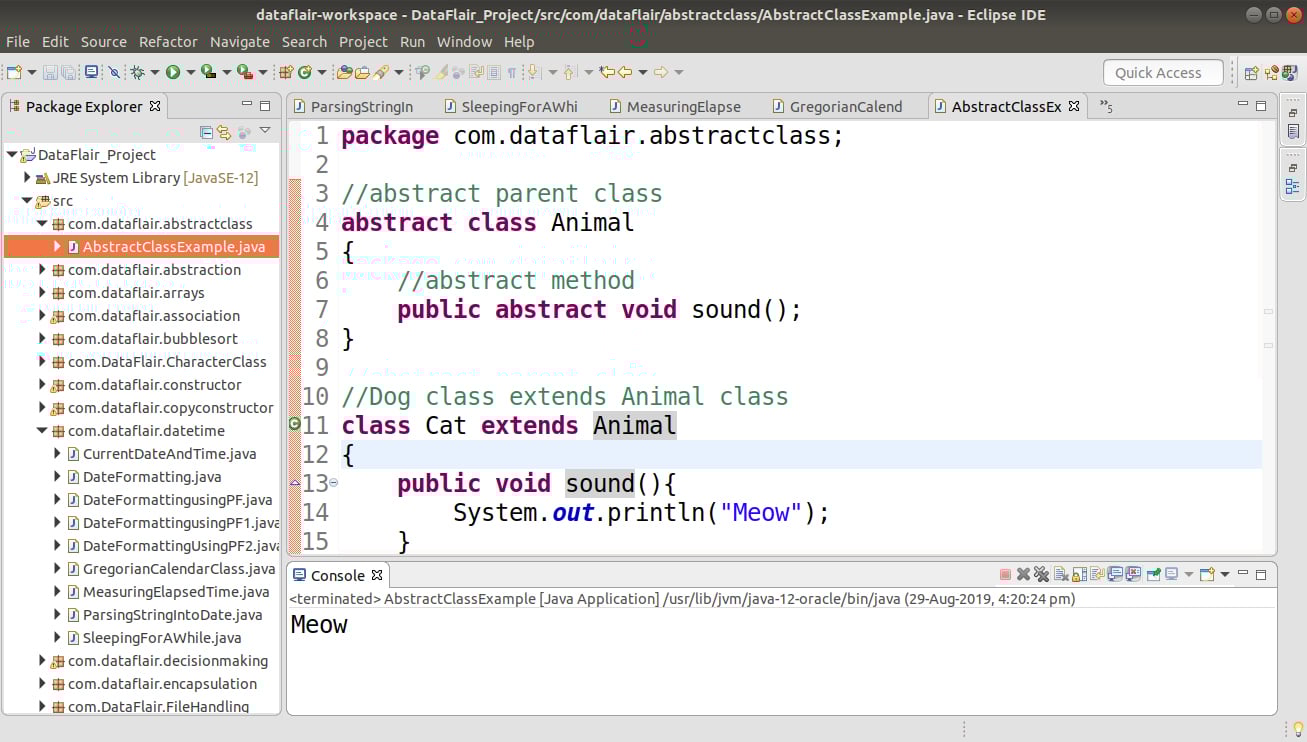
package com.dataflair.abstractclass;
//abstract parent class
abstract class Animal
{
      //abstract method
      public abstract void sound();
}
//Dog class extends Animal class
class Cat extends Animal
{
      public void sound(){
            System.out.println("Meow");
      }
}
public class AbstractClassExample
{
      public static void main(String args[]){
            Animal obj = new Cat();
            obj.sound();
      }
}
Output –
Don’t forget to check the difference between an abstract class and an interface in Java!
Super Keyword in Java
The super keyword in Java is a variable that is used to indicate parent class objects. The keyword “super” came into the scene with the concept of Java Inheritance. It is mainly used in the contexts mentioned below:
1 Use of super with variables
This thing occurs when a derived class and base class carry the same data members. In that case, there might be a possibility of ambiguity for the JVM. It can be understood more clearly using the code snippet:
class Vehicle
{
   int maxSpeed = 120;
}
class Car extends Vehicle
{
   int maxSpeed = 180;
   void display()
   {
       System.out.println("Maximum Speed: " + super.maxSpeed);
   }
}
class Test
{
   public static void main(String[] args)
   {
       Car small = new Car();
       small.display();
   }
}
Output-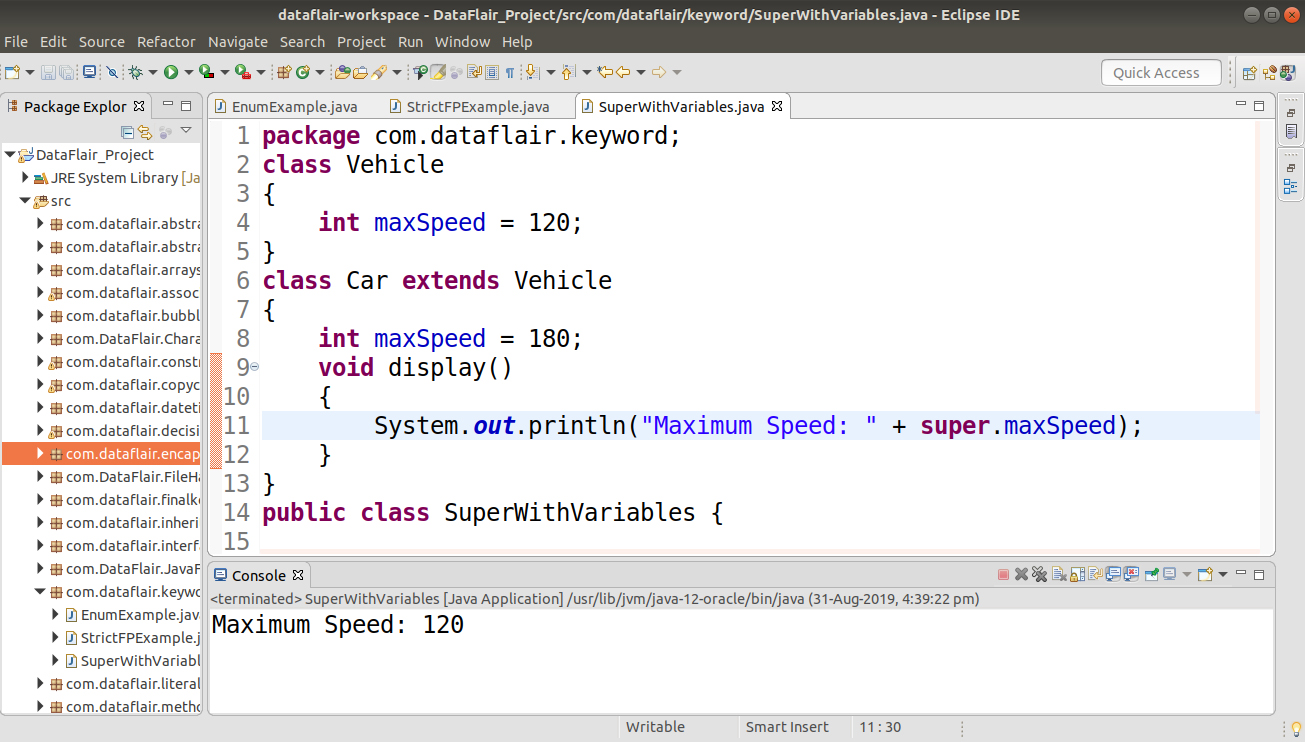 In the example above, both the base class and the subclass have a member maxSpeed in common. We could access the maxSpeed of the base class in sublcass using super keyword.
2 Use with methods
It is done when we need to call the method of the parent class. To avoid ambiguity in classes with the same name, we use this Super keyword.
package com.dataflair.keyword;
class Person
{
  void message()
  {
    System.out.println("This is person class");
  }
}
class Student extends Person
{
  void message()
  {
    System.out.println("This is student class");
  }
  void display()
  {
    message();
    super.message();
  }
}
public class SuperWithMethods {
  public static void main(String args[])
  {
    Student studentObject = new Student();
    studentObject.display();
  }
}
Output-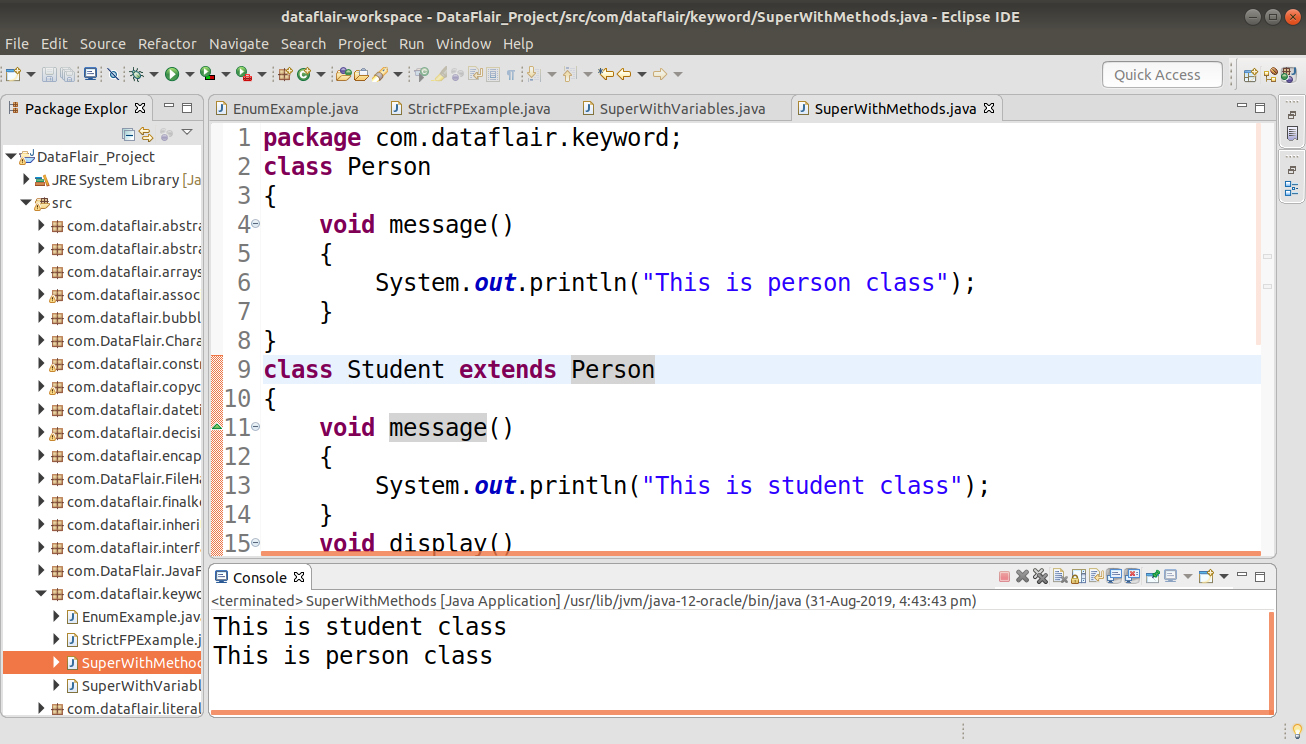
Before we proceed, you should revise the concept of Constructors in Java.
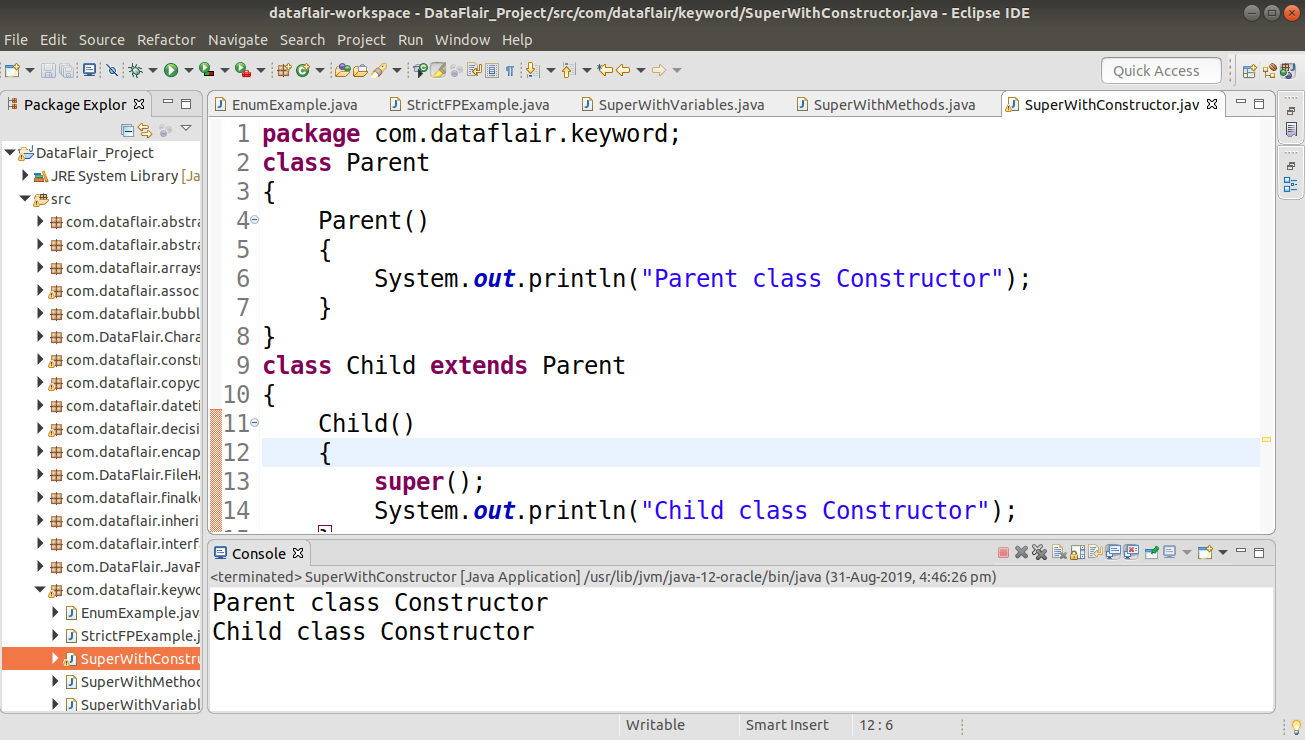
3 Use with constructors
It is used to access the parent class constructor. It can be both parametric and non-parametric.
package com.dataflair.keyword;
class Parent
{
  Parent()
  {
    System.out.println("Parent class Constructor");
  }
}
class Child extends Parent
{
  Child()
  {
    super();
    System.out.println("Child class Constructor");
  }
}
public class SuperWithConstructor {

  public static void main(String[] args)
  {
    Child childObject = new Child();
  }
}
Output-
Static Keyword in Java
Java Static is a non-access modifier which is appropriate for accompanying:
- Blocks
- Variables
- Methods
- Nested classes
To make a static member(block, variable, method, nested class), go before its declaration with the keyword static. At the point when a member is declared static, it gets to before any objects of its class are made, and without reference to any object. For instance, in beneath java program, we are getting the static method m1() without making any protest of Test class.
Master the concept of Java Static Keyword in single-shot!!
Volatile Keyword in Java
The volatile keyword in Java modifies the value of a variable using different threads. It makes the class thread-safe. In other words, multiple threads can use a single method and instance of the classes at the same time without. It can be used with primitive types or objects.
We cannot use the volatile keyword with classes or methods. However, it can be used with variables. Reordering of code is also prevented by using the volatile keyword.
Syntax of the volatile keyword in Java –
class VolatileDemo
{
   static int number = 10;
}
In the following code, suppose two threads are in the same class. But both of them are on different processors, where each thread has a local copy of the variable ‘number’. If any thread tries to change the value of ‘number’, the value will not change, or the change will not be reflected in the main memory.
Let’s explore the important facts about Multithreading in Java
class VolatileDemo
{
   static volatile int number = 10;
}
In the following code, the static variables are the members of a class, and they are shared among all objects. Only one copy exists in the main memory. It is not possible to store the value of a volatile variable in the cache. All read-write operations will be done from the main memory to the main memory.
Summary
Keywords are defined names that are associated with the methods, classes, or variables. It contains the specific task assigned to them in Java. Hence, we cannot use the keyword for defining the variable, method, or class because it violates the task related to that keyword. If the Keywords are used, the properties related to them will be applied.
Java language keywords (reserved words/predefined keywords) add value to code. We can’t use them as a variable name, class name, method name, or object name.
Hope you like the article, and now you can easily practice the abstract, volatile, super, and static keywords.
If you face any queries or doubts, feel free to ask in the comments section.
It’s time to uncover the concept of Final Keywords in Java
You give me 15 seconds I promise you best tutorials
Please share your happy experience on Google





