
10 Astonishing Applications of Java – Where Java is Used in Real World?
Get Job-ready: Java Course with 45+ Real-time Projects! - Learn Java
Sun Microsystems brought Java to the world of programming in 1995. Yeah we learnt that Java contains a plethora of features but where are they used? Where do such features bond together to complete beautiful softwares which benefits people from all over the world? Java has been a prime component for developing a plethora of real-time applications, embedded systems, web apps and a lot more.
We are going to learn about them here in this article,so gear up!
Java has been the backbone for developing Macintosh, Windows and even UNIX based systems. Oracle acquired Sun Microsystems in 2010 after which they revealed that Java was now running on more than 3 billion devices.
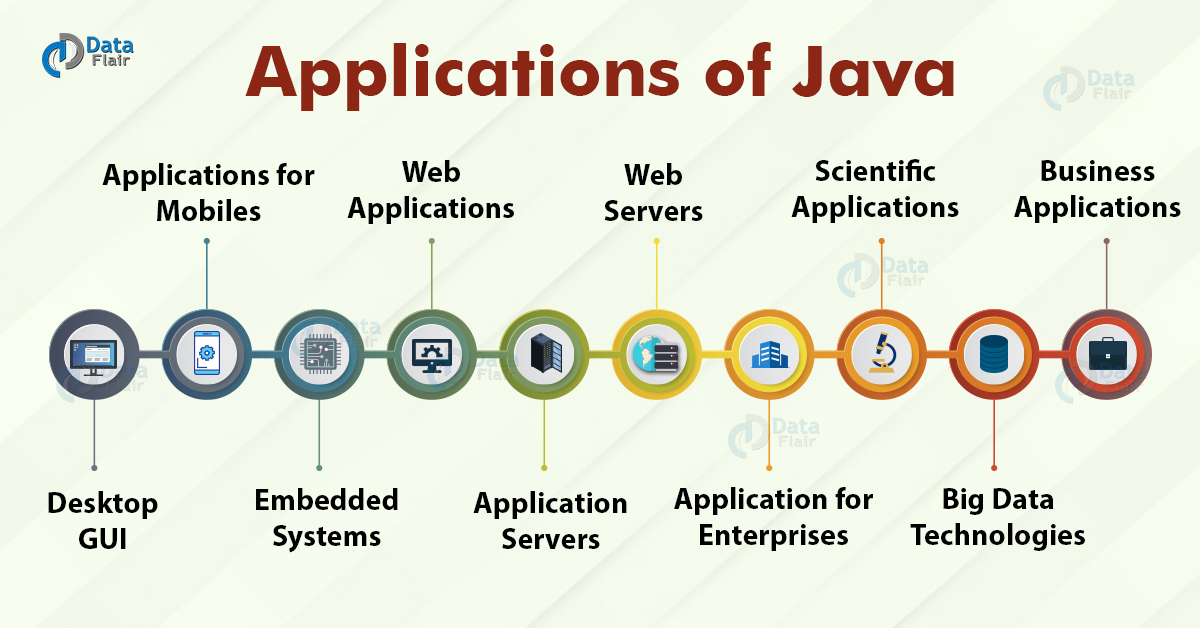
Applications of Java
Some of the many applications of Java are:
- Desktop GUI
- Applications for Mobiles
- Embedded Systems
- Web Applications
- Application Servers
- Web Servers
- Applications for Enterprises
- Scientific Applications
- Big Data Technologies
- Business Applications
1. Desktop GUI
Java has a lot of features that are particularly inclined towards GUI development. There are special packages such as Abstract Windowing Toolkit, JavaFX, and Swing, which aid developers in stitching together various components of GUI, such as window panes and toolbars, to create fluid and responsive interfaces for the users. Swing is a little bit advanced, containing options for developing progressive GUI elements such as trees, tables, tabbed panels, and lists.
2. Applications for Mobiles
Whenever there is a need for developing applications for Android, what is the go-to IDE we all talk about? Yes, Android Studio. However, after the advent of Flutter, mobile applications can also be developed in Dart. But Java still has the monopoly on being the most used language for developing mobile apps. It is even compatible with Kotlin. The reason for Java being the language for Android development is that Android applications use Dalvik Virtual Machines.
The main programming language used to create Android apps is Java. Creating Android apps in Java is made simple by the array of tools and libraries included in the Android SDK (Software Development Kit). Java is an excellent choice for creating intricate and modular applications because of its object-oriented programming features. Android apps can also run on a range of devices thanks to Java’s platform independence.
On the other hand, Java uses Java Virtual Machines, hence it’s easy to develop and bundle the class variables in Java. It becomes entirely platform independent. These are further bundled into an Android Application Package(APK).
Java’s object-oriented principles make it simpler and more effective for developing individual components of an application.
3. Embedded Systems
A lot of electromechanical applications use embedded systems like microchips and mini-computers to perform dedicated tasks in a system.
Several systems, such as SIM cards and televisions, still use Java as their building blocks.
Java acts as a core for TV devices and Blu-Ray disc players.
4. Web Applications of Java
Java is not limited to building Android applications or desktop-based applications; it is also used for creating dynamic web applications. Java consists of various packages and frameworks that help in developing web applications. Java has inbuilt packages such as Servlets, Struts, and Java Server Pages to manage request-response, data processing, and to show the content dynamically.
These packages are easy to code and grasp at the same time. These technologies also provide high security, allowing the development of applications pertaining to health, social security, education, etc.
BroadLeaf, which is a huge open-source eCommerce website, involves the use of Java.
5. Application Servers and web servers
What is an application server in the first place? Well, simply put, it’s a framework that helps and provides in developing a server environment and applications for the web. It has a set of components that are accessible to developers through an API predefined for that platform. In the case of Java Application servers, the server acts like an extended virtual machine. It handles database connections on one hand and the assigned web client on the other.
Java also finds its immense application in commercial application services like WebLogic, WebSphere
However, speaking of a web server, it’s a server software/hardware that satisfies the client requests on the WWW(World Wide Web). It has the job of storing, processing, and delivering web pages to clients/users. The communication takes place by using an HTTP request.
Some very popular web server applications, such as Tomcat, Simpoe, Rimfaxe Web Server, are all developed using Java.
6. Java Applications for Enterprises
What are enterprises? Well, simply put, if a company is aimed at profit whilst being associated with entrepreneurial ventures, it can be called an enterprise. You can think of an Enterprise as any company that runs for profit.
Now, a lot of enterprises use applications that use Java. For example, Muriel is a high-frequency trading application designed entirely in Java EE(Enterprise Edition). It is responsible for providing runtime environments and APIs for running and scripting enterprise software.
7. Scientific Applications of Java
MATLAB is one of the popular scientific applications which involve the use of Java. They use Java for both the UI and the core system. Why? Because Java has high portability and low maintenance. Hence, the applications are fast and reliable; they are able to work with a large amount of data at hand.
8. Big Data Technologies
Java, being fast, reliable, and robust, is useful for many applications to manipulate and study Big Data. With the help of frameworks like Apache Mahout, Apache Spark, Java JFreechart, which are useful while working on big data, Java reserves its place as a valuable language for Big Data applications.
One of the main reasons for Java being the core language for a lot of these technologies is that Java is ingrained with open-source communities.
9. Business Applications of Java
However, Java EE provides API, development models, and runtime environments that make the development of these applications relatively easy.
During the building of business-oriented applications, Java’s EE edition is useful in order to create large-scale, multi-tier, scalable, and secure network applications. The security and reliability requirements of a business application make it complex.
10. Distributed Applications
Distributed applications are such that they are dynamic on the platforms they are working on. They have several common requirements, like the environment being distributed and dynamic at the same time. They also have to be equally efficient on whatever platform they are working on. Also, they have support for all kinds of processors, which makes them versatile.
The JINI(Java Intelligent Networking Infrastructure) is an essential tool that features plug-and-play. It means that whenever a device is plugged into a network, it can immediately provide its services. The distributed services are used by other nodes on the network as and when required. Javaspaces is an application that uses this concept.
It’s basically an online bulletin board of multiple collaborators. It’s a network accessible repository for objects. Kind of like Facebook for business. If you have an apple to sell, you put it up there, and the interested buyer mentions his price there, and so on.
Here are a few main advantages of developing Android applications with Java:
- Java is a programming language that has grown to be stable and mature, and it has a sizable developer community. That implies that you can learn and create Java applications with a lot of support from the available resources.
- By bundling data and functionality within objects, Java promotes modularity. This makes code easier to understand, maintain, and modify. Imagine a complex application managing different shapes. In Java, you could create separate Shape objects with their properties (like several sides and colors) and methods (like calculating area). This keeps the code clean and avoids redundancy. – updated paragraph
- Platform independence: Java can be compiled and executed on a range of devices because it is a platform-independent language. This is crucial for Android development since apps for Android must function on a variety of devices with various hardware and software setups.
- Active and sizable developer community: Java boasts a robust developer community. This implies that a multitude of resources are at your disposal to assist you in learning Java and creating Java applications. There are forums, documentation, and tutorials available where you can get help from other Java developers.
Summary
Java is hugely popular, hence there are so many applications of Java, of which we observed a few in this article. As we progress through the DataFlair Java Tutorial series, we will come to know a lot more about the intricacies of Java, which paves the way to great applications that are dynamic, fluid, and easy to use at the same time.
Stay with DataFlair to learn more about Java!!!
Did you know we work 24x7 to provide you best tutorials
Please encourage us - write a review on Google






Thank you for your article! Java is accelerating in Data Science if Java has an in road in that space but might be good to mention in future coverage. Thank you again!