
Network Scanning with Nmap and Kali Linux
Job-ready Online Courses: Click, Learn, Succeed, Start Now!
In the contemporary interconnected world, network protection has ended up more vital than ever. To guard your systems and discover potential vulnerabilities, it’s essential to behave through community scans.
Nmap, a powerful and versatile network scanning device mixed with Kali Linux, a popular penetration checking out platform, offers a comprehensive solution for network exploration and protection auditing.
This blog aims to delve into the intricacies of Kali Linux Nmap, exploring its capabilities, experiment kinds, command utilization, and moral issues.
Why use Nmap?
Nmap is a famous open-supply network scanner that allows users to discover hosts and services on a PC network, hence allowing protection checks and community inventories. Here are a few reasons why Nmap is extensively used:
1. Flexibility: Nmap offers a large range of scanning strategies and customizable options, making it adaptable to diverse network architectures and protection necessities.
2. Efficiency: With its lightning-rapid execution, Nmap can test large networks swiftly and appropriately, presenting timely insights into the network’s protection posture.
3. Extensibility: Nmap’s scripting engine, NSE (Nmap Scripting Engine), empowers users to create and proportion custom scripts to automate tasks and decorate scanning competencies.
4. Community Support: Nmap boasts an active and committed personal network, making sure of non-stop improvement, worm fixes, and the availability of valuable resources and plugins.
What is Zenmap?
Zenmap is a graphical user interface (GUI) that accompanies Nmap, simplifying the technique of jogging Nmap scans and studying the effects. It provides an intuitive interface with advanced filtering options, and graphical representations of community topology and gives admission to additional functionalities offered by way of Nmap.
What does Nmap do?
Nmap gives a plethora of functions that empower network administrators and security specialists to understand their networks better and perceive ability vulnerabilities. Let’s discover some of its key abilities:
a) Network Mapping
Nmap can discover hosts on a network and create a visible representation of the network topology, helping in identifying devices and their relationships.
B) Port Rules Discovery
By scanning goal structures, Nmap can determine open ports and the offerings associated with them, giving insights into potential assault vectors.
C) Shadow IT Hunting
Nmap can discover unauthorized gadgets or offerings within a community, helping administrators come across and deal with capability protection risks.
D) Operating System Detection
Nmap’s running system detection characteristic enables it to become aware of the underlying running device of a target host, aiding in vulnerability evaluation and making the most of plans.
E) Service Discovery
Nmap can perceive jogging offerings and their variations, allowing directors to evaluate potential vulnerabilities related to precise provider variations.
F) Vulnerability Scanning
Nmap can do vulnerability scans to find protection flaws in purpose systems, coupled with several scripting alternative databases, which include the National Vulnerability Database (NVD) and Nmap NSE scripts.
Port Statuses in Nmap
Nmap is a powerful device for community scanning and protection checks. Understanding the port statuses stated with the aid of Nmap is vital for effective community reconnaissance. Here are the important things port statuses to be aware of:
Open Ports:
These ports indicate that a carrier is actively listening and prepared for incoming connections. They are precious for figuring out potential access factors for attackers.
Closed Ports:
Closed ports are not actively listening and respond with a TCP RST packet. They provide insights into community security features and the presence of firewalls.
Filtered Ports:
Nmap reports ports as filtered while it cannot determine their repute because of blockading or dropping of packets. They can suggest the presence of security features or efforts to hide offerings.
Open | Filtered Ports:
This status occurs when a port doesn’t respond, making it difficult to determine if it is open or filtered. It often arises from stateful firewalls.
Unfiltered Ports:
Unfiltered ports are ports that Nmap determines are open but do not acquire a reaction. It was the port is out there, however, Nmap can not decide if a carrier is walking.
Closed | Unfiltered Ports:
This popularity occurs when a port responds with both a TCP RST and an ICMP unreachable message. It shows that the port is closed. However, Nmap continues to be able to reach it in different ways.
Understanding those port statuses enables protection experts to become aware of vulnerabilities and enhance community protection. In the following section, we will explore practical packages of Nmap in aggregate with Kali Linux for comprehensive network scanning and evaluation.
Types of Nmap scans:
Nmap helps an extensive range of experiment types, each tailored to particular targets. Let’s explore some of the most generally used experiment types:
a) TCP Scan
This experiment type is the default and most not unusual, analyzing TCP ports on target structures to determine their nation (open, closed, or filtered).
B) UDP Scan
UDP scans the goal of the UDP ports, utilized by some services, to stumble on open or closed ports. UDP scans are generally slower and require extra tuning.
C) SYN Scan
Also called half-open scanning, this method sends SYN packets to goal structures without completing the TCP handshake. It lets in for faster scans by fending off the establishment of full connections.
D) ACK Scan
ACK scans determine whether or not a firewall is filtering incoming packets by sending ACK probes. It helps us become aware of structures and not use filtering or only filter positive packet types.
E) Bang Scan
This unconventional experiment sends a mainly crafted ICMP packet to goal structures, imparting a brief overview of their availability and reaction times.
F) Full Scan
The full scan, also known as the complete scan, exhaustively scans all 65,535 TCP ports of a target device. It gives a comprehensive view but may additionally take a giant amount of time.
G) Xmas Scan
This scan sends packets with more than one flag set to pick out open ports and discover structures with unconventional behavior or vulnerabilities.
H) IDE Scan
The Incremental test (IDE) objective is to identify stay hosts within a large network by using scanning a subset of ports step by step.
Note: Each experiment type has its very own benefits and limitations. It is important to understand the unique necessities and objectives before deciding on the precise kind of experiment.
Commands with particular content:
Nmap offers a big selection of instructions, providing significant management over the scanning procedure. Here are some normally used instructions with syntaxes and examples:
a) Basic Scans:
Perform an easy experiment at the goal IP address to decide the country of typically used ports.
- Command: nmap <target>
- Example: nmap 192.168.0.1
- Explanation: This command plays a basic scan on the specified target IP deal. It scans the maximum common ports to determine their kingdom (open, closed, or filtered).

B) Stealth Scan:
Conduct a stealthy TCP SYN experiment that avoids completing the handshake, lowering the possibilities of detection by IDS or firewalls.
- Command: nmap -sS <target>
- Example: nmap -sS 192.168.0.1
- Explanation: The “-sS” option permits a stealthy TCP SYN experiment. This scan kind sends SYN packets to the target structures without completing the TCP handshake, making it less probably to be detected through intrusion detection structures (IDS) or firewalls.

C) Version Scanning:
Identify the strolling carrier and its version on open ports, aiding in vulnerability assessment and patch management.
- Command: nmap -sV <target>
- Example: nmap -sV 192.168.0.1
- Explanation: The “-sV” option permits version scanning, which tries to determine the carrier and its version jogging on open ports. This enables figuring out ability vulnerabilities related to unique carrier variations.

D) OS Scanning:
Determine the underlying operating device of the target host, permitting higher information on its vulnerabilities and capability attack vectors.
- Command: nmap -O <target>
- Example: nmap -O 192.168.0.1
- Explanation: The “-O” choice triggers running machine (OS) scanning. It tries to perceive the underlying running machine of the goal host by reading its community responses and behavior. This information can be beneficial for vulnerability assessment and exploit-making plans.

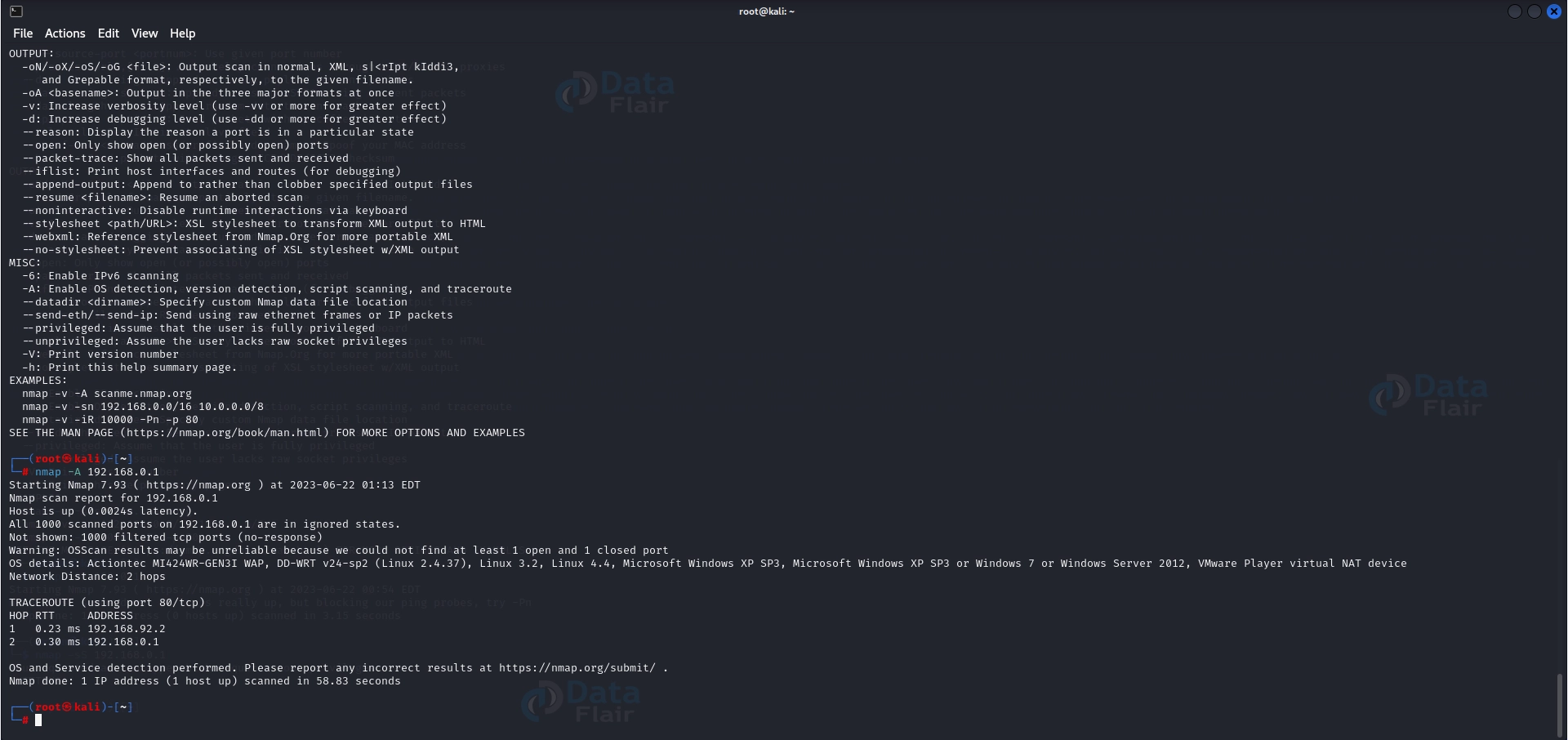
E) Aggressive Scanning:
Utilize aggressive scanning strategies, together with version detection, OS detection, script scanning, and traceroute, to obtain comprehensive records of the goal device.
- Command: nmap -A <target>
- Example: nmap -A 192.168.0.1
- Explanation: The “-A” option turns on competitive scanning, which mixes numerous scanning strategies, including version detection, OS detection, script scanning, and traceroute. This comprehensive test affords certain records about the goal system and its capacity vulnerabilities.
F) Scanning Multiple Hosts:
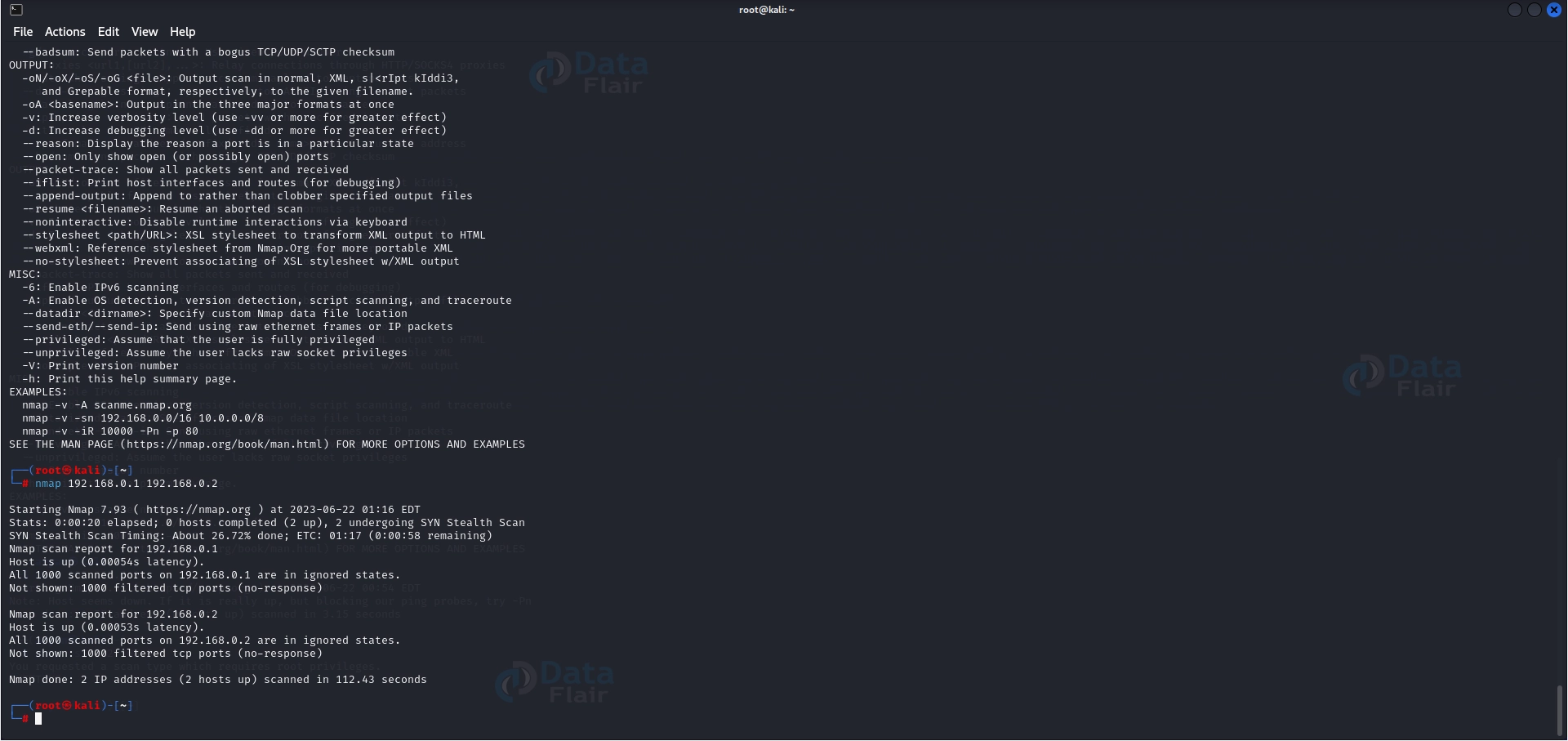
Efficiently scan multiple goal IP addresses in a single command, saving time and supplying a holistic view of the network’s safety posture.
- Command: nmap <target1> <target2>
- Example: nmap 192.168.0.1 192.168.0.2
- Explanation: This command allows you to test more than one target IP address in a single command. Simply list the IP addresses separated by using spaces.
G) Port Scanning:
Specify a specific port or variety of ports to scan on the goal system, taking into consideration the targeted analysis of unique services.
- Command: nmap -p <port> <target>
- Example: nmap -p 22 192.168.0.1
- Explanation: The “-p” alternative specifies a specific port or several ports to experiment on the target machine. Replace “<port>” with the favored port variety or port range and “<target>” with the target IP address.

H) Scanning from a File:
Read a list of goal IP addresses from a report, allowing batch scanning and simplifying the scanning procedure for large-scale networks.
- Command: nmap -iL <file>
- Example: nmap -iL targets.txt
- Explanation: The “-iL” option instructs Nmap to read a list of goal IP addresses from a record. Create a text file that incorporates one IP address in keeping with the line and offer the record path after “-iL”.
Note: The examples provided here are for illustrative purposes. Ensure that you have proper authorization earlier than performing any scanning sports.
Verbosity and Exporting Scan Results:
Nmap offers numerous alternatives for controlling the level of output verbosity and exporting the scan consequences. Here are some high-quality alternatives:
a) Verbose Output:
Obtain a detailed and verbose output all through the scanning technique, imparting complete records about open ports, offerings, and different test-related information.
- Command: nmap -v <target>
- Example: nmap -v 192.168.0.1
- Explanation: The “-v” alternative will increase the verbosity of the output. It presents extra targeted information all through the scanning system, inclusive of open ports, services, and additional information about the experiment.

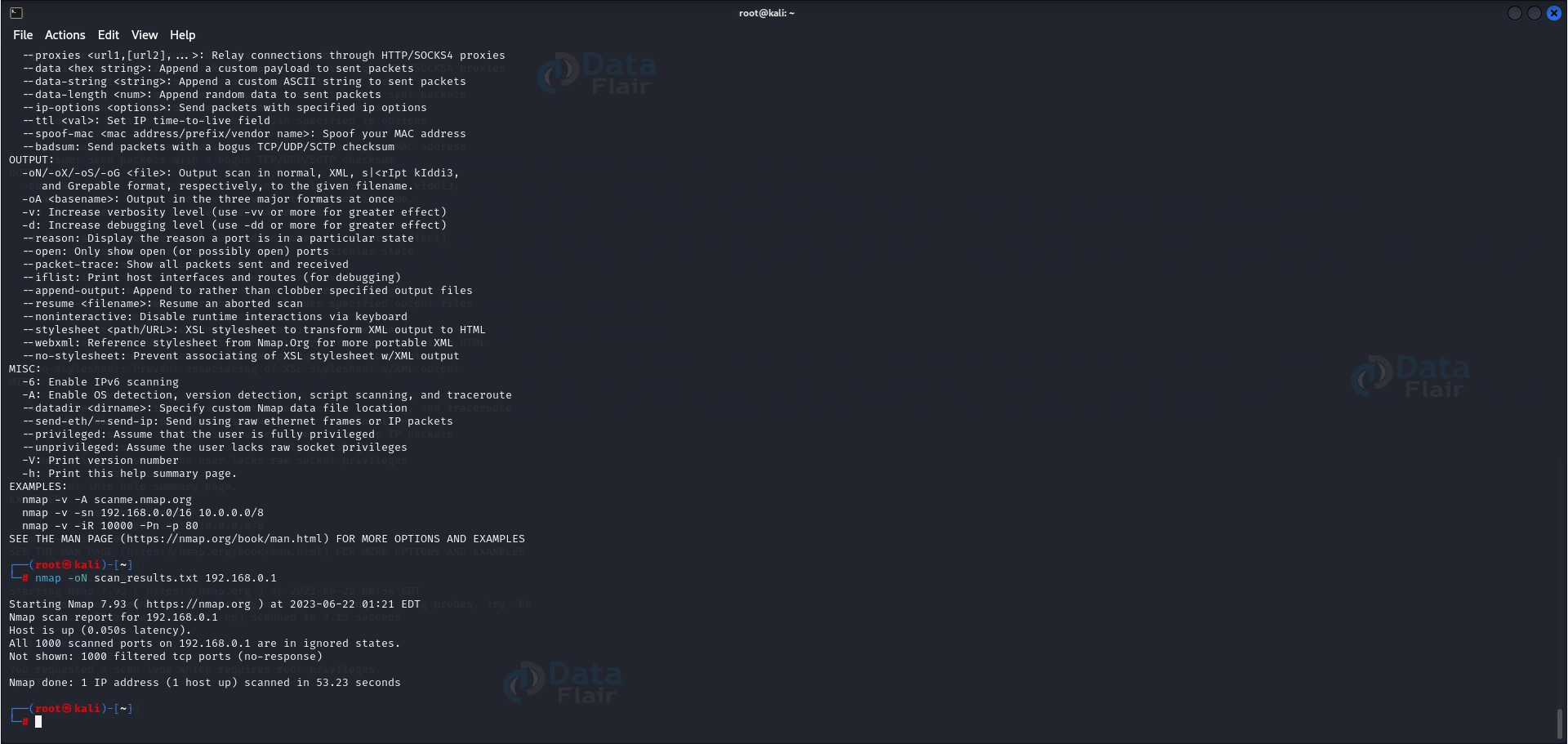
B) Normal Output:
Save the scan effects in a readable textual content format, making an allowance for easy overview and analysis of the essential facts collected during the experiment.
- Command: nmap -oN <output_file> <target>
- Example: nmap -oN scan_results.txt 192.168.0.1
- Explanation: The “-oN” choice specifies the output format as every day. The scan outcomes are saved in a file distinctive through “<output_file>”. This layout gives a readable text output with vital facts about the test.

C) XML Output:
Export the test consequences in XML layout, facilitating device-readable information that can be parsed and processed by way of other equipment or scripts for similar analysis.
- Command: nmap -oX <output_file> <target>
- Example: nmap -oX scan_results.xml 192.168.0.1
- Explanation: The “-oX” choice exports the scan outcomes in XML layout. XML documents are gadget-readable and can be without problems parsed and analyzed with the aid of different equipment or scripts.
D) Multiple Formats:
Save the scan outcomes in a couple of formats simultaneously, inclusive of normal layout, XML layout, and agreeable layout, presenting flexibility and compatibility with numerous analysis tools.
- Command: nmap -oA <basename> <target>
- Example: nmap -oA scan_results 192.168.0.1
- Explanation: The “-oA” option allows you to shop the test effects in more than one format concurrently. Specify a “<basename>” for the output documents, and Nmap will generate three files with one-of-a-kind extensions: ordinary format (.Nmap), XML layout (.Xml), and groupable layout (.Gnmap).

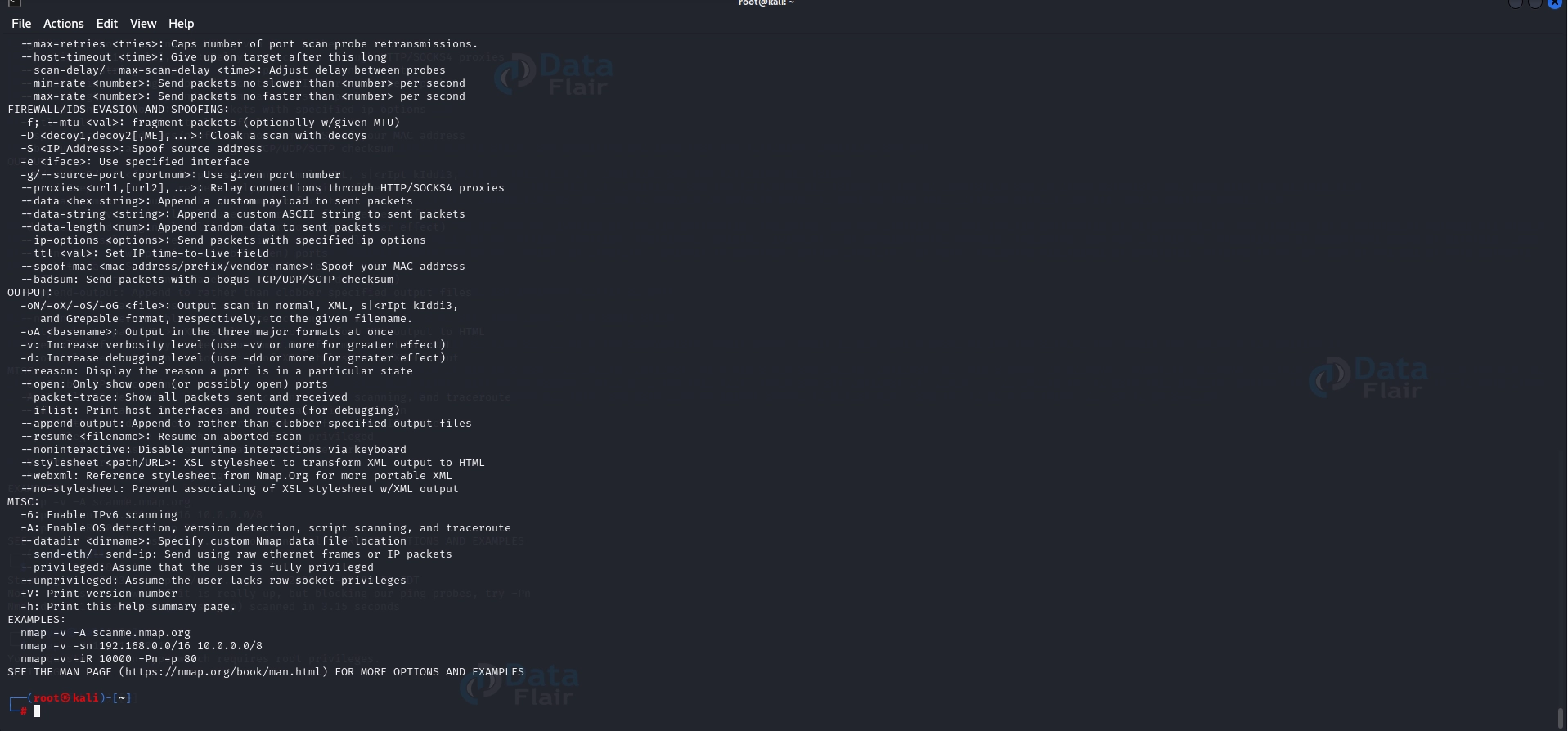
E) Nmap Help:
Access the comprehensive Nmap assist menu, which offers specific information about the available alternatives, commands, and outlines, serving as a treasured reference for utilizing Nmap efficiently.
- Command: nmap –help
- Example: nmap –help
- Explanation: This command displays the Nmap assist menu, supplying a complete listing of to-be-had options, commands, and their descriptions. It serves as a brief reference for knowledge of Nmap’s abilities and syntax.
What is the destiny of Nmap?
Nmap has a vibrant and committed personal network, which guarantees its continuous development and enhancement. The destiny of Nmap is promising, with ongoing efforts to improve scanning efficiency, extend scripting capabilities, and integrate with rising technologies along with IPv6 and cloud environments. The energetic development and community help make Nmap a dependable and evolving tool within the area of community protection.
Ethical and Legal Considerations:
It is important to reflect on consideration on the moral and legal ramifications before the usage of Nmap or another community scanning program. To recollect, have the following in mind:
1. Permission: Always obtain the right authorization earlier than scanning a network. Unauthorized scanning is illegal and may result in intense felony effects.
2. Privacy: Respect the privacy of people and agencies. Avoid capturing and storing any touchy or personally identifiable data through the scanning procedure.
3. Use Case: Ensure that your intentions and use of Nmap align with moral practices, consisting of network protection checks, penetration checking out (with consent), or gadget management duties.
4. Local Laws and Regulations: Familiarize yourself with the legal guidelines and regulations related to community scanning in your jurisdiction. Compliance with criminal necessities is essential to keep away from prison repercussions.
Conclusion
Nmap, mixed with the energy of Kali Linux, presents a complete toolkit for network exploration, vulnerability assessment, and protection auditing. With its great variety of scanning strategies, customization options, and strong community assistance, Nmap stays a move-to preference for specialists in the subject of community protection.
However, it is critical to technique network scanning ethically and legally, ensuring proper authorization and adherence to privacy and compliance guidelines. By leveraging Nmap’s talents responsibly, you may decorate the security posture of your networks and defend against potential threats.
Did we exceed your expectations?
If Yes, share your valuable feedback on Google





