How to Install Kali Linux
Job-ready Online Courses: Dive into Knowledge. Learn More!
Kali Linux is a powerful open-source, Debian-based working device evolved for moral hacking and penetration testing. It is intended to allow users to enter an extensive network, device, and software security arsenal by trying out gear. Installing Kali Linux on your laptop may be a fantastic manner to improve your security expertise, exercise penetration by trying out, and expand your hacking capabilities.
The system for installing Kali Linux to your computer, from downloading the working gadget to customizing it to satisfy your desires, could be included in this newsletter.
Getting started with Kali Linux
Explanation of Kali Linux
Kali Linux is a Debian-primarily based Linux distribution that Offensive Security evolved. It is a powerful machine designed for virtual forensics, penetration checking, and ethical hacking.
The purpose of putting in Kali Linux
Installing Kali Linux is a powerful and customizable platform for undertaking penetration, vulnerability assessments, and community testing. It is a notable resource for training in ethical hacking strategies and gaining cybersecurity knowledge.
Advantages of using Kali Linux
Kali Linux is designed to offer users a complete toolkit of safety checking out gear, inclusive of software programs, hardware, and community trying-out equipment. It is a versatile and adaptable running system that can be used for various responsibilities, including network security trying out, virtual forensics, and moral hacking.
System Requirements
Before putting in Kali Linux, You must verify that your computer satisfies the minimal gadget requirements. The minimal machine requirements for Kali Linux are:
- 1 GHz processor
- 512 MB of RAM
- 10 GB of disk area
- CD-DVD pressure or USB port for installation
The endorsed device requirements are:
- 2 GHz processor
- 4 GB of RAM
- 20 GB of disk space
Downloading Kali Linux
To download Kali Linux, you can visit a reliable internet site and pick the correct version of your computer. There are three kinds of snapshots available for download:
- Installer
- Live
- Netinstall
The Installer photograph is used to install Kali Linux on your computer. The Live image allows you to run Kali Linux from a CD or USB power without installing it for your PC. The net installation photograph is used to put Kali Linux over the net.
Choosing the satisfactory approach to download
Choose the download technique that is most appropriate for your wishes. Download the Installer picture if you intend to put Kali Linux on your PC. Download the Live image if you need to run Kali Linux from a CD or USB force. If you install Kali Linux over the internet, download the Netinstall picture. You can also download Kali Linux for digital machines, which is the perfect and fastest method.
Creating a bootable USB drive
Make a bootable USB disc to install Kali Linux. Create a bootable USB device by following those steps.:
- Selecting the USB drive – Put a USB pressure on your laptop and fix it because of the setup’s goal device.
- Formatting the USB drive – Format the USB power using a device like Rufus or UNetbootin. Make sure to pick out the proper report device and formatting options.
- Writing Kali Linux photo to a USB drive – After formatting the USB force, write the Kali Linux photo to the USB power with the use of a device like Rufus or UNetbootin.
Installing Kali Linux
Follow these steps to install Kali Linux for your pc.:
Booting from a USB drive
Enter the BIOS settings after restarting your computer to pick the USB power because of the boot tool.
Kali Linux installation process
To finish the setup manner, adhere to the on-display screen instructions. You might be required to choose the setup approach, set up the network, and partition the disc.
Disk partitioning
You need to choose the disc partitioning technique at some stage in the installation technique. You have the option of guide or computerized partitioning. Automatic partitioning will create a default partition scheme on your device, while guide partitioning lets you create custom partition sizes and layouts.
Configuring Kali Linux
After installing Kali Linux, you’ll want to configure it to your desires. This consists of putting in place the network, configuring software repositories, and updating and upgrading the machine.
Setting up a community
You can use the Network Manager applet or edit the configuration files manually to set up the community. You can configure VPNs and other community settings and install a stressed or wireless connection.

Configuring software repositories
By default, Kali Linux is configured to apply the Kali Linux repositories. You also can add extra repositories on your machine to get admission to more software program programs.
Updating and upgrading the machine
You should mechanically update and upgrade your device’s software program applications to keep it modern. You can use the apt bundle manager or the GUI software updater.
Using Kali Linux
Kali Linux may be used for various things once you have mounted and set it up.

Exploring the user interface
Kali Linux uses a user-friendly and recognizable GNOME laptop environment. You can customize the laptop surroundings to your desires by adding and eliminating widgets, changing the theme, and adjusting the settings.
Using Kali Linux equipment
Numerous safety testing tools, including vulnerability scanners, community analysis gear, and password-cracking equipment, are covered with Kali Linux. You can discover and use those gear to enhance your protection information and practice ethical hacking techniques.
Basic commands in Kali Linux

Kali Linux uses the Linux command-line interface (CLI) to execute instructions. You can use basic commands like cd, ls, mkdir, and rm to navigate and control documents and directories in your machine.
How to Change Language Preference
To change the language choice in Kali Linux, you can follow the steps:
1. Open a terminal window. You can do that with the aid of right-clicking on the computer and choosing “Open Terminal” or with the assistance of pressing Ctrl+Alt+T on the keyboard.
2. Run the subsequent command to open the language settings document in a text editor:
sudo nano /etc/default/locale
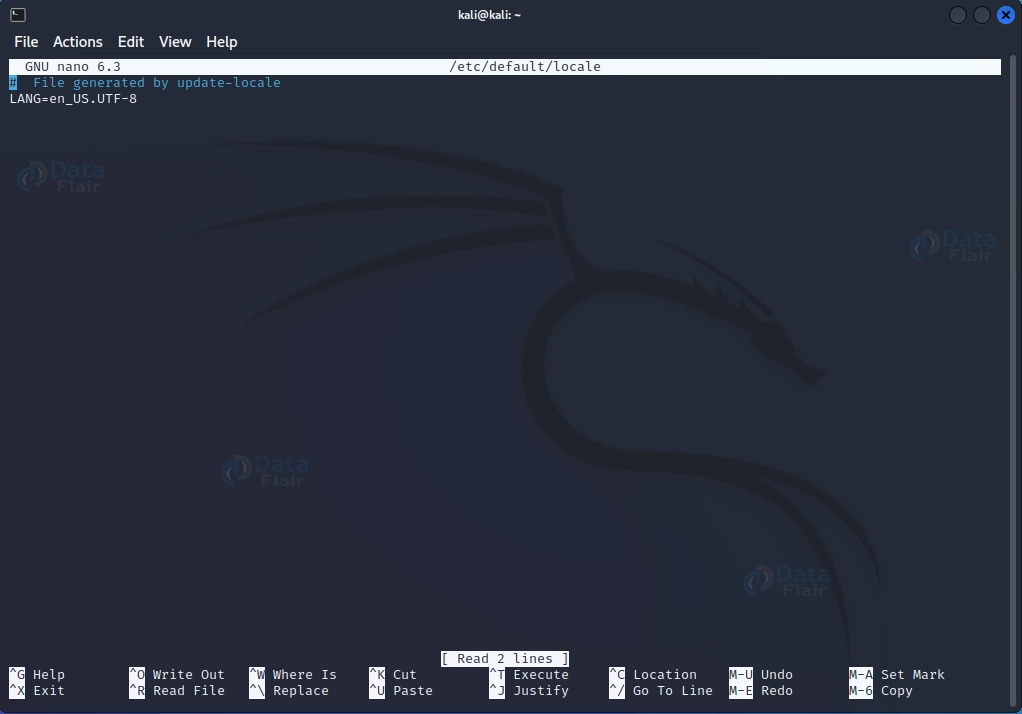
3. In the text editor, you’ll see a line that starts evolving with LANG= accompanied by a language code. This represents the current language setting. To exchange the language, you want to replace the prevailing language code with the code for your favoured language. For instance, if you want to trade the language to Spanish, you will replace the present code with es_ES.UTF-8 or es_ES.Utf8.
4. Save the modifications by using urgent Ctrl+O and then press Enter. Exit the text editor via urgent Ctrl+X.
5. Next, you want to generate brand-new language settings. Run the subsequent command within the terminal:
sudo locale-gen
6. After the locale technology procedure is completed, you may want to replace the gadget’s modern surroundings variables. Run the following command:
source /etc/default/locale
7. Finally, restart your system for the language modifications to take effect. You can do this by using strolling the command:
sudo reboot
Upon rebooting, Kali Linux ought to begin using the new language choice you’ve got set.
Conclusion
Installing Kali Linux can be an excellent way to improve your safety expertise and exercise ethical hacking techniques. You can download, set up, and set up Kali Linux on your laptop by following the instructions in this article. With its complete toolkit of protection, trying out gear, and flexible customization options, Kali Linux is a beautiful working machine for virtual forensics, penetration checking out, and community safety testing.
We work very hard to provide you quality material
Could you take 15 seconds and share your happy experience on Google