
Introduction to Kali Linux
Job-ready Online Courses: Knowledge Awaits – Click to Access!
Kali Linux, an effective open-supply running gadget for advanced penetration trying out, virtual forensics, and protection auditing, is primarily based on the Debian platform. Cybersecurity professionals and hobbyists frequently use it to assess the safety of computer systems and networks, pick out vulnerabilities, and simulate cyberattacks. In this tutorial, we will delve into the essential functions and blessings of Kali Linux and observe its role in cybersecurity.
History of Kali Linux
BackTrack Linux, the previous name of Kali Linux, debuted in 2006. BackTrack Linux developed into a Linux distribution emphasizing networking and safety, and it quickly gained popularity among enthusiasts and experts in cybersecurity. However, BackTrack Linux’s development was halted in 2013, and Kali Linux, a brand-new distribution, kept its heritage.
Devon Kearns (dookie) is a co-creator of the Metasploit Unleashed assignment, an OffSec educator, the administrator of the Exploit Database, an enthusiast for exploitation, and a co-author of Metasploit: The Penetration Tester’s Guide. OffSec was founded via Mati Aharoni (must). Both of them created Kali Linux collectively.
After its preliminary release in 2013, Kali Linux quickly became the most widely used Linux distribution for virtual forensics and penetration testing. Offensive Security, a cybersecurity company that offers protection schooling and certification programs, keeps and budgets Kali Linux. The Kali Linux network includes builders, protection professionals, and lovers globally.
Offensive Security, a famous provider of cybersecurity education and penetration checking out, created and continues Kali Linux. Kali Linux is actively advanced and stepped forward by using the group at Offensive Security, which consists of seasoned protection experts and builders, to ensure that it remains a solid and dependable platform for safety testing and auditing purposes.
Key Features of Kali Linux
Numerous protection software programs and gear are pre-established on Kali Linux, along with equipment for online utility testing, wireless hacking, network analysis, Wi-Fi penetration checking out, password cracking, and more. Kali Linux has several crucial functions, together with:
1. Comprehensive Security Tools: Kali Linux includes complete protection gear for penetration checking, digital forensics, and incident reaction. Metasploit, Nmap, Wireshark, Aircrack-ng, John the Ripper, and more are the 600 pre-installed equipment included.
2. Customizable Environment: Kali Linux is customizable, and customers can install the extra gear and programs to shape their specific wishes. It also helps multiple desktop environments, including GNOME, KDE, Xfce, and Extra.
3. Live Boot Option: Kali Linux can be run without delay from a USB force or DVD without being hooked to a computer. This permits customers to check the safety of a gadget without altering the prevailing running device.
4. Kali Linux has a massive and colorful developer, security, and enthusiast community that actively contributes to the development of the working gadget and gives help to users.
5. Kali Linux offers support for multiple languages.
It affords considerable multi-language support, allowing customers to paint with the running system and its equipment in diverse languages.
Here are some critical components of the multi-language guide in Kali Linux:
1. Localization:
Kali Linux helps localization, enabling the translation of the person interface, device messages, and documentation into distinctive languages. This permits customers to interact with the running device of their favoured language, improving usability.
2. Keyboard Layouts:
Kali Linux helps many keyboard layouts specific to distinct languages and areas. This enables customers to enter characters and symbols accurately in their local language.
3. Language Support in Applications:
Many packages protected in Kali Linux aid multiple languages. This method that customers can use those packages of their favored language, improving accessibility and usability.
4. Language-Specific Tools:
Kali Linux includes plenty of equipment that assists in the analysis and manipulation of software written in exceptional programming languages. These tools cater to languages consisting of Python, Ruby, JavaScript, and C/C++, allowing customers to paint with code written in their language of preference.
5. Documentation and Community Support:
The respectable documentation and community assets for Kali Linux are to be had in multiple languages. This makes learning and effectively using the working machine easier by ensuring clients can access courses, tutorials, and help materials in their preferred language.
Pre-installed programs in Kali Linux
Kali Linux comes with several pre-established packages designed for particular cybersecurity responsibilities. These applications are prepared into unique classes: records accumulating, vulnerability analysis, internet applications, password assaults, and more significant others.
Some of the most generally used pre-hooked-up applications in Kali Linux include:
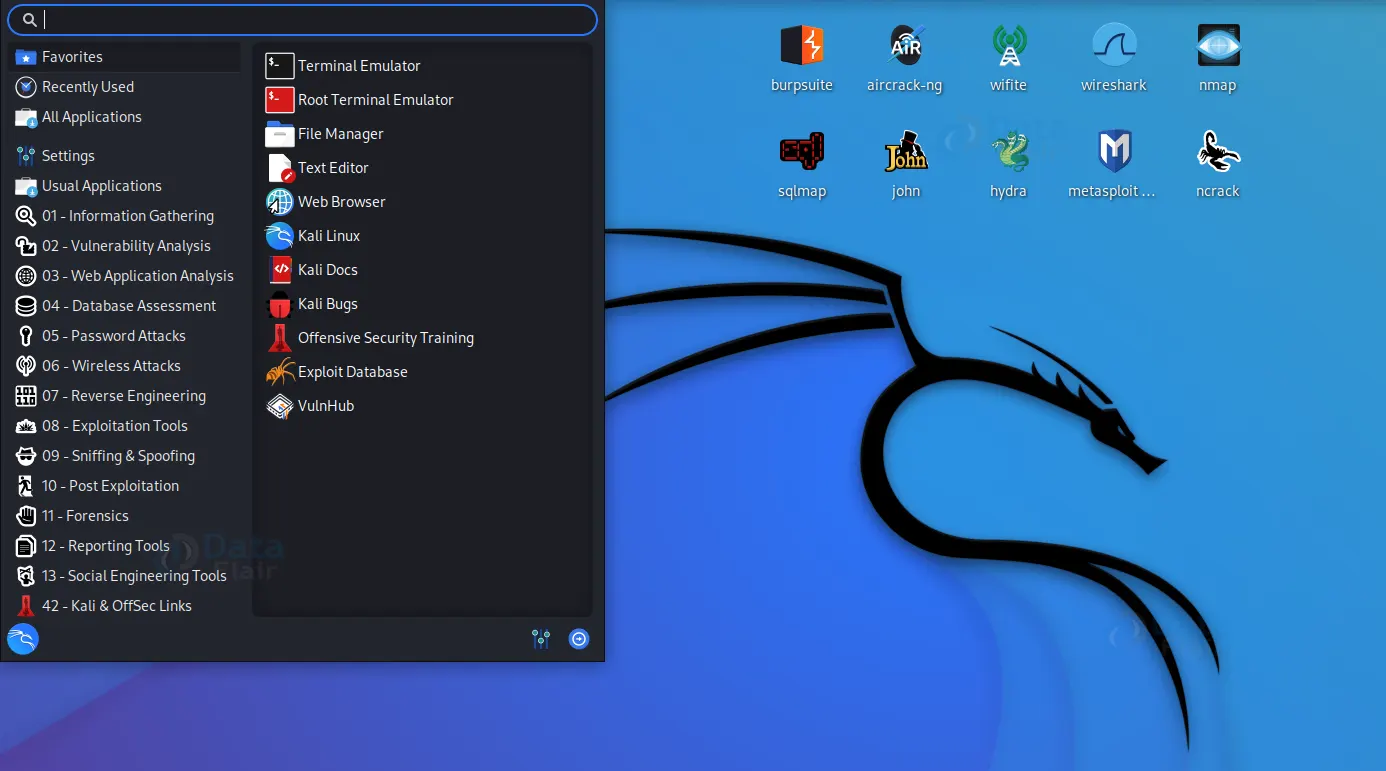
1. Metasploit:
Metasploit is a sturdy framework for exploiting computer and network vulnerabilities. Cybersecurity specialists use it to assess the security of computer systems and discover flaws.
2. Nmap:
Nmap is a community auditing and research device. On a PC network, it’s used to discover hosts and offerings and spot any ability safety threats.
3. Wireshark:
Wireshark is a network protocol analyzer. It captures and analyzes network site visitors to identify capability protection problems and troubleshoot network troubles.
4. Aircrack-ng:
A suite of gear referred to as Aircrack-ng is used for penetration trying out and wireless network auditing. It may be used to check the safety of wireless networks and crack WEP and WPA-PSK keys.
5. John the Ripper:
John the Ripper is a password-cracking tool used to check the strength of passwords. It can be used to crack encrypted passwords and become aware of vulnerable ones that may be effortlessly guessed or cracked.
6. Hydra:
Hydra is a network logon cracker that can check the security of faraway authentication services. It helps many protocols, including HTTP, FTP, SSH, and Telnet.
7. Burp Suite:
Burp Suite is an internet utility checking out a tool that could take out and exploit network application vulnerabilities. It consists of a web proxy, scanner, intruder, and other tools for checking out the security of internet applications.
8. SQLMap:
Finding and exploiting SQL injection vulnerabilities in online programs is automated using the open-source penetration checking-out software SQLMap. It can be used to check the safety of online SQL database applications.
Only a few of the pre-set-up applications that come with Kali Linux are indexed right here. The Kali Linux distribution consists of numerous additional programs and instruments for evaluating the safety of networks and laptop structures. Users can also install extra tools and programs to suit their precise needs.
Usage and Applications of Kali Linux
Kali Linux offers numerous programs and utilization situations for cybersecurity experts and lovers, including:
1. Penetration Testing: Kali Linux can be used for penetration checking out, which mimics actual intrusions to evaluate the security of laptop structures and networks. Penetration testing can assist in discovering system faults and vulnerabilities so that they can be rectified to enhance safety.
2. Digital Forensics: Kali Linux includes numerous virtual forensics and incident reaction tools. It can recover deleted documents, examine machine logs, and check safety incidents. Digital forensics can assist in becoming aware of the reason for security breaches and accumulate proof for felony proceedings.
3. Security Auditing: Security audits, which evaluate a device or community’s security to discover holes and safety worries, may be carried out using Kali Linux.
4. Companies can find places where security features might be improved to prevent security breaches by conducting security audits.
5. Cybersecurity Training: Kali Linux may be used for cybersecurity schooling and training. It affords complete testing surroundings for college kids and professionals to learn cybersecurity standards and strategies.
6. Web Application Security: Kali Linux is useful to create burp suite to analyze and manipulate web traffic.
Usage of Kali Linux in Reverse Engineering
Kali Linux is a widely used operating gadget for reverse engineering responsibilities. Reverse engineering involves studying software or hardware to apprehend its functionality, shape, and behavior. Kali Linux provides quite a few practical tools and utilities, which can be, in particular, designed for opposite engineering functions.
One of the critical pieces of equipment to be had in Kali Linux for reverse engineering is Radare2. Radare2 is a versatile framework that allows customers to disassemble, debug, analyze binary, and manipulate information. It helps various architectures and file formats, making it suitable for opposite engineering multiple software programs and firmware.
Another essential device in Kali Linux for reverse engineering is Ghidra. Ghidra is an effective software opposite engineering suite evolved using the National Security Agency (NSA). It gives a comprehensive set of functions, such as disassembly, decompilation, scripting, and debugging abilities. Ghidra simplifies the process of reading binaries, allowing users to gain insights into the underlying code and discover ability vulnerabilities or safety weaknesses.
Overall, Kali Linux serves as a complete platform for opposite engineering sports. Its huge series of tools and utilities, balance, and versatility as a Debian-based running system make it a move-to choice for professionals and hobbyists engaged in reverse engineering responsibilities.
Comparing Kali Linux to Alternative Distributions
Kali Linux is tailored for white-hat hackers, penetration testers, and cybersecurity professionals. Several other distributions, such as Wifislax, BlackArch, and Parrot OS, also prioritize penetration testing. However, Kali Linux distinguishes itself from these alternatives in penetration testing and cybersecurity. Additionally, Kali Linux offers unique features, including the ability for the default user to assume superuser privileges within its environment.
Advantages and Disadvantages of Using Kali Linux.
Kali Linux offers several advantages, making it a popular choice for cybersecurity professionals and fanatics. Its sizable collection of pre-established equipment designed for penetration checking out, digital forensics and security auditing is a primary gain. These tools range from network scanners and vulnerability assessment frameworks to password-cracking utilities and exploit development systems. This comprehensive suite of gear saves customers the trouble of manually putting in and configuring personal equipment, making it convenient and time-saving.
Secondly, Kali Linux provides fairly customizable surroundings, allowing users to tailor their workflows and alternatives. It supports various desktop environments, allowing customers to choose the only one that fits their desires. Additionally, Kali Linux is a Debian-based distribution, which means it benefits from the stableness, reliability, and extensive software repositories of Debian.
Moreover, Kali Linux gives excellent documentation and network help. The reliable Kali Linux documentation presents distinct publications, tutorials, and sources for customers to apprehend and utilize the equipment effectively. Furthermore, a vibrant and lively community of Kali Linux users and builders exists, which allows expertise sharing, troubleshooting, and collaboration.
Despite its several benefits, Kali Linux has a few dangers to bear. Its massive variety of equipment may additionally overwhelm customers new to cybersecurity or Linux. The mastering curve can be steep, requiring commitment and time to be talented in using the tools and expertise in their functionalities. Additionally, the powerful equipment included in Kali Linux can be misused if it is not used ethically or responsibly. While undertaking protection checking or assessments, customers must adhere to prison and moral suggestions.
Another drawback is that Kali Linux makes extensive use of beneficial resources. A complete set of device resources, such as CPU, RAM, and storage, may also be needed to run the operating device and equipment simultaneously. As a result, users of outdated or inadequate hardware may also experience performance issues.
Overall, the advantages of using Kali Linux, including its comprehensive toolset, customization options, and sturdy community help, make it a valuable asset for cybersecurity specialists. However, customers should be aware of the knowledge of the curve associated with studying the tools, the duty of moral utilization, and the potential aid necessities of the running system. With proper expertise and utilization, Kali Linux can be indispensable for safety, trying out, forensics, and auditing purposes.
Conclusion
The solid and adaptable running device Kali Linux is designed for cybersecurity experts and lovers. Its complete safety equipment, customizable surroundings, and active network make it a vital instrument for penetration trying out, digital forensics, and protection auditing. Whether you are a cybersecurity expert or a student, Kali Linux offers a comprehensive checking-out environment for mastering and improving your cybersecurity competencies.
However, it’s essential to observe that using Kali Linux for unauthorized activities, such as hacking or cyberattacks, is illegal and unethical. Kali Linux has to be used for valid security purposes and with the consent of the gadget proprietors.
Kali Linux is a need-to-have tool for all and sundry interested in cybersecurity. Its robust security functions, lively community, and versatility make it a vital tool for cybersecurity professionals and enthusiasts. Whether you’re engaging in penetration trying out, virtual forensics, or protection auditing, Kali Linux affords the essential equipment and resources to test and improve the security of computer systems and networks.
Did you know we work 24x7 to provide you best tutorials
Please encourage us - write a review on Google





