
Conditional Operators in C
Programming is all about making decisions, and conditional operators in C provide a powerful way to control the flow of your program based on different conditions. In this piece, we will delve into the realm of conditional operators, investigating their variations, syntax, and recommended approaches. By the end, you’ll have a solid grasp of how to use these operators effectively in your C code.
Overview of Conditional Operators
Conditional operators are essential tools for decision-making in programming. They enable your code to perform varying actions based on whether specific conditions are satisfied. The two main types of conditional operators in C are the ternary operator and the if statement. These operators are the building blocks of logic in your code, helping you achieve efficient and accurate execution.
The Ternary Operator
The ternary operator, often referred to as the conditional operator, presents a concise method of decision-making within just one line of code. Its format is outlined as follows:
condition ? true_expression : false_expression;
Here’s a straightforward example to demonstrate its application:
int number = 10;
char* result = (number > 5) ? "Greater" : "Less or equal";
In this example, if a number is greater than 5, the result variable will hold “Greater”; otherwise, it will hold “Less or equal”. The ternary operator is particularly useful for concise assignments and decisions within expressions.
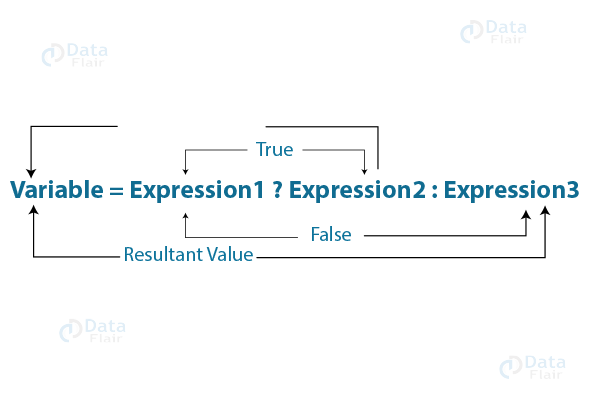
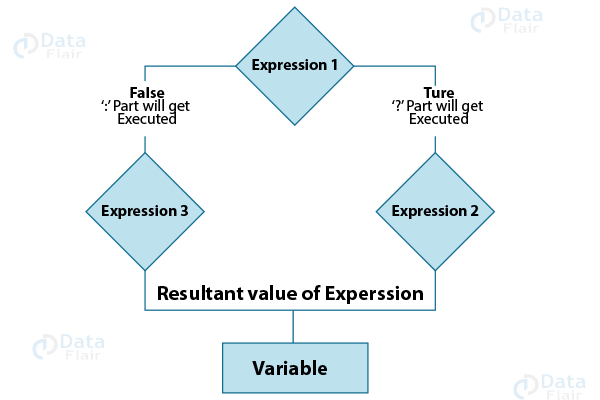
Functioning of the Conditional/Ternary Operator in C
The operation of the conditional or ternary operator in C follows these steps:
- Evaluate Expression1, which serves as the condition.
- If Expression1 is determined to be True, then Expression2 will be executed. However, if Expression1 is found to be False, Expression3 will be executed instead.
- The outcome of this process will be the final result.
The if Statement
The if statement is a fundamental construct in C that allows you to execute different code blocks based on a condition. Its syntax is as follows:
if (condition) {
    // code
} else {
    // code
}
Consider this example:
#include <stdio.h>

int main() {
    int userAge;
    printf("Please enter your age: ");
    scanf("%d", &userAge);
    if (userAge >= 18) {
        printf("Congratulations! You can enter the event.\n");
    } else {
        printf("Entry requirement not met.\n");
    }
    return 0;
}
Output:
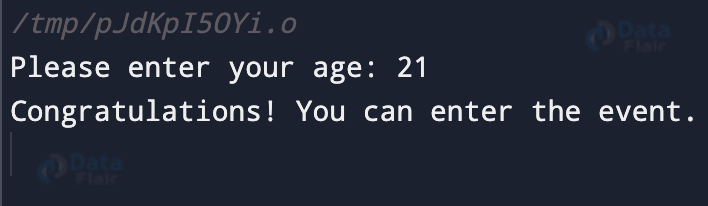
Here, the program checks if the age is greater than or equal to 18. If the condition is met, it prints that the person is eligible to vote; otherwise, it prints that they are not eligible.
Nested Conditionals
Sometimes, you need to make more complex decisions that involve multiple conditions. This is where nested conditionals come into play. You can nest both ternary operators and if statements to handle intricate decision trees.
Here’s a simplified example using nested if statements:
#include <stdio.h>

int main() {
    int score = 75;
    if (score >= 90) {
        printf("A\n");
    } else {
        if (score >= 80) {
            printf("B\n");
        } else {pu
            printf("C\n");
        }
    }
    return 0;
}
Output
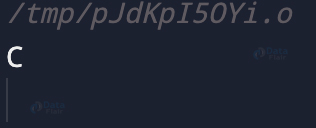
While nested conditionals offer flexibility, it’s important to maintain code readability and organization. Excessive nesting can make code hard to understand, so use this technique judiciously.
Comparison Among Ternary and if
| Aspect | Ternary Operator | If Statement |
| Syntax | condition? true: false | if (condition) { … } |
| Use cases | Simple assignments and decisions | Complex decisions and actions |
| Readability | Concise, suitable for quick decisions | Clear and structured code |
| Nesting | Limited nesting due to compactness | It can be extensively nested |
| Code length | Shorter, condenses decision-making | Longer due to separate blocks |
| Collaboration | Compactness can reduce clarity | Enhances collaboration with structure |
| Maintenance | Simplicity can aid maintenance | Well-defined blocks aid maintenance |
| Decision complexity | Ideal for simple decisions | Suitable for handling multiple conditions |
| Use with expressions | Fits into larger expressions | Requires separate blocks |
| Readability emphasis | Code conciseness | Code clarity and organization |
Deciding whether to use the ternary operator or the if statement relies on the specific context and your coding preferences. The ternary operator is most fitting for uncomplicated assignments and expressions, while the if statement offers greater adaptability when handling intricate decisions involving multiple statements.
In situations where clarity and readability are paramount, favour the if statement, as it often results in more comprehensible code.
Common Mistakes and Pitfalls
While conditional operators are powerful tools, they can lead to errors if not used carefully. Be cautious of certain common errors that you should be attentive to:
- Forgetting parentheses in conditions.
- Mixing up the true and false expressions in the ternary operator.
- Neglecting to add the else clause in nested if statements.
To avoid these pitfalls, double-check your syntax and logic when using conditional operators.
Best Practices
To ensure your code remains maintainable and readable, follow these best practices:
- Use meaningful variable and condition names to improve code understanding.
- Add comments to clarify complex conditions or decision logic.
- Maintain consistent indentation to enhance code structure.
- When nesting conditionals, use proper formatting to improve readability.
Advanced Usage and Complex Conditions
Conditional operators can also be used within loops and functions to create dynamic decision-making structures. Additionally, combining conditional operators with logical operators (&&, ||) enables you to handle complex conditions effectively.
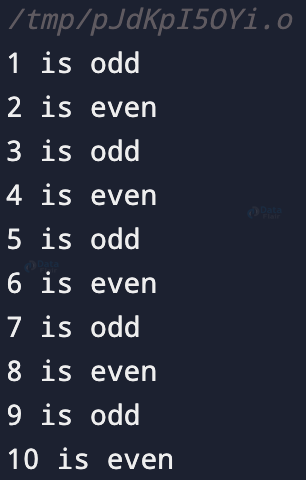
Consider this example that uses conditional operators within a loop:
#include <stdio.h>
int main() {
    for (int i = 1; i <= 10; ++i) {
        printf("%d is %s\n", i, (i % 2 == 0) ? "even" : "odd");
    }
    return 0;
}
Output
Conclusion
Conditional operators are the bedrock of decision-making in C programming. Whether you choose the succinctness of the ternary operator or the versatility of the if statement, mastering these tools is essential for writing efficient and flexible code. By understanding the nuances, avoiding common pitfalls, and following best practices, you can confidently navigate complex conditions and create well-structured programs.
Remember to practice and experiment with different scenarios to solidify your understanding of conditional operators in C.
Did we exceed your expectations?
If Yes, share your valuable feedback on Google





