Different Types of Pointers in C
Pointers in C are a fundamental concept that allows you to work directly with memory addresses. They serve as a powerful tool, enabling you to manipulate data and structures efficiently. However, improper use of pointers can lead to subtle and challenging-to-debug issues.
In this guide, we will explore four important types of pointers in C: Dangling Pointers, Generic Pointers (Void Pointers), Null Pointers, and Wild Pointers.
Dangling Pointer in C
1. De-allocation of Memory
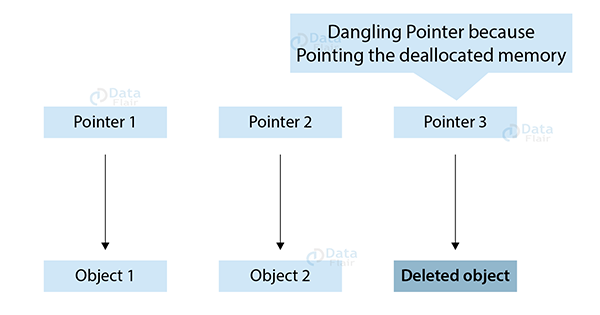
A dangling pointer in C occurs when a pointer continues to reference a memory location after it has been deallocated or freed. This situation can lead to unexpected behavior and security vulnerabilities.
Consider the following code snippet:
#include <stdlib.h>
#include <stdio.h>

int main() {
    int* ptr = (int *)malloc(sizeof(int));

    // After the below free call, the pointer gets hanging.
    free(ptr);

    // No more dangling pointer
    ptr = NULL;

    return 0;
}
In this example, ptr initially points to a dynamically allocated memory location using malloc. However, after we call free(ptr), the memory is deallocated, and ptr becomes a dangling pointer. To avoid this, it’s a good practice to set dangling pointers to NULL.
2. Function Call
Another common scenario for creating dangling pointers is when a pointer points to a local variable that goes out of scope. Local variables are typically destroyed when the function they belong to exits.
Consider this example:
#include <stdio.h>

int* fun() {
    int x = 5;
    return &x;
}

int main() {
    int* p = fun();
    printf("%d\n", *p);

    return 0;
}
In this case, p points to the local variable x. When the fun function exits, x goes out of scope, leaving p dangling. It’s essential to be cautious when returning pointers to local variables from functions.
3. Variable Goes Out of Scope
A similar situation to the one discussed earlier occurs when a variable goes out of scope, rendering a pointer dangling. Observe this code:
void main() {
   int *ptr;
   // ...
   {
       int ch;
       ptr = &ch;
   }
 }
In this example, ptr is assigned the address of ch, which is a local variable within an inner block. Once that block exits, ch goes out of scope, making ptr a dangling pointer. It’s crucial to be aware of the lifetimes of variables and pointers to avoid dangling situations.
Generic Pointer (Void Pointer) in C
A generic pointer, often referred to as a void pointer, is a versatile pointer type. It is not associated with any specific data type, making it suitable for handling various types of data. However, working with void pointers requires typecasting to access the actual data.
Characteristics of C Void Pointers
- Inability to Dereference Directly: You cannot directly dereference a void pointer because the compiler doesn’t know the type of data it points to.
- No Pointer Arithmetic: Pointer arithmetic (e.g., incrementing or decrementing a pointer) is not possible on void pointers due to their lack of a concrete size.
#include <stdlib.h>
#include <stdio.h>

int main() {
    int x = 4;
    float y = 5.5;

    void* ptr;
    ptr = &x;

    // Typecasting to int* before dereferencing
    printf("Integer variable is = %d\n", *((int*)ptr));

    // Void pointer is now float
    ptr = &y;

    // Typecasting to float* before dereferencing
    printf("Float variable is = %f\n", *((float*)ptr));

    return 0;
}
Output:
Integer variable is = 4
Float variable is = 5.500000
Here, we use void pointers to handle both int and float variables by typecasting them appropriately. This versatility can be valuable when writing generic functions or handling data of unknown types.
Null Pointer in C
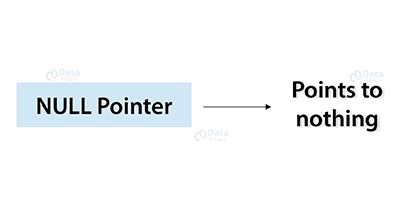
A unique kind of pointer called a null pointer points to nothing. It is frequently employed to indicate that a pointer does not at the moment have a valid memory location.
Characteristics of C NULL Pointers
When we talk about an uninitialized pointer, it holds an unspecified value, while a null pointer holds a specified value that the system designates as an invalid address for any object or data.
In the context of pointers, a null pointer represents a specific value, indicating the absence of a valid memory address, whereas a void pointer is a pointer type without a specific associated data type.
#include <stdio.h>

int main() {
    int *ptr = NULL;

    printf("The value of ptr is %p\n", ptr);

    return 0;
}
Output:
The value of ptr is (nil)
In this example, ptr is initialized as a null pointer, meaning it doesn’t point to any valid memory location. Null pointers are helpful for indicating that a pointer is not currently referencing any data.
Use Cases of Null Pointers
1. Initialization: To initialize a pointer variable when you don’t have a valid memory address to assign initially.
2. Function Arguments: When you don’t want to pass any valid memory address to a function, you can pass a null pointer.
3. Error Handling: Checking for null pointers before dereferencing them allows you to perform error handling in pointer-related code, preventing crashes and undefined behavior.
Wild Pointer in C
A wild pointer is a pointer that hasn’t been initialized to anything, not even NULL. It points to an arbitrary memory location, often containing garbage data. Dereferencing a wild pointer leads to undefined behavior and can crash your program.
int main() {
    int *p; // wild pointer
    *p = 5; // Oops!

    return 0;
}
In this code, p is a wild pointer because it’s not initialized to any memory location. Attempting to dereference it like *p = 5; will result in undefined behavior, and your program may crash.
Comparison Table
| Aspect | Wild Pointer | Null Pointer | Dangling Pointer | Generic Pointer |
| Initialization | Uninitialized | Explicitly initialized to null | Was previously initialized and valid | Must be initialized before use |
| Value | Points to an arbitrary unknown location | Evaluates to 0/null constant | Points to deallocated or invalid memory | Points to object of generic type |
| Validity | Always invalid | Valid – points to nothing | It was valid but is now invalid | Valid if properly initialized |
| Safety | Extremely dangerous – may corrupt memory | Safe to use | Dangerous – can cause crashes or corruption | Safe if used correctly |
| Type checking | No compile-time checking | Checked at compile time | No checking if memory is freed | Dynamic type checking at runtime |
| Usage | Should never be dereferenced | Used to indicate null object | Should not be dereferenced after freeing | Can point to objects of any type |
Conclusion
Understanding the nuances of different pointer types in C is crucial for writing robust and error-free code. Always initialize your pointers and free memory when you’re done with it, and check for null pointers before using them. By mastering these concepts, you’ll harness the power of pointers while avoiding common pitfalls. Happy coding!
Did you like this article? If Yes, please give DataFlair 5 Stars on Google