
Bitwise Operators for Negative Numbers in C
Bitwise operators are fundamental tools in low-level programming, enabling the manipulation of individual bits within data. Understanding how these operators work is essential, especially when dealing with negative numbers. In this article, we’ll explore how bitwise operators can be used with negative numbers in the C programming language.
Representation of Negative Numbers
INegative numbers are typically represented in computers using the two’s complement representation. In this arrangement, the sign of the number is indicated by the highest-value bit (the bit on the left). In contrast to sign-magnitude representation, two’s complement facilitates easy arithmetic operations, making it more suitable for hardware implementations.
Bitwise NOT (~) Operator
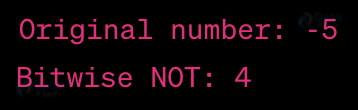
The unary operator known as bitwise NOT (~) is used to reverse the bit values of a number.When applied to negative numbers, the outcome might initially appear counterintuitive. In two’s complement representation, the result of bitwise NOT involves flipping all the bits, including the sign bit. However, the transformed bits no longer follow the two’s complement pattern, leading to an unexpected result.
Let’s consider an example:
#include <stdio.h>

int main() {
    int num = -5;
    int result = ~num;

    printf("Original number: %d\n", num);
    printf("Bitwise NOT: %d\n", result);

    return 0;
}
Output:
Time Complexity: O(1)
Space Complexity: O(1)
Bitwise AND (&) Operator
The bitwise AND operator (&) performs a bitwise AND operation between corresponding bits of two numbers. This operator can be employed to extract specific information from a set of bits. When working with negative numbers, bitwise AND can isolate certain bits without impacting the sign bit. This feature is valuable in scenarios where you need to analyze or modify particular flags or attributes. Example:
#include <stdio.h>

int main() {
    int num1 = -10;  // 11110110 in binary
    int num2 = 12;   // 00001100 in binary
    int result = num1 & num2;

    printf("Bitwise AND: %d\n", result);

    return 0;
}
Output:

Time Complexity: O(1)
Space Complexity: O(1)
Bitwise OR (|) Operator
The bitwise OR operator (|) performs a bitwise OR operation between corresponding bits of two numbers. Utilizing this operator, you can set specific bits within a number to 1, effectively turning them on. When applied to negative numbers, the sign bit remains intact while specific bits are modified. This can be particularly useful when implementing configuration settings or combining multiple attributes. Example:
#include <stdio.h>

int main() {
    int num1 = -10;  // 11110110 in binary
    int num2 = 12;   // 00001100 in binary
    int result = num1 | num2;

    printf("Bitwise OR: %d\n", result);

    return 0;
}
Output:

Time Complexity: O(1)
Space Complexity: O(1)
Bitwise XOR (^) Operator
The bitwise XOR operator (^) conducts an exclusive OR operation between corresponding bits of two numbers. XORing a number with a mask can toggle specific bits, turning them on if they’re off and off if they’re on. For negative numbers, the XOR operation is performed similarly to positive numbers, with the sign bit unaffected. This operator is valuable for bit manipulation tasks and data encryption algorithms. Example:
#include <stdio.h>

int main() {
    int num1 = -10;  // 11110110 in binary
    int num2 = 12;   // 00001100 in binary
    int result = num1 ^ num2;

    printf("Bitwise XOR: %d\n", result);

    return 0;
}
Output:

Time Complexity: O(1)
Space Complexity: O(1)
Bitwise Left Shift (<<) Operator
The operator for bitwise left shift (<<) moves the bits of a number to the left by a designated number of positions. This operation is equivalent to multiplying the number by 2, raised to the value of the shift count. When working with negative numbers, left shifts to maintain the integrity of the sign bit. However, shifting negative numbers might lead to unexpected outcomes if not carefully managed. Example:
#include <stdio.h>

int main() {
    int num = -8;  // 11111000 in binary
    int result = num << 2;

    printf("Bitwise Left Shift: %d\n", result);

    return 0;
}
Output:

Time Complexity: O(1)
Space Complexity: O(1)
Bitwise Right Shift (>>) Operator
The operator used for bitwise right shift (>>) moves the bits of a number towards the right. For negative numbers, the behavior of right shifting involves propagating the sign bit. This preserves the sign of the number but alters its magnitude. Right shifting a negative number can lead to an arithmetic shift, where the vacant bits are filled with the sign bit. Example:
#include <stdio.h>

int main() {
    int num = -16;  // 11110000 in binary
    int result = num >> 2;

    printf("Bitwise Right Shift: %d\n", result);

    return 0;
}
Output:

Time Complexity: O(1)
Space Complexity: O(1)
Truth Table of Bitwise Operators
| Operand A | Operand B | A & B | A | B | A ^ B | ~A |
| 0 | 0 | 0 | 0 | 0 | 1 |
| 0 | 1 | 0 | 1 | 1 | 1 |
| 1 | 0 | 0 | 1 | 1 | 0 |
| 1 | 1 | 1 | 1 | 0 | 0 |
Handling Negative Numbers with Bitwise Operators
Bitwise operators have practical applications beyond basic operations. They are crucial in real-world scenarios such as:
- Optimizing Memory Usage: Using bitwise flags to save memory in data structures.
- Configuration Settings: Storing configuration options efficiently using bitwise flags.
- Data Serialization: Efficiently encoding and decoding data for transmission or storage.
- Cryptography: Implementing cryptographic algorithms that involve bit manipulation.
Common Mistakes to Avoid
- Forgetting Sign Bit: Neglecting to account for the sign bit during right shifts can lead to unexpected results. Always remember that the sign bit should be preserved during the right shifts of negative numbers.
- Misinterpreting Bitwise NOT: Applying bitwise NOT to negative numbers involves inverting all the bits, including the sign bit. This might lead to unintended outcomes if not anticipated.
- Assuming Positive Results: Assuming that bitwise AND or OR operations on negative numbers will always yield positive results is incorrect. The outcome depends on the specific bits being operated upon.
Conclusion
Our exploration of bitwise operators for negative numbers in C reveals a world of intricate manipulations at the bit level. By comprehending these operators and their behavior within the context of negative numbers, you gain a powerful toolkit for low-level programming. Whether you’re optimizing memory, implementing configurations, encoding data, or delving into cryptography, the realm of bitwise operations holds immense potential. Embrace the intricacies, and you’ll wield a finer level of control over your programming endeavours.
You give me 15 seconds I promise you best tutorials
Please share your happy experience on Google






int main() {
int num1 = -10; // 11110110 in binary
int num2 = 12; // 00001100 in binary
int result = num1 & num2;
printf(“Bitwise AND: %d\n”, result);
return 0;
}
Ans is 4 not 12