
AWS DevOps
In the ever-evolving business landscape, organizations constantly seek ways to enhance application development and delivery processes. Enter DevOps, a transformative approach that fosters collaboration between development and operations teams. DevOps streamlines the software development lifecycle, expedites application delivery, and boosts overall efficiency. When combined with the power of Amazon Web Services (AWS), the result is AWS DevOps—a flexible and potent solution enabling companies to build and deliver products using cloud-based infrastructure and DevOps practices.
What is AWS DevOps?
AWS DevOps is Amazon’s comprehensive solution for implementing DevOps principles using their cloud platform and dedicated tools. AWS DevOps empowers organizations with a versatile set of services designed to expedite product delivery and reliability. This robust suite of tools simplifies infrastructure provisioning, automates software release processes, facilitates application deployment, and ensures efficient development and deployment cycles.
Why AWS for DevOps?
1. AWS provides a seamless and quick setup for DevOps teams, granting easy access to a wide range of services with just an AWS account. There’s no need for complicated setup or software installations, so teams can dive right into their projects without any delay.
2. The availability of fully managed services in AWS accelerates the process of utilizing AWS resources, freeing teams from the burden of manual infrastructure setup and management. This allows DevOps teams to focus more on their core products and innovations.
3. Scalability is a breeze with AWS, offering the flexibility to manage a single instance or scale up to thousands. AWS services simplify the provisioning, configuration, and scaling of compute resources, ensuring optimal performance and efficiency.
4. AWS empowers developers with programmable interfaces, offering the choice to use services through the AWS Command Line Interface, APIs, and SDKs. The use of declarative AWS CloudFormation templates enables seamless modelling and provisioning of AWS resources and entire infrastructures.
5. Automation is a key strength of AWS, enabling teams to build and deploy applications faster and more efficiently. By automating manual tasks, development workflows, container management, and configuration, DevOps teams can streamline their processes and boost productivity.
6. Security is paramount in AWS, as it provides robust AWS Identity and Access Management (IAM) tools for granular control over user permissions and policies. With AWS, teams can ensure secure access to their resources and data.
7. The extensive partner ecosystem of AWS allows seamless integration with third-party and open-source tools, offering DevOps teams a comprehensive and tailored solution for their projects.
8. In terms of cost, AWS adopts a pay-as-you-go model, allowing teams to pay only for the services they use and the duration of their usage. With no upfront fees, termination penalties, or long-term commitments, AWS provides cost-effective and flexible options for DevOps projects. The AWS Free Tier further encourages exploration and experimentation without any financial commitment.
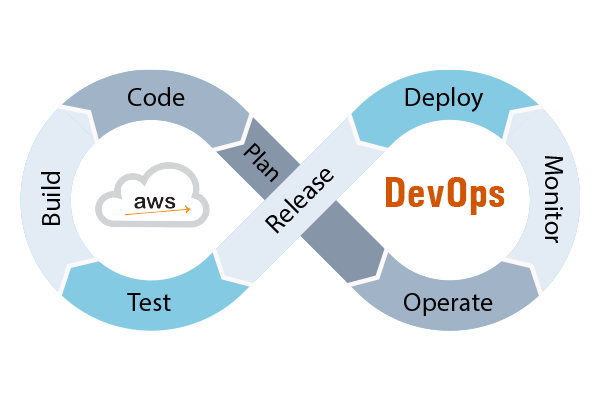
AWS DevOps Architecture
The core of AWS DevOps revolves around key services, with AWS EC2 (Elastic Compute Cloud) as an exemplary example. EC2 empowers users to configure virtual machines and effortlessly manage underlying resources from a central console, leveraging automation for scalable resource allocation and cost-effectiveness.
The key components of AWS DevOps architecture include:
1. Load Balancing: Elastic Load Balancing optimizes web server resources by distributing EC2 traffic and adjusting capacity based on demand.
2. Amazon CloudFront: Delivering content, including dynamic, streaming, and static types, CloudFront operates efficiently with AWS components and non-AWS clouds.
3. Amazon Security Group: Acting as an inbound network firewall, the Security Group authorizes specific protocols, ports, and IP ranges for EC2 access, enhancing security.
4. Elastic Caches: This web service manages cloud memory caches, boosting performance and scalability through data caching.
5. Amazon RDS (Relational Database Service): Simplifying setup, operations, and scalability of relational databases, RDS supports various databases like Amazon Aurora, MariaDB, Microsoft SQL Server, MySQL, Oracle, and PostgreSQL.
6. Amazon S3 (Simple Storage Service): Offering simple, scalable, and secure data storage, S3 allows data management as objects within buckets, accessible from anywhere on the web.
7. Amazon EBS (Elastic Block Store): Providing high-performance block storage for managing data partitions and application logs, EBS ensures rapid access and long-term persistence.
8. Amazon Auto Scaling: Enabling users to create capacity groups of servers that can be scaled up or down as needed.
AWS Tools
AWS DevOps boasts a plethora of tools to streamline software development and deployment on the cloud. Some prominent tools include:
1. AWS Cloud Development Kit: An open-source development framework using familiar programming languages to model and provision cloud application resources.
2. AWS CodeBuild: An integration service that scales continuously, allowing the build and test of code with continuous scaling.
3. AWS CodeDeploy: Automates software deployments to various computer services like Amazon EC2, AWS Fargate, AWS Lambda, or on-premises servers.
4. AWS CodePipeline: Automates continuous delivery of code for rapid and accurate updates.
5. AWS CodeStar: Offers an intuitive user interface to develop, build, and deploy applications effortlessly on AWS, setting up an entire continuous delivery toolchain swiftly.
6. AWS Device Farm: Enables testing of web and mobile apps on real mobile devices and desktop browsers hosted in the AWS Cloud.
Benefits of AWS DevOps
1. Rapid and Reliable Application Delivery: AWS DevOps accelerates application delivery, enhancing customer satisfaction and ensuring a competitive edge.
2. Scalability and Flexibility: AWS’s scalable cloud infrastructure and DevOps practices facilitate easy adaptation to changing demands and optimized costs.
3. Cost-Effectiveness: AWS DevOps offers a pay-as-you-go model, eliminating upfront infrastructure investments and aligning expenses with actual usage.
4. Automation and Efficiency: Automation is at the core of DevOps, and AWS provides robust tools that reduce errors, increase productivity, and accelerate development cycles.
5. Improved Collaboration: AWS DevOps promotes seamless collaboration between development and operations teams, fostering a shared responsibility for the application lifecycle.
6. Security and Compliance: Combining AWS’s extensive security measures and DevOps practices results in a secure and compliant development and deployment process.
Drawbacks of AWS DevOps
1. Learning Curve: Implementing AWS DevOps requires a solid understanding of AWS services, DevOps principles, and automation tools, presenting a learning curve for new teams.
2. Cost Management: While AWS’s pay-as-you-go model is cost-effective, careful management is necessary to avoid unexpected costs due to misconfigured resources.
3. Security Risks: The cloud environment introduces new security challenges that must be addressed to protect sensitive data and applications effectively.
4. Complexity of Integration: Integrating different DevOps tools and AWS services can be complex, especially in large organizations with existing infrastructure.
AWS CloudFormation
AWS CloudFormation proves to be an invaluable asset for DevOps teams in their pursuit of efficient cloud resource creation and deployment. By utilizing pre-defined templates for various AWS resources, such as EC2 instances, ECS containers, and S3 storage buckets, the entire stack can be seamlessly set up, eliminating the need for laborious manual configuration.
AWS EC2
For a reliable and scalable infrastructure to run containers, DevOps teams turn to AWS EC2, which offers a robust suite of security and management features. Leveraging EC2 instances ensures a secure and controlled environment for applications, empowering teams to maintain top-notch performance and data integrity.
AWS CloudWatch
When it comes to monitoring the health and performance of AWS resources, AWS CloudWatch emerges as a comprehensive monitoring tool, offering valuable insights that enable DevOps teams to take proactive measures to ensure optimal system health. Its compatibility with third-party monitoring tools like Sumo Logic further enhances the monitoring capabilities of DevOps teams, making it easier to manage and maintain peak performance levels.
AWS CodePipeline
In the realm of Continuous Integration and Continuous Deployment (CI/CD), AWS CodePipeline emerges as a game-changer. By seamlessly integrating with popular tools like Jenkins, GitHub, and CodeDeploy, CodePipeline streamlines the management of CI/CD pipelines, providing a visual interface to control the smooth flow of application updates from development to production. This efficient approach enhances the development process, leading to faster and more reliable deployment cycles for DevOps teams.
Best Practices for AWS DevOps
1. Infrastructure as Code: Use AWS CloudFormation or other infrastructure as code tools to provision and manage AWS resources, promoting consistency and repeatability.
2. CI/CD Pipeline: Establish a robust CI/CD pipeline for automated code testing, integration, and continuous delivery to production environments.
3. Monitoring and Logging: Implement comprehensive monitoring and logging solutions to gain insights into application and infrastructure performance.
4. Collaboration and Communication: Foster a culture of collaboration and effective communication among development, operations, and other relevant teams.
5. Security and Compliance: Implement security best practices, such as IAM, encryption, and compliance checks, to safeguard applications and data.
AWS DevOps Use Cases
1. Infrastructure Automation: AWS DevOps enables the automation of cloud instances and services, leading to frequent updates and improved development efficiency.
2. Career Transition: AWS DevOps skills offer diverse and lucrative job opportunities for professionals seeking career transitions.
3. CI/CD: Continuous Integration (CI) and Continuous Delivery (CD) result in rapid and reliable application delivery.
4. Infrastructure as Code: AWS CloudFormation ensures consistent and simplified AWS cloud development using human-readable templates.
5. Collaboration and Communication: Effective collaboration and communication foster successful AWS DevOps implementations.
6. Logging and Monitoring: Comprehensive monitoring and logging solutions ensure timely event triggering and performance optimization.
7. AWS Device Farm: Real-time interaction and testing of Android, iOS, and web apps on physical devices hosted by AWS.
Jobs and Salaries
The demand for skilled DevOps professionals, especially those with AWS expertise, continues to rise. Glassdoor reports an average annual salary of approximately Rs. 12,00,000 for a Senior DevOps Engineer in India. In the USA, there are over 12,505 job openings for DevOps Engineers.
How to Learn AWS DevOps
1. Acquire Skills in AWS and DevOps Services: Develop proficiency in AWS and fundamental DevOps concepts.
2. Master Key Concepts: Deepen your understanding of AWS and DevOps principles.
3. Learn DevOps Tools: Familiarize yourself with the various tools used in AWS DevOps.
4. Gain Practical Experience: Work on real-world projects to gain hands-on experience in AWS DevOps.
5. Get Certified: Pursue the AWS Certified DevOps Engineer – Professional certification to validate your expertise and stand out in the job market.
Conclusion
AWS DevOps leverages the synergy of Amazon Web Services and DevOps principles, delivering a seamless, efficient, and scalable application development and deployment experience. By adhering to best practices, organizations can fully harness the potential of AWS DevOps, achieving rapid innovation, cost optimization, and exceptional customer experiences.
As DevOps shapes the future of software development, professionals with AWS DevOps skills will find themselves at the forefront of an ever-evolving and high-demand industry. Embrace the future of software delivery with AWS DevOps and pave your path to success.
You give me 15 seconds I promise you best tutorials
Please share your happy experience on Google






Excellent breakdown of AWS DevOps! I particularly liked how you highlighted the role of services like CodePipeline and CloudFormation in enabling true automation and Infrastructure as Code—it really shows how AWS simplifies CI/CD at scale. For readers exploring the broader ecosystem, this overview of leading AWS
cloud service providers in California adds another perspective on practical adoption and migration support.