
DevOps vs Agile – Difference Between Agile and DevOps
In the ever-evolving realm of software development, methodologies like Agile and DevOps have significantly transformed the way organizations create and deliver products. Agile, known for its customer-centric, iterative approach, was quickly embraced for its effectiveness.
Later, DevOps emerged as a complement to Agile, addressing operational aspects that were not fully covered before. This blog aims to provide an in-depth understanding of Agile and DevOps, delving into their respective strengths, similarities, differences, and the potential for seamless collaboration.
What is Agile?
Agile represents a project management and software development approach centred around customer needs, adaptability, and continuous feedback. The Agile Manifesto outlines its core values, emphasising individuals and interactions, working software, customer collaboration, and responsiveness to change. Several Agile methodologies, such as Scrum, XP, and Kanban, offer diverse processes to achieve the objectives of Agile.
What is DevOps?
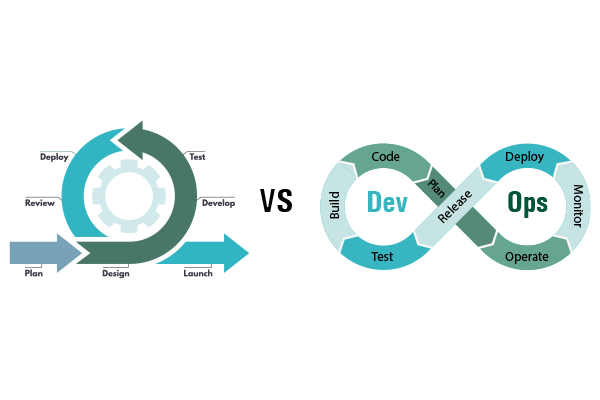
DevOps is a collaborative software development approach that brings together software development teams and IT operations to work as a cohesive unit. Unlike traditional methods where these teams operated independently, DevOps promotes a culture of communication and teamwork throughout the entire development process, from design to product release.
According to Tyler Duzan, a Product Manager at Percona in Raleigh, NC, DevOps combines the efforts of development (Dev) and operations (Ops) teams to achieve faster and more efficient software building, testing, and deployment. By breaking down silos and integrating these teams and processes, DevOps enables continuous integration, continuous deployment, automated testing, and greater transparency in code repositories.
Prasanna Singaraju, CTO and co-founder of Qentelli in Dallas, highlights the collaborative nature of DevOps, where development and operations teams work together seamlessly to deliver high-quality products and services on an ongoing basis. This approach boosts overall efficiency and customer satisfaction. DevOps has become a crucial methodology in modern software development, streamlining the delivery of software products and services through effective communication and cooperation between teams.
DevOps Culture
The DevOps culture is centred on the crucial concept of “culture,” which refers to communities of like-minded people who work with similar tools and adhere to standardized procedures. It is essentially focused on the people, procedures, and tools involved. To shorten the software delivery pipeline and reach higher standards of efficiency and quality, the main emphasis is on encouraging collaboration, communication, and seamless integration between development and operations teams.
Complementary Approaches of Agile & DevOps
Agile and DevOps share common ground and can be mutually reinforcing when applied together. Agile lays a robust foundation for iterative development, customer feedback, and collaboration. DevOps builds on this foundation, extending the focus to encompass deployment, operations, and automation. Combining DevOps practises with Agile enables organisations to enhance their delivery pipelines, ensuring a continuous flow of valuable software.
DevOps and Agile Combined
1. Boosting Feedback Loops: Agile methodologies, such as Scrum, already facilitate feedback loops through regular ceremonies like daily standups and retrospectives. DevOps enhances these loops by fostering improved communication across teams, leading to faster issue resolution and continuous improvement.
2. Enabling Continuous Delivery: While Agile promotes frequent releases of functional software, continuous delivery to production is a DevOps practice. By integrating DevOps into Agile, organisations ensure efficient deployment to production, maintaining a smooth development-to-deployment pipeline.
3. Fostering a Collaborative Culture: Both Agile and DevOps advocate for a culture of collaboration and shared responsibility. By aligning these cultural aspects, organisations can break down barriers and cultivate a cooperative and cohesive work environment.
Agile vs DevOps – Similarities and Differences
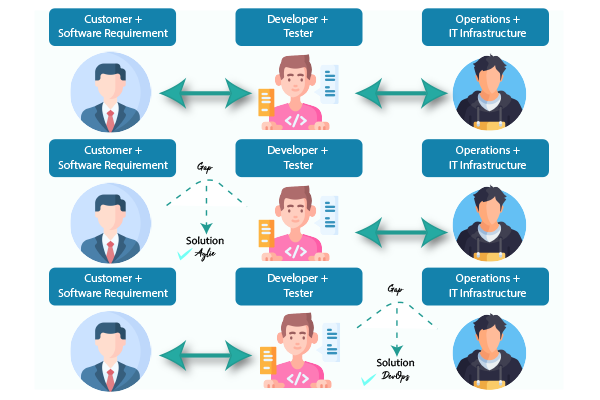
1. Focus Area: Agile primarily concentrates on the development process and delivering incremental value to customers. In contrast, DevOps extends this focus to encompass operations, streamlining deployment and overall system management.
2. Team Collaboration: Agile emphasizes collaboration between developers and product management, whereas DevOps extends this collaboration to include operations teams, promoting a holistic approach.
3. Automation: DevOps places a higher emphasis on automation, including infrastructure provisioning, continuous integration, and continuous deployment, ensuring faster, more reliable, and error-free releases.
4. Scale and Scope: Agile is well-suited for individual projects or small teams, while DevOps scales across the entire organization, making it ideal for large enterprises seeking end-to-end transformation.
5. Tooling: While Agile methodologies do not mandate specific tools, DevOps relies heavily on automation tools like Jenkins, Chef, Puppet, and Kubernetes to streamline processes.
| PARAMETER | DevOps | Agile |
| Definition | Brings dev and ops teams together. | Continuous iterative approach. |
| Purpose | Manage end-to-end engineering processes. | Manage complex projects. |
| Task | Focuses on constant testing and delivery. | Focuses on constant changes. |
| Team Size | Large team involving all stakeholders. | Small team for faster movement. |
| Team Skill Set | Spreads skillset between dev and ops. | Emphasises a wide skill variety. |
| Implementation | No commonly accepted framework. | Tactical frameworks like Scrum. |
| Duration | Ideal goal: deliver code daily/hourly. | Managed in units of sprints. |
| Target Areas | End-to-end business solutions | Software development |
| Feedback | The internal team provides feedback | Customer feedback is crucial |
| Shift Left | Supports both left and right shifts. | Supports only left-shift |
| Focus | Operational and business readiness | Functional and non-functional readiness |
| Importance | Developing, testing, and implementation are equally important | Developing software is inherent. |
| Quality | Automation and early bug removal | Follows coding and architectural practices. |
| Tools | Puppet, Chef, AWS, Ansible, etc | Bugzilla, Kanboard, JIRA, etc. |
| Automation | Primary goal is automation for efficiency | Doesn’t emphasize automation |
| Communication | Involves specs and design documents | Scrum meetings are common |
| Documentation | Process documentation is important. | Emphasizes working system over complete documentation |
Challenges in Integrating Agile and DevOps
While combining Agile and DevOps offers numerous benefits, there can be challenges in the adoption process, including:
1. Organisational Resistance: Integrating Agile and DevOps might encounter resistance from traditional, siloed organisational structures. Overcoming this resistance requires strong leadership support and a shared vision of the advantages of combining these methodologies.
2. Cultural Shift: Implementing Agile and DevOps often necessitates a significant cultural shift, involving breaking down barriers between teams and promoting a culture of collaboration and continuous learning. Ensuring buy-in from all stakeholders and providing sufficient training and support can ease this transition.
3. Tooling and Automation: DevOps relies heavily on automation and tooling to streamline processes, but integrating multiple tools can be complex. Ensuring seamless integration and proper training for team members is essential for maximising the benefits of automation.
4. Legacy Systems and Processes: Organisations with legacy systems and established processes may find it challenging to implement Agile and DevOps practices. A gradual, iterative approach to modernization can help address these challenges.
Conclusion
All in all, Agile and DevOps are powerful methodologies with distinct strengths, each addressing different aspects of software development and delivery. Agile excels in iterative development, customer collaboration, and continuous feedback, while DevOps emphasises collaboration, automation, and continuous delivery to optimise operations.
Although Agile and DevOps can be utilised independently, combining their strengths leads to greater synergy and more effective software delivery. Agile lays the foundation for iterative development, while DevOps extends the focus to include deployment and operations. By adopting a combined Agile-DevOps approach, organisations can achieve faster, more reliable, and customer-focused software delivery, gaining a competitive edge in today’s fast-paced market.
Did you like our efforts? If Yes, please give DataFlair 5 Stars on Google





