
DevOps Pipeline and Methodology
Having a strong DevOps pipeline is essential in today’s fast-paced software development environment for promptly meeting customer requests and providing high-quality software products. To build, test, and deploy software quickly, development and operations teams use a set of procedures called a DevOps pipeline. The parts of a DevOps pipeline, such as continuous integration, continuous delivery, continuous deployment, continuous testing, and continuous operations, are thoroughly covered in this blog post.
Additionally, we will look at the stages of a DevOps pipeline, including planning, development, building, testing, deployment, and monitoring, offering insights into the significance of each stage. Finally, we’ll go over the procedures for building a DevOps pipeline and emphasise the advantages of using this approach.
DevOps Methodology
Our DevOps methodology offers a thorough strategy for implementing the cloud, taking into account essential elements like people, procedures, and technology to guarantee success. We give the ensuing crucial factors priority:
1. Empowered Team: We think it’s important to equip mission or project teams with the abilities and information they need to efficiently manage cloud resources. This strategy encourages a culture of accountability and ownership, which improves results.
2. Seamless Connectivity: The complexity of cloud network access, encompassing public, on-premises, and hybrid cloud systems, is addressed in the section on seamless connectivity. Our methodology guarantees secure data transfer and easy communication between different contexts.
3. Automation at Scale: We offer automated orchestration and deployment of cloud resources by embracing Infrastructure as Code (IaC) and scripting. Automation speeds up procedures, lowers human mistake rates, and boosts productivity all around.
4. Effective Onboarding: Our technique includes a streamlined onboarding procedure, allowing projects to make the switch to the cloud swiftly and easily. We make sure the transition goes smoothly, reducing downtime and disturbances.
5. Consistent Environments: We utilise identical deployment setups to maintain consistency between the development, testing, and production phases. This method lowers the possibility of errors and improves overall accuracy.
6. Utilizing Shared Services: To increase resource efficiency and cut costs, we discover shared services that the company offers as common capabilities. This strategy encourages standardization and makes resource management easier.
7. Standardized Naming Convention: We stress the significance of using standardized naming practices for cloud resources. The right naming facilitates cost optimization, billing and reporting simplification, and resource utilization tracking.
8. Role-Based Permissions: Clear role-based permissions are defined by our technique, which grants access to cloud resources in accordance with job duties. This enables effective collaboration while ensuring that the appropriate security safeguards are in place.
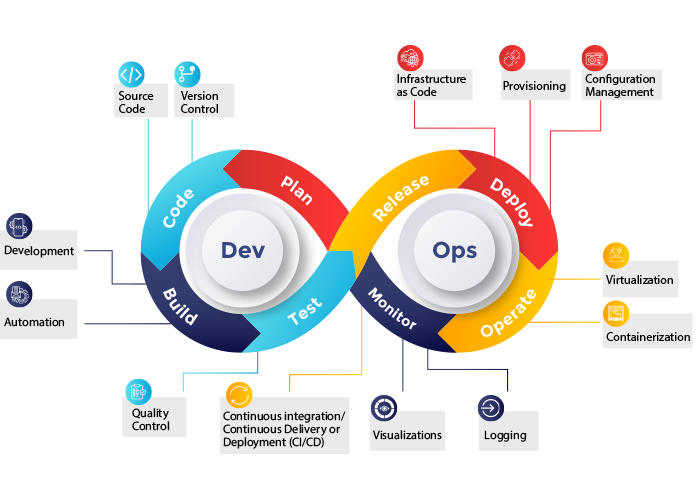
Organizations may successfully adopt cloud computing, make the most of cloud technologies, and foster a culture of innovation and continuous improvement by adopting our all-encompassing DevOps methodology. Our strategy prepares the path for effective cloud-based operations with a heavy emphasis on collaboration, automation, and standardization.
Components of a DevOps Pipeline
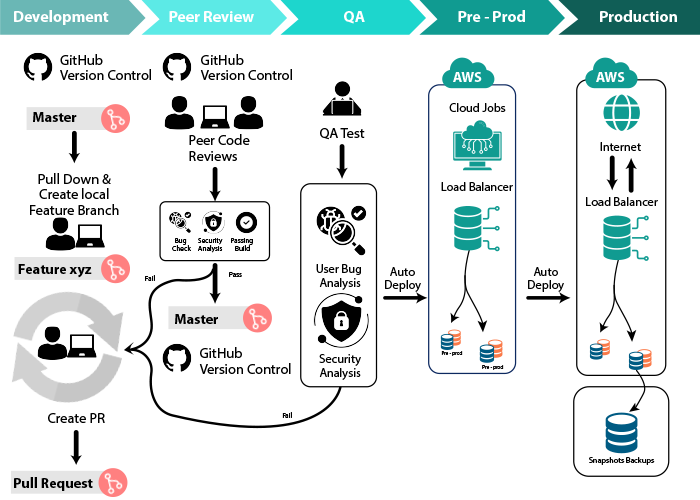
1. Continuous Integration (CI):
- Integrating minor code alterations often to avoid integration issues and provide a solid codebase.
- Implementing automatic builds that are sparked by code commits will guarantee reliable and consistent builds.
- During the CI process, code analysis and static code checks are carried out to find potential problems early.
2. Continuous Delivery (CD):
- Automating deployment to cut down on time-consuming manual errors.
- Directing the flow of changes from development to production environments via deployment pipelines.
- Putting in place configuration management technologies to guarantee uniform deployment environments at various stages.
3. Continuous Deployment:
- Reducing the amount of time between code modifications and production deployment by automating the release process.
- To progressively roll out new features and reduce risks, use canary releases or feature toggles.
- Utilising infrastructure-as-code (IaC) technologies to manage infrastructure resources and supply infrastructure for smooth deployments.
4. Continuous Testing:
- Putting in place a complete test suite that includes end-to-end tests, integration tests, and unit tests.
- Using test automation to quicken the testing process and guarantee reliable test execution.
- Utilising test settings that closely mirror the actual environment to discover potential issues properly.
5. Continuous Operations:
- Real-time monitoring of infrastructure data, application health, and system performance.
- Using analytics and log management tools to quickly identify and fix problems.
- Putting self-healing and automated scaling into place to guarantee high availability.
Phases of DevOps Pipeline
1. Plan:
- Working together to define the project’s objectives, specifications, and deadlines.
- Establishing a backlog of work items and breaking jobs down into smaller pieces.
- Carrying out capacity planning to efficiently deploy resources.
2. Develop:
- Writing clear, modular, and maintainable code while adhering to coding standards and best practices.
- Facilitating code reviews and team collaboration using version control systems to guarantee code quality.
- Enforce coding conventions by including automated code formatting and linting tools.
3. Build:
- Establishing a build server to streamline code compilation, packaging, and versioning.
- Adding tools for dependency management to manage dependencies and external libraries.
- Setting up build pipelines to speed up builds and enable parallel processing.
4. Test:
- Putting in place various test types, including unit tests, integration tests, and performance tests.
- Executing tests quickly and reliably using test automation tools.
- Using continuous feedback loops to deliver test results quickly to developers.
5. Deploy:
- Coordinating the deployment process, which includes infrastructure provisioning and configuration management.
- Using deployment tactics to reduce risk and downtime, such as blue-green deployments or canary releases.
- Putting in place automated rollbacks and rollback procedures in the event of deployment problems.
6. Monitor:
- Establishing mechanisms for tracking application performance user experience, and alerts.
- Identifying and resolving problems by using log aggregation and analysis technologies.
- Conducting regular vulnerability and security audits.
Steps to Create a DevOps Pipeline
- Clearly define the goals and expectations of the DevOps pipeline to ensure that the team’s activities are coordinated.
- Choose the best tools and technologies based on the project’s requirements, taking into account variables like scalability, compatibility, and integration simplicity.
- Create a pipeline architecture that includes all required phases, as well as automation and monitoring components, while designing the pipeline.
- Set up version control: Create a method for managing source code and facilitating collaboration.
- Automate the build procedure by setting build servers up to automatically compile, package, and version the code after each commit.
- Implement testing frameworks: To automate the execution of unit, integration, and end-to-end tests, select and integrate testing frameworks.
- Set up automated deployment procedures to speed up the release of new features and problem fixes by enabling continuous deployment.
- Monitor and improve: Set up alerting and monitoring systems to proactively spot performance problems and enhance the pipeline.
Benefits of Implementing DevOps Pipeline
1. Faster time to market: Simplified feature delivery and speedier market reaction are made possible by the development, testing, and deployment procedures.
2. Collaboration between development and operations teams is encouraged through DevOps, which also encourages cross-functional cooperation and knowledge exchange.
3. Better code quality, fewer errors, and increased stability of software products are all the results of ongoing testing and monitoring.
4. Increased deployment frequency: By enabling frequent and dependable releases, continuous integration, delivery, and deployment help to mitigate the risk associated with big, infrequent deployments.
5. Scalability and flexibility: Automated provisioning and infrastructure-as-code make it possible to scale resources effectively in response to demand, ensuring peak performance.
6. The DevOps pipeline promotes continual feedback loops, allowing teams to take customer feedback to heart and create iterative improvements.
The Data Pipeline
You are guided through the whole data lifecycle by the School of Data’s all-inclusive method for working with data, The Data Pipeline. It includes a number of crucial stages that let you get useful insights and make data-driven projects successful.
1. Define: Clearly state the issue you’re trying to solve at the outset. Create precise inquiries pertaining to your theme, making sure they point to the necessary information. This stage aids in project scoping and data availability evaluation.
2. Find: Finding the required information can be difficult. Use a variety of resources and methods, such as search engine operators, public data portals, or inquiries to government agencies. Here, creativity is essential as you investigate unusual sources and signs.
3. Get: Once the data has been located, it can be obtained through a variety of methods, including web scraping, crowdsourcing, downloading datasets from official government portals, and making FOIA requests.
4. Check: The integrity of the data is crucial. Verify the specifics, such as the metadata, data collection techniques, and the reliability of the data sources. Find any probable errors or omissions that could compromise your analysis.
5. Clean: Data frequently comes in a disorganised state with duplicates, misaligned columns, and formatting problems. To clean the data and get it ready for analysis, use programs like OpenRefine or LibreOffice Calc.
6. Analyze: This is the magic moment. Investigate the dataset using statistical and mathematical knowledge to spot trends and insights. Data exploration is aided by visualizations, computer languages like Python or R, and spreadsheet applications.
7. Present: To make your findings compelling, think about your target audience, the questions you set out to address, and the most effective way to communicate your ideas. Working together with designers and storytellers can improve the way your data is visually presented.
The Data Pipeline is an adaptive process that changes with every project, not a fixed architecture. Adopt this process to bring out the full potential of data and draw meaningful findings that influence decision-making and generate thought-provoking dialogue.
Conclusion
Employing a DevOps pipeline enables organisations to release software more quickly and dependably while upholding high standards. Teams can efficiently optimise their software development processes, maximise cooperation, and maintain competitiveness in the constantly changing technological world by adopting the elements and stages outlined.
Did you like our efforts? If Yes, please give DataFlair 5 Stars on Google





