
How to Mail a Postcard?
Expert-led Online Courses: Elevate Your Skills, Get ready for Future - Enroll Now!
- The first postcard was created in Austria in 1869 with the intention of making short communications more affordable, quick, and simple to convey. They were then blank cards with space for the recipient’s address on the front and a brief message on the back that cost half as much as a letter and did not include an envelope.
- Today’s postcards still need to meet the three criteria of being less expensive, quicker, and easier to send than other postal mail. Generally speaking, they take less than 15 minutes to write and cost three-quarters of what a letter currently costs in the United States.
- The size, theme, and style of postcards might vary greatly, yet they all function in much the same ways. Here is all the information you require on composing and mailing a postcard.
1. What Qualifies as a Postcard?
- Size and shape must match for something to be deemed a postcard. Your mailpiece must be “of uniform thickness and made of unfolded and uncreased paper or cardstock of approximately the quality and weight of a stamped card” (i.e., a card available from the USPS) in order to be eligible for mailing at the First-Class Mail (FCM) postcard rate when using the United States Postal Service (USPS). Also required are:
- Rectangular
- 3 to 5 inches long, 0.007 inches thick, and at least 3.5 inches high.
- Maximum dimensions are 4.25 inches high by 6 inches long by 0.016 inches wide.
- only 3.5 ounces maximum
- The Postal Service considers your mailpiece to be a letter and charges letter-size postage if it does not fit within the aforementioned dimensions. Postage for letters typically consists of one standard Forever stamp, whereas postage for postcards consists of one standard postcard stamp. Both varieties of stamps are available at any post office and, on occasion, in other establishments such as supermarkets, banks, and pharmacies. Ask at the counter, and many souvenir stores that sell postcards will also sell you the appropriate quantity of stamps to go with them. Postcard stamps are also available to buy online.
- The best locations to purchase postcards are at tourist destinations, bookstores, gift shops, museums, and Internet postcard retailers. The majority of postcards have the following design components:
- On the front, an image.
- A back that is largely blank, with room for a message on the left side, an address on the right side, and your postage stamp in the top right corner.
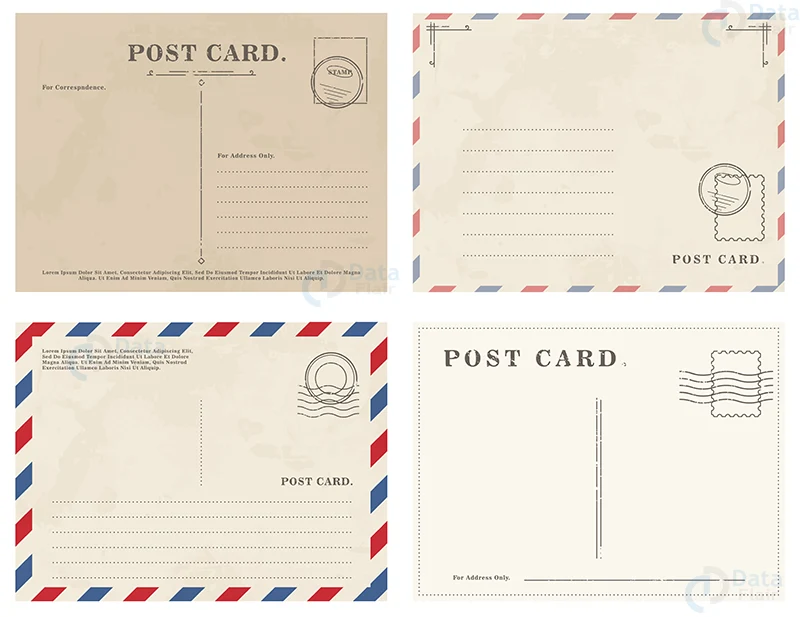
2. Acquire a stamp
Without a stamp, the post office won’t process any letters or postcards. A stamp serves as proof of payment for your postcard. The cost of the stamp varies depending on the final destination. Typically, domestic stamps are less expensive than foreign ones. Some postal services charge a single flat rate for all international mail, while others charge various rates based on the distance to the destination nation. Always double-check with the post office or the website for the postal service.
1. Two, three, or even more stamps may be required, depending on where you are sending the postcard. See if you can find out the postage requirements for, say, “mailing from Tanzania to the U.S.”
2. The post office is typically where you can purchase stamps. Most supermarkets, certain mini-marts, and petrol stations in the US sell postage stamps. You may also purchase postage stamps in vending machines and gift stores.
3. A current stamp must be present. Over time, stamp costs fluctuate. One postage stamp for a postcard purchased some time ago would not be sufficient unless you send them frequently.
3. Address the postcard
Your family and friends will get a unique look inside your journey or destination when you send them a postcard. Make sure that your card is properly addressed to prevent any errors if you want to make your postcard stand out. Read on for some simple instructions on how to address a postcard:
1. Address the recipient on the reverse of the postcard.
2. On the right side of the postcard, type the address of the receiver.
3. On the left side of the postcard, write the recipient’s name and address.
4. Record the date.
5. Make a handwritten note and send it.
6. Inscribe your postcard.
7. Do not neglect to include a stamp.
8. If feasible, send mail using First Class.
4. Write the postcard
- Sometimes just getting started is the hardest part! Your greeting can begin with “Dear/est,” a brief “hello” or “hey,” or something a little more sentimental like “To the one I love” or “To my dearest friend in the world.”
- You’ll find several suggestions on how to start a postcard below, in addition to your greeting.
- Whereabouts are you?
- How are you using the place?
- What is going on?
- What is being cooked?
- Morning salutations
- Share fascinating information
- Reviews
- Putting local news on a postcard
- Wish you were present!
- How is the weather?
- Research and work Awards Sports Recommendations for books
- Creating postcards for birthdays, anniversaries, and weddings

5. Send out the postcard
- Locate a post office or a public drop box for mail in your neighborhood.
- Make sure the card is addressed correctly and that the appropriate number of stamps is included. Send the postcard as you would a regular letter once you are certain. Give the letter at least a week or two to arrive if you’re located abroad.
- A mailbox might be present in some office buildings, public buildings, or community facilities. When staying at a hotel, the front desk will frequently include your postcard in the mail that is sent out. Ask the residents and other travelers if you can’t find a post office to mail your postcard.
Conclusion
You can let your loved ones know you’re thinking of them by sending them a postcard. It might be a wonderful method to save a memory of your time spent at a fascinating and foreign place.
A postcard must be properly addressed, have the appropriate number of stamps applied, include your message, and be mailed to the appropriate location. Sending a postcard is fundamentally identical to sending a letter.
Did we exceed your expectations?
If Yes, share your valuable feedback on Google





