Free Python Course for BSc with Certificate in Hindi

- Self paced video-based course
- Complete study materials, practicals, quizzes, projects
- Acquire practical knowledge which industry needs
- Practical Python course with real-time case-studies
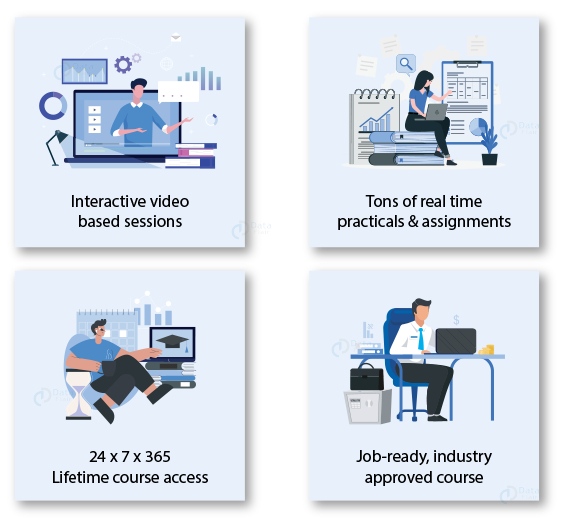
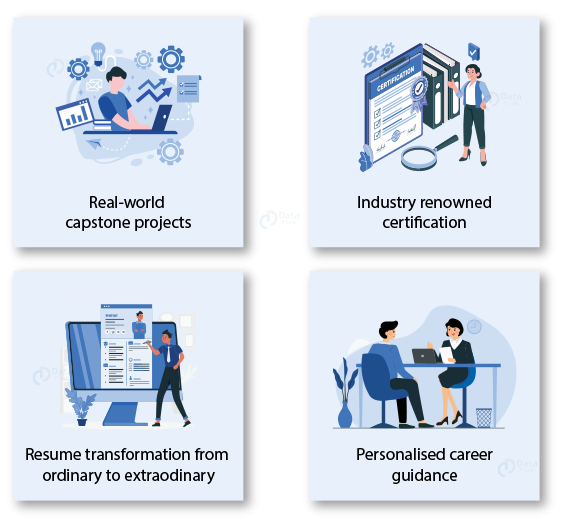
- Lifetime access with industry-renowned certification
Why should you enroll in this Free Python course?
- Access a well-structured curriculum covering essential Python concepts
- Gain practical coding experience through engaging projects
- Receive a recognized certificate upon successful completion
- Suitable for all levels, from beginners to those with minimal programming experience
- Test and reinforce your Python skills through quizzes
- Apply Python knowledge to real-world coding challenges
- Adapt the course to your schedule and learn at your own pace
- Develop strong problem-solving skills crucial for programming
- Acquire valuable skills applicable to various roles in software development
- Get to interact and form connections with a community of peers and instructors
About Python Course for BSc
Welcome to DataFlair’s free Python course for BSc, a transformative learning experience designed to provide programming proficiency to learners. Tailored for learners of all levels, this online Python course for BSc provides a holistic understanding of Python’s fundamentals, blending theoretical insights with hands-on practical applications. Whether you’re a beginner embarking on your coding journey or an enthusiast seeking to advance your Python skills, this Python course for BSc offers a well-structured curriculum to guide you through the intricacies of this versatile programming language.
Dive into the world of Python with confidence as our course not only imparts knowledge but also emphasizes practical application. Engage in hands-on projects that reinforce theoretical concepts, ensuring a dynamic and immersive learning experience. What sets this Python Programming course apart is the recognition of your achievements — upon completion, you’ll receive a free certificate, a testament to your commitment and competence in Python programming.
Join us in this educational adventure where learning is not just informative but also enjoyable and applicable. Whether you aspire to master Python for personal projects, academic pursuits, or career growth, DataFlair’s free Python course is your gateway to a world of coding possibilities.
Python Course Objectives for BSc
The objective of DataFlair’s free Python course for BSc is to provide learners with detailed knowledge of Python programming, fostering both theoretical understanding and practical application. Tailored for individuals at all skill levels, this free course aims to demystify Python, covering key concepts and techniques crucial for effective coding. Participants will engage in hands-on projects, reinforcing their problem-solving skills and preparing them for real-world applications.
By the end of the free Python course, learners will not only comprehend the intricacies of Python but will also receive a free certificate, validating their proficiency in this versatile programming language. The primary objectivel is to empower participants to confidently navigate the Python landscape, whether for personal projects, academic pursuits, or career advancement. Join us in this educational journey where accessibility, engagement, and tangible recognition of your Python skills await.
Our students are working in leading organizations
Online Python Free Training Course Curriculum for BSc
- Algorithms & building blocks of algorithms (statements, state, control flow, functions).
- Notations (pseudo code, flow chart, programming language).
- Algorithmic problem solving & strategies for developing algorithms (iteration, recursion).
- Solve illustrative problems: find minimum in a list, insert a card in a list of sorted cards, guess an integer number in a range.
- Python interpreter & interactive mode.
- Values & types: int, float, boolean, string, list.
- Variables, expressions, and statements in Python.
- Tuple assignment, precedence operators, and commenting in Python.
- Definition & use of function, flow of execution, parameters and arguments.
- Illustrative programs: exchange the value of two variables, circulate the values of n variables, distance between two points.
- Conditional statements including if, if-else, if-elif-else.
- Iteration: state, while, for, break, continue, pass.
- Fruitful functions: return values, parameters, local and global scope, function comparison, recursion.
- Strings: string slices, immutability, functions,methods, and modules.
- Lists as arrays.
- Illustrative programs: square root, gcd, exponentiation, sum of an array of number, linear search, binary search.
- Lists: operations, slices, methods, loop, mutability, aliasing, cloning lists, parameters.
- Tuples: tuple assignment, tuple as a return value.
- Dictionaries: options and methods.
- Advanced list processing – list comprehension.
- Illustrative programs: selection sort, insertion sort, mergesort, histogram.
- Files and exceptions: text files, reading & writing files.
- Command line arguments, errors, and exceptions.
- Modules & packages.
- Illustrative programs: word count, copy file.
Features of Python Free Course


Python Online Training FAQs
Python is a high-level, multipurpose programming language used for activities like web development, data analysis, and artificial intelligence.
R is mainly used for advanced statistical suites whereas Python is more general purpose. Python is specifically used in fields like web development, artificial intelligence, etc.
Python is an object-oriented programming language using which one can create classes and objects.
Primary limitations of Python are its speed and efficiency, memory management, concurrency, and parallelism support, static typing and web support.
Python is mainly used for web development, artificial intelligence, data analysis and even for designing.
Python is preferred among many programming languages in the software development market because of its simple syntax, making it easy to understand and comprehend.