

Master Python with 70+ Hands-on Projects and Get Job-ready - Learn Python
In the world of Java, Python is quickly making its way into the charts. Python developers are in high demand, and not so high in supply. This means they also get paid a lot.
If you’re reading this, it probably means you’ve decided or are deciding to start a career in Python and want to become a Python Developer.
How to land a job as a Python Developer? This article will answer all your queries about making a career as a Python Developer.
Before we learn how to become a Python developer, let’s explore why you should learn Python Programming.
Why Learn Python?
To simply say, Python is at #3 in the TIOBE Index (for popularity of programming languages) for 2020. And in the list of top programming languages for 2019 by the IEEE Spectrum, it is at #1.
Python is great both for beginners to programming and for experienced coders.
But what makes it even better is that Python is being preferred for domains like Data Science, Machine Learning, and Artificial Intelligence.
My favorite language for maintainability is Python. It has simple, clean syntax, object encapsulation, good library support, and optional named parameters.
– Bram Cohen (author of the peer-to-peer (P2P) BitTorrent protocol)
It has great analytical capabilities and multiple libraries geared for these domains; it is a very powerful general-purpose language.
Ready to learn Python for free? Now, let’s find out how to do it to get a job as a Python Developer.
How to Become a Python Developer?
Below is the Python developer roadmap –
- Decide to learn Python; decide why you want to do it.
- Follow online tutorials. DataFlair has this comprehensive list of Python tutorials where you’ll find everything in one place. Keep practicing as you learn.
- Read some good books on Python and enroll in an online Python course.
- DataFlair has a Certified FREE Python Course to help you learn Python. Here, you’ll understand the concepts, solve practicals and assignments, and even work on some exciting projects.
- Keep reading the official Python documentation for different constructs.
- Take a peek into the source code of your favorite Python package to know how it works.
Follow these steps to become the next Python Developer –
1. What to Learn in Python?
- Learn the basics. Learn about its history, syntax, installation, and some basic constructs like statements, variables, and operators.
- Find out about the applications of Python. Also, understand the differences between Python 2 and Python 3.
- Learn about basic data structures like lists, sets, and dictionaries.
- Understand important concepts like decision making and loops.
- Learn how to create a virtual environment.
- Move on to functions and recursion.
- Get started with object-oriented concepts like classes and methods, and inheritance and overloading.
- Find out about modules and packages, and get some experience with common modules like os, namedtuple, and calendar.
- Learn file handling. Learn about more complex topics like generators and decorators, and shallow and deep copying.
- Also, learn to generate and use random numbers and regular expressions.
- Learn about more complex topics like networking, XML processing, and multiprocessing.
- Learn to build GUIs with Python.
- Find out about exceptions and how to handle them.
- Learn to use SciPy, NumPy, and Pandas.
- Learn to debug, unit-test, log, serialize, and access the database.
2. Things to master Python
a. Python Frameworks
You should now learn to work on a framework.
Python has some very powerful frameworks like Django, Flask, and CherryPy.
You can begin with Django, which is a very powerful framework following the DRY (Don’t Repeat Yourself) principle. It makes work easier for you and takes care of trivial things.
At the end of the day, it motivates you to build complex, database-driven websites quickly and cleanly, without even applying massive effort.
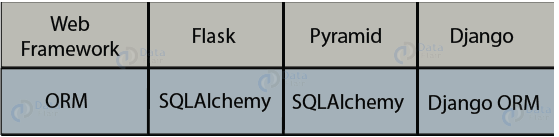
b. ORM Libraries in Python
ORM stands for Object Relational Mapping. This is a way to query and manipulate data from a database using an object-oriented paradigm.
You can learn to use ORM libraries like SQLAlchemy and Django ORM. This is easier and faster than writing SQL.
There are many other ORM implementations in Python, like:
- Peewee: Lightweight and expressive, perfect for small projects or scripts.
- PonyORM: It has a unique query syntax that uses generator expressions to define them.
- SQL model: it deals with complex data types, encapsulation, inheritance, and other concepts in an object-oriented way.
c. Python used for Front-End Technologies
Technologies like HTML5, CSS3, and JavaScript/jQuery are not a requirement to be a Python developer.
But if you can, try to gain a basic understanding of these, and they will let you understand how things work and what is possible.
As a Python developer, you may need to work with the front-end team.
d. Version Control
Changes to a code multiple times by multiple people can ultimately break it.
You should learn GitHub and its simple terms like push, pull, fork, and commit if you want to implement version control (you should).
3. Build Projects in Python
You now have enough skills; building some personal Python projects will give you confidence.
You can also build something to try to solve an actual problem you face. Once you feel confident enough, you can then build for popular open-source projects like Django.
Check out 47 Python Projects with source code and become a Python developer
Who is a Good Python Developer?
To be a good Python developer, you will need more than just technical knowledge and the following skills:
- A problem-solving mindset
- Strong communication skills- You’ll need to communicate project requirements and features to your team. This will also help you write better documentation.
- An eagerness to learn new tools and libraries
- Knowledge of how things work internally
- Strong technical skills
Now that you know what to learn and how to do it, get ready and enroll in this FREE Python Course to change your life.
Summary
We have discussed how to become a Python Developer and who is a good Python Developer. Start with the basics: variables, loops, functions, and simple file handling, and cover every concept till advance level.
Next, build small but real projects—a to-do list web app with Flask, a CSV data cleaner, or a chatbot using an API. Post each project on GitHub; recruiters look at commit history to judge skill level and growth.
Learn one framework deeply (Django, FastAPI, or PyTorch if you like AI). Add testing, virtual environments, and Docker. Finish with Git workflows. This toolkit shows you can take a feature from idea to production.