



Get Job-ready: Java Course with 45+ Real-time Projects! - Learn Java
After method overloading, here we come up with the concept of Constructor Overloading in Java. It is the process of declaring the same constructor with various parameters in the same class. Here, we will also discuss the copy constructor in Java with example.
Constructor Overloading in Java
Constructor overloading is possible in Java; it is called upon the parameters being executed. In general words, we can say it is a concept of having various constructors with a different parameter list; in this way every constructor performs a different task.
When do we need Constructor Overloading in Java?
We need to initialize the object in different ways as per the requirement, for which we use Java constructor overloading. If we do not specify anything about a thread, then we can use the default, but if we do want to specify, then we use this syntax.
Syntax of Constructor Overloading in Java –
Thread t= new Thread (" MyThread ");
Example of Java Constructor Overloading –
class Box
{
double width, height,depth;
Box(double w, double h, double d)
{
width = w;
height = h;
depth = d;
}
double volume()
{
return width * height * depth;
}
The Box() constructor requires three parameters to pass through, and if we do not declare them, then there will be an error. The problem is overcome using constructor overloading.
package com.dataflair.copyconstructor;
class Box
{
  double width, height, length;
  Box(double widthvar, double heightvar, double lengthvar)
  {
    width = widthvar;
    height = heightvar;
    length = lengthvar;
  }
  Box()
  {
    width = height = length = 0;
  }
  Box(double num)
  {
    width = height = length = num;
  }
  double volume()
  {
    return width * height * length;
  }
}
public class VolumeProgram
{

  public static void main(String args[])
  {
    Box mybox1 = new Box(10,20,30);
    Box mybox2 = new Box();
    Box mycube = new Box(5);

    double volumeOfBox;
    volumeOfBox = mybox1.volume();
    System.out.println(" Value of First Constructor is " + volumeOfBox);

    volumeOfBox = mybox2.volume();
    System.out.println(" Value of Second Constructor is " + volumeOfBox);

    volumeOfBox = mycube.volume();
    System.out.println(" Value of Third Constructor is " + volumeOfBox); 	}

}
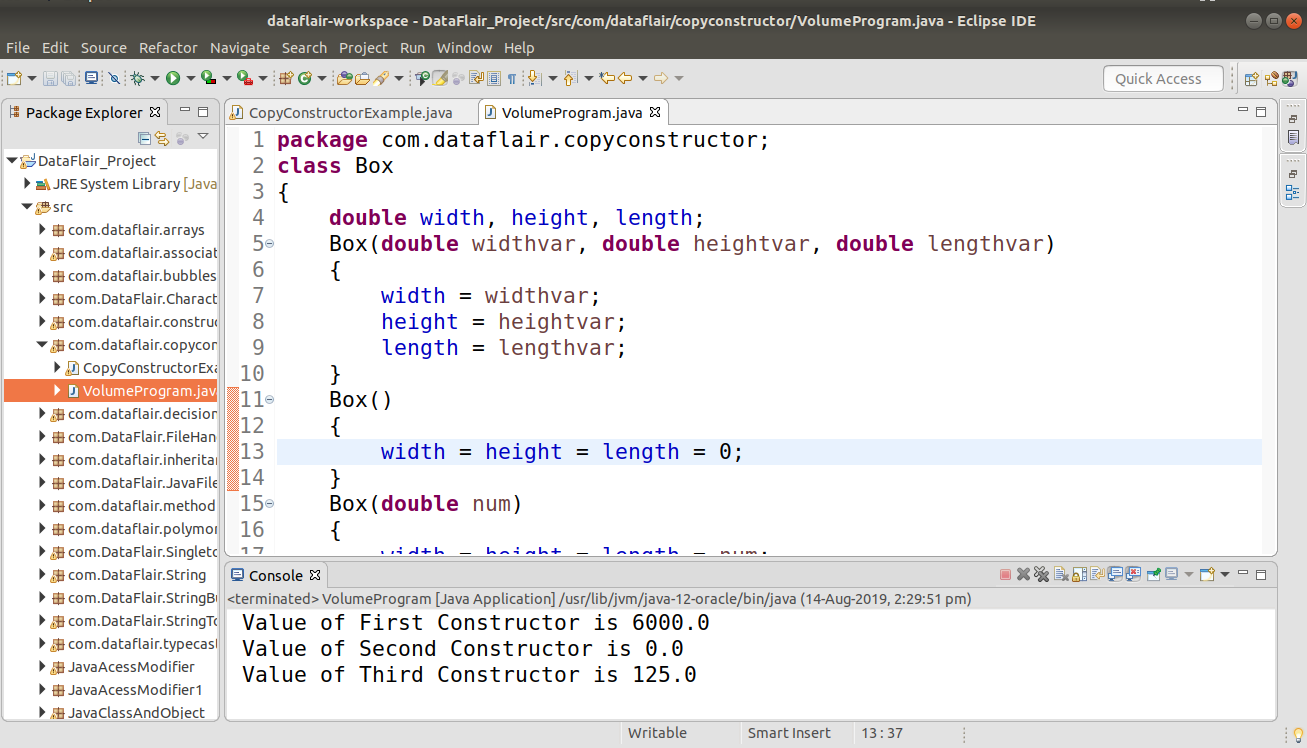
Output-
Using this() method in Constructor Overloading
this() statement inside the constructor is used during constructor overloading.
package com.dataflair.copyconstructor;
class Box
{
  double width, height, length;
  int boxNo;
  Box(double widthvar, double heightvar, double lengthvar, int num)
  {
    width = widthvar;
    height = heightvar;
    length = lengthvar;
    boxNo = num;

  }
  Box()
  {
    width = height = length = 0;
  }
  Box(int num)
  {
  this();
  boxNo = num;
  }
  double volume()
  {
    return width * height * length;
  }
}
public class VolumeProgram
{

  public static void main(String args[])
  {
    Box mybox1 = new Box(10);
    double volumeOfBox;
    volumeOfBox = mybox1.volume();
    System.out.println(" Volume of mybox1 is " + volumeOfBox);
  }

}
Output-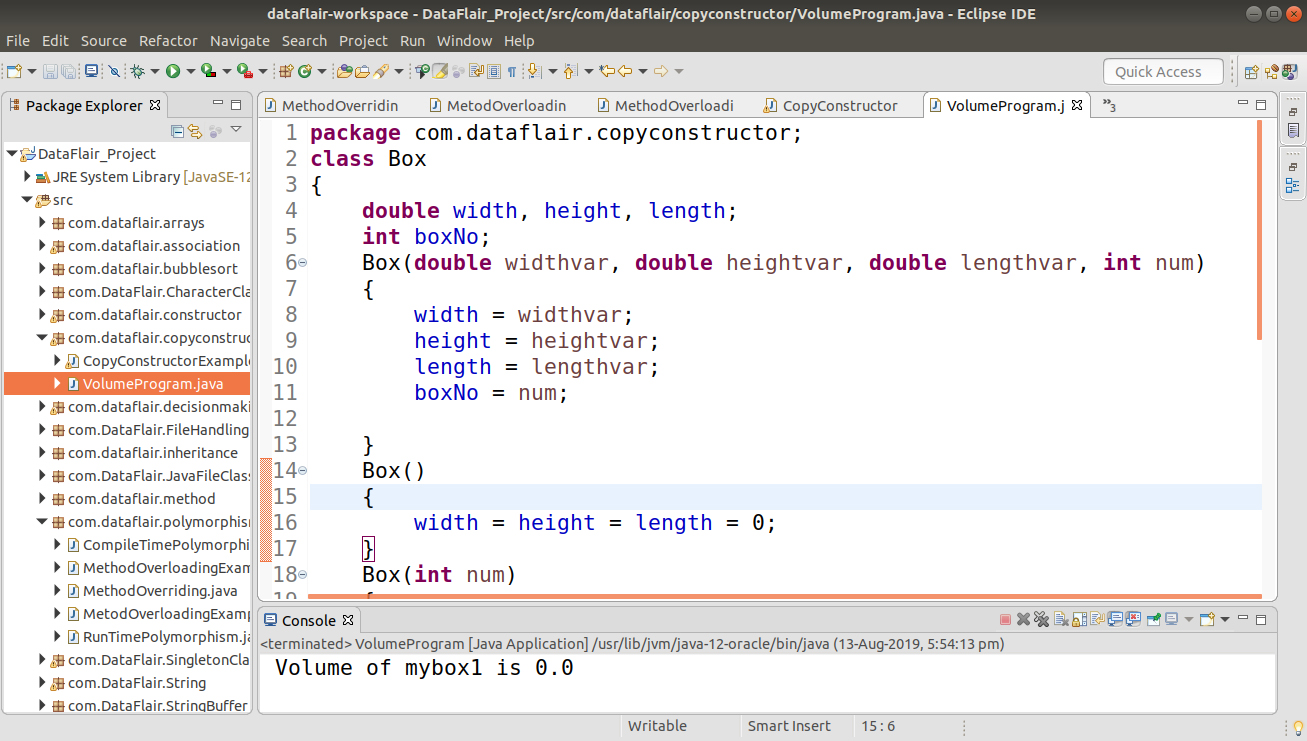
Java Copy Constructor
A Java copy constructor is just like the constructor copying in C++, with only one difference it has to be declared, and not like in C++, it declares itself. It is a special type of constructor that takes the same class as an argument.
Java Copy Constructor Example–
package com.dataflair.copyconstructor;
class ComplexNumber
{
  private double realNumber, imaginaryNumber;
  public ComplexNumber(double realNumber, double imaginaryNumber)
  {
    this.realNumber = realNumber;
    this.imaginaryNumber = imaginaryNumber;
  }
  ComplexNumber(ComplexNumber copy)
  {
    System.out.println("Copy constructor called");
    realNumber = copy.realNumber;
    imaginaryNumber = copy.imaginaryNumber;
  }
  @Override
  public String toString()
  {
    return "(" + realNumber + " + " + imaginaryNumber + "i)";
  }
}
public class CopyConstructorExample
{

  public static void main(String[] args) {
    ComplexNumber ComplexNumberObject1 = new ComplexNumber(5, 10);
    ComplexNumber ComplexNumberObject2 = new ComplexNumber(ComplexNumberObject1);
    ComplexNumber ComplexNumberObject3 = ComplexNumberObject2;
    System.out.println(ComplexNumberObject2);
  }
}
Output-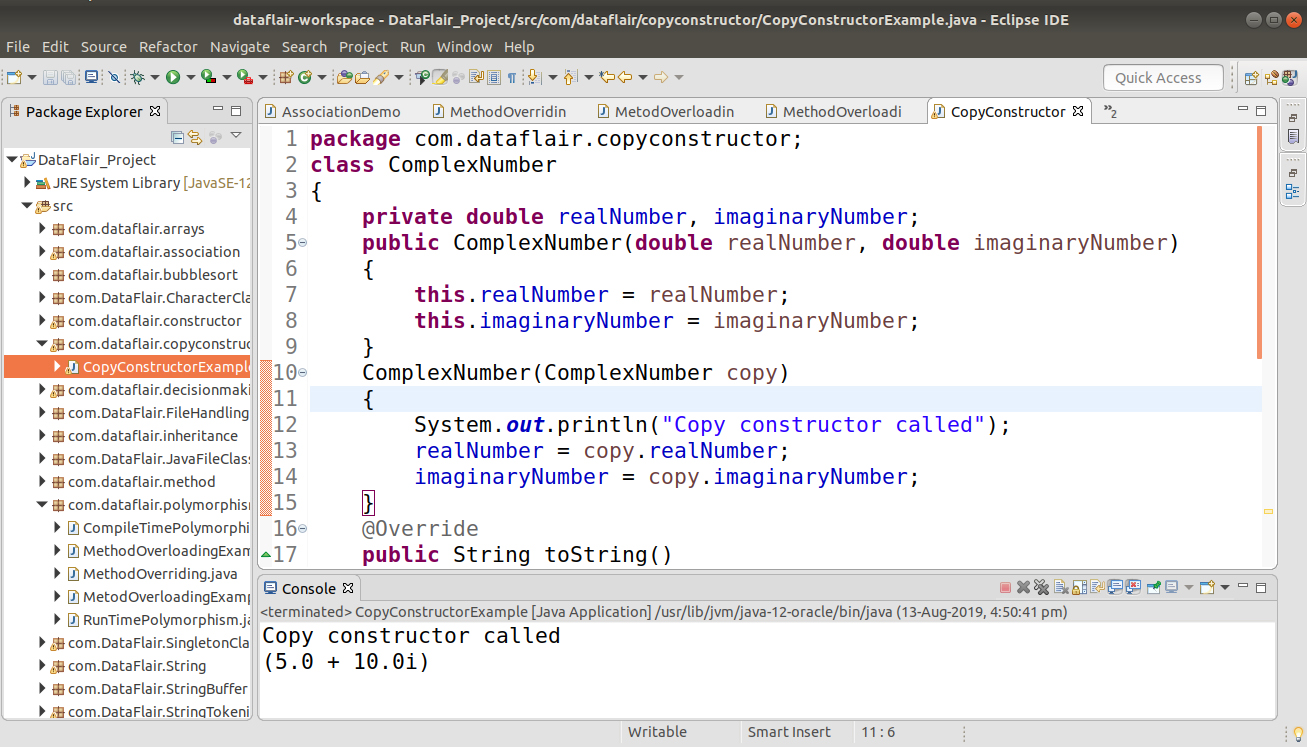
Benefits of Constructor Overloading in Java
Constructor overloading offers several advantages in object-oriented programming:
- Enhanced Flexibility: It allows you to create objects with varying initial states, catering to diverse use cases within your program. This flexibility promotes code reusability and reduces the need for multiple classes to handle similar functionalities with slightly different initialization requirements.
- Improved Code Readability: By using constructors with distinct parameter lists, you enhance code clarity. Each constructor clearly communicates its purpose by the parameters it accepts. This promotes better code maintainability for you and other developers working on the project.
Disadvantages of constructor overloading
- It creates confusion for the compiler when the constructor has the same parameter list, and only the position of parameters is different in the constructor definition. It leads to an error, causing confusion for the compiler to determine which constructor to call first.
- Harder for the developer to understand the work of a particular constructor because they have the same name and use the same variable.
Cautions When Using Constructor Overloading
While constructor overloading is a powerful tool, it’s essential to use it judiciously. Here are some factors to consider:
- Maintainability: An excessive number of constructors with very subtle parameter variations can hinder readability. Strive for a balance between flexibility and code clarity. Aim to create a set of constructors that effectively covers the initialization scenarios your objects require without introducing unnecessary complexity.
- Clarity: Ensure the parameter names and their order are consistent and intuitive across your constructors. This consistency makes the code easier to understand and reduces the likelihood of errors when invoking constructors with different arguments.
Summary
With the constructor overloading, every constructor can perform a different task. By the end of this article, we learned the importance and how to use this() method in constructor overloading. In addition, we discussed a copy constructor with an example. Hope you like the explanation.