



Iterations are a foundational idea in coding that permits the repetitive execution of a chunk of code. In the C language, programmers primarily utilize three iteration constructs: the while loop, the for loop, and the do-while loop. Of these three options, the while loop is regarded as extremely adaptable for constructing repetitive processes. The while loop facilitates executing a code block multiple times based on evaluating a condition. This offers programmers flexibility compared to the more rigid structure of a for loop. Overall, iterations are essential in programming to repeat code efficiently.
Understanding the While Loop in C
At its core, the while loop keeps executing a block of code as long as a certain condition remains true. The syntax is straightforward:
while (condition) {
    // Code
}
The loop condition dictates the loop’s continuation or termination. This conditional expression gets checked before each loop iteration. When it evaluates to false, the loop stops. As long as it remains true, the iteration persists. The condition controls whether the loop body repeats or breaks.
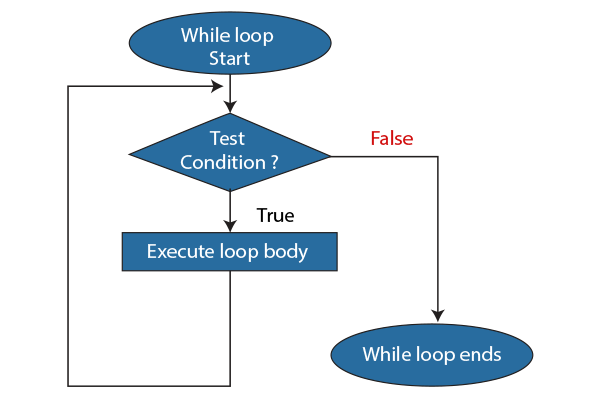
How does the While Loop in C Work?
Imagine it like this: you’re at the entrance of a maze with a checklist of conditions. You keep navigating through the maze as long as the checklist isn’t complete. Once all conditions are checked off, you exit the maze.
Similarly, in a while loop, the program enters the loop only if the condition is met. It then executes the code block and rechecks the condition. This process continues until the condition is false, at which point the program moves on.
While Loop in C Structure
The structure of a while loop in c follows a well-defined sequence consisting of the following components:
- Initialization: This phase involves setting an initial value for the loop variable. Though not explicitly stated within the while loop syntax, initialization is vital, especially when the loop variable is used in the test expression.
- Condition Evaluation: This stage holds significant importance as it determines whether the code block within the while loop will be executed. Only when the test condition specified in the conditional statement evaluates as true will the body of the while loop execute.
- Body Execution: The body represents the actual collection of statements that are carried out as long as the condition holds true.
- Updation: This component involves an expression responsible for updating the loop variable’s value with each iteration. While not explicitly stated in the syntax, it is necessary to define this expression within the loop’s body.
Working of While Loop in C
Step 1: Upon entering the loop, the program assesses the validity of the test condition.
Step 2: If the evaluation results in a false outcome, the loop’s body is bypassed, and the program progresses.
Step 3: Alternatively, if the test condition proves true, the loop’s body is executed.
Step 4: Following the execution of the body, the program control loops back to Step 1. This iterative process persists as long as the test condition remains true.
Properties of the while loop in c
- The conditional test is a required component of a while loop. Without it, the loop would execute indefinitely.
- It is possible to have an empty body in a while loop, though this would be an infinite loop if no conditions were present.
- Multiple conditional expressions can be used in a while loop body. The loop will continue until all conditions become false.
- A while loop utilizes a conditional test to determine if the loop body should run again. The loop repeatedly executes the statements inside as long as the condition remains true (returns 0).
- Braces around the body are optional syntax if there is only one statement inside the loop. The braces define the block of code, making up the loop body.
Common Use Cases
1) Iterating Over Elements:
Suppose you have an array of values, and you want to process each element. The while loop can traverse through the array until the end is reached.
int index = 0;
while (index < array_size) {
    // Process array[index]
    index++;
}
2) User Input Validation:
When you’re collecting user input, the while loop can ensure the input is valid before proceeding.
int user_age;
while (user_age <= 0) {
    printf("Enter your age: ");
    scanf("%d", &user_age);
}
3) Conditional Repetition:
You might need a loop that runs until a certain condition is met, even if you don’t know how many iterations are required upfront.
Best Practices for Using While Loops
- Ensure Termination: Make sure the loop’s condition eventually becomes false to prevent infinite loops.
- Avoid Infinite Loops: Double-check your loop control expression to prevent unintended infinite looping.
- Clear Variable Names: Use meaningful variable names and clear conditions for better readability.
Example Code Walkthroughs
Example 1: Counting Down with a While Loop in C
#include <stdio.h>

int main() {
    int countdown = 10;
    while (countdown >= 0) {
        printf("%d\n", countdown);
        countdown--;
    }

    return 0;
}
Output:
10
9
8
7
6
5
4
3
2
1
0
Example 2: Finding the Sum of Digits using a While Loop in C
#include <stdio.h>

int main() {
    int number = 12345;
    int sum = 0;
    while (number > 0) {
        sum += number % 10;
        number /= 10;
    }

    printf("Sum of digits: %d\n", sum);

    return 0;
}
Output:
A sum of digits: 15
Example 3: Generating a Fibonacci Sequence using a While Loop in C
#include <stdio.h>

int main() {
    int previous = 0, current_num = 1, next_num;
    while (current_num <= 100) {
        printf("%d ", current_num);
        next_num = previous + current_num;
        previous = current_num;
        current_num = next_num;
    }

    return 0;
}
Output:
1 2 3 5 8 13 21 34 55 89
Important Points
- It operates as an entry-controlled loop.
- The loop continues executing the designated statements until the conditions specified are met; once these conditions cease to hold true, the loop concludes.
- The loop’s sequence begins with condition verification followed by body execution. This characteristic defines it as a form of a pre-tested loop.
- When the quantity of iterations isn’t predetermined, the while loop often proves to be more suitable than the for loop.
Infinite Loops
In programming, an infinite loop is a situation where a loop keeps executing its statements endlessly without ever meeting the conditions for termination. While loops are particularly susceptible to this issue, as they continue as long as their condition remains true. Infinite loops are often unintentional and can lead to freezing or crashing of programs.
#include <stdio.h>

int main() {
    while (1) {
        printf("This loop will run infinitely!\n");
    }

    return 0;
}
Tips for Debugging While Loops
- Insert print statements to track variable values and condition evaluation.
- Utilize debugging tools provided by your IDE for step-by-step analysis.
Key Differences from Other Loops
- The for loop offers a compact structure for iteration and is suitable when you know the number of iterations beforehand.
- The do-while loop guarantees the code block is executed at least once, as the condition is checked after the execution.
Conclusion
Mastering the while loop in C programming opens doors to creating efficient and dynamic code structures. Its ability to repeatedly execute code while a condition holds true offers versatility in various scenarios. By understanding its structure, working mechanism, and best practices, you’ve gained a valuable tool to tackle iterative tasks with precision. Embrace its power but stay cautious, avoiding the pitfalls of infinite loops. Remember, a well-utilized while loop enhances your programming toolkit and empowers you to create elegant and functional solutions.