


Interactive Online Courses: Elevate Skills & Succeed Enroll Now!
United Progressive Alliance which is commonly known as UPA is a left-leaning political alliance that was formed during 2004 general election. The idea was proposed by the largest party in the coalition which is Indian National Congress (INC). Sonia Gandhi was chosen as the president of the UPA. It was formed when no single party could hold the majority by joining hands with the left-leaning parties.
Adhir Ranjan Chowdhary is UPA leader in the Lok Sabha with 91 representative seats. In Rajya Sabha, they have 51 seats under the leadership of Mallikarjun Kharge. During the 2004 general elections when no party could hold the majority, The Left Front with 59 MPs, the Samajwadi Party with 39 MPs, the Bahujan Samaj Party with 19 MPs along with other regional parties came in support of the INC.
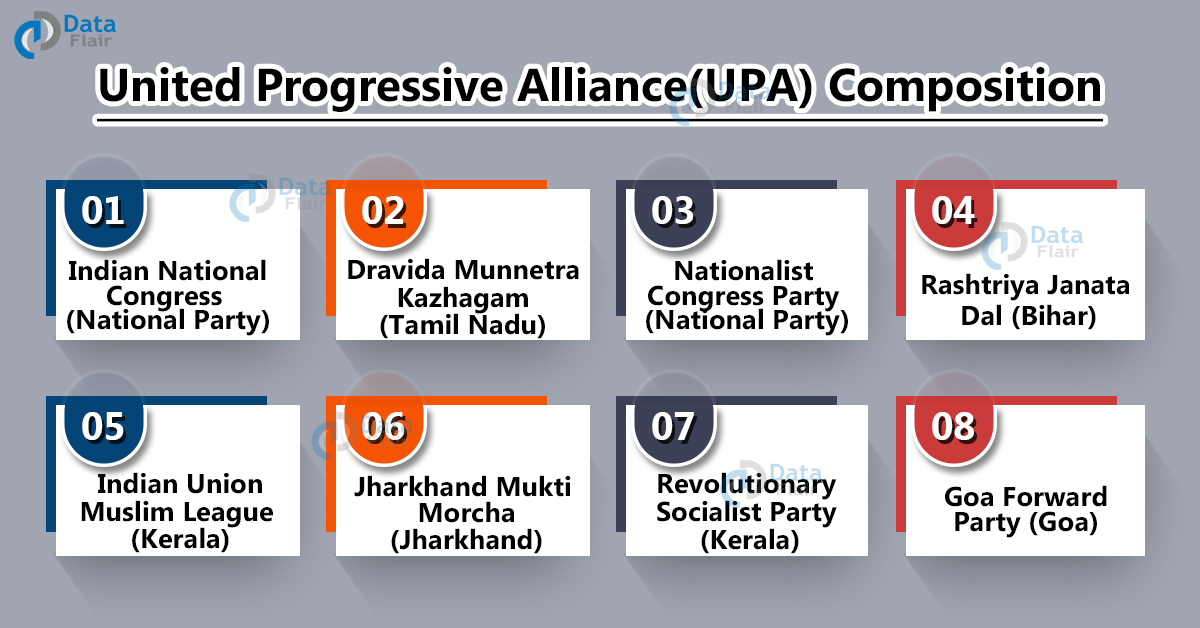
UPA Composition
Parties that are currently the member of the UPA:
1. Indian National Congress (National Party)
2. Dravida Munnetra Kazhagam (Tamil Nadu)
3. Nationalist Congress Party (National Party)
4. Rashtriya Janata Dal (Bihar)
5. Indian Union Muslim League (Kerala)
6. Jammu & Kashmir National Conference (Jammu and Kashmir)
7. Jharkhand Mukti Morcha (Jharkhand)
8. Marumalarchi Dravida Munnetra Kazhagam (Tamil Nadu)
9. Revolutionary Socialist Party (Kerala)
10. Viduthalai Chiruthaigal Katchi (Tamil Nadu)
11. All India United Democratic Front (Assam)
12. Goa Forward Party (Goa)
13. Bahujan Vikas Aaghadi (Maharashtra).
They are currently running the government of the following States
1. Punjab
2. Jharkhand
3. Chhattisgarh
4. Maharashtra
5. Rajasthan
6. Tamil Nadu
UPA Situation During 2009 Elections
During the 2009 general elections, UPA got 262 seats out of which INC had 206 seats and India was governed by Mr. Manmohan Singh up until 2014. From 2014 onwards, we can say that the performance of UPA has been deteriorating. They lost their power in 2014 after losing their general election. They also lost the state elections in Jharkhand, Odisha, Sikkim, Jammu and Kashmir, Maharashtra, Telangana and Haryana. However, they won 1 election in Arunachal Pradesh.
In 2015, they lost Delhi and won Bihar state elections. They lost state elections of Tamil Nadu, West Bengal, Assam, Kerala but won in Puducherry. In 2017, Janta Dal (United) broke the UPA alliance with Congress and joined hands with BJP run NDA. This caused their loss of power in Bihar. UPA also lost the state elections in Uttar Pradesh, Himachal Pradesh, Uttarakhand, and Gujarat but won Punjab elections. Another prominent defeat that UPA faced at the hand of NDA was losing the presidential election to Ram Nath Kovind. MDMK and VCK which are state parties hailing from Tamil Nadu joined UPA.
While MDMK left NDA and joined UPA for the first time VCK re-joined UPA after leaving it in 2014. Janta Dal(secular) joined hands with UPA to help them with Karnataka elections. UPA won the Karnataka elections along with other state elections such as in Rajasthan, Chhattisgarh. They also lost the state elections in Telangana, Mizoram, Nagaland, Meghalaya.
They also got support of one of the powerful political parties of Bihar that is RJD. Despite winning the Karnataka elections in 2018 the by polls took power from UPA and gave it to NDA hailing them the majority there in 2019. After which Janta Dal (secular) also left the alliance.
Wrapping Up
Like any other political body UPA too couldn’t stay aloof from the controversies that were allegedly built around them. The then opposition called it the fruit of their karma. UPA has been accused of being the voice of Parliament during the sessions. These accusations were later backed by the left parties too which led to friction within the allegiance.
During the UPA government many scams such as a Commonwealth Games Scam of 2010, 2G Spectrum Case etc. This caused the downfall of the government as their leadership’s have been vocally questioned.