


In the realm of programming, the act of determining outcomes based on particular conditions is a fundamental aspect of crafting operational and engaging software applications. One of the essential tools at a programmer’s disposal is the “switch case” statement. This powerful construct plays a crucial role in C programming by enabling developers to efficiently manage multiple conditional scenarios. The switch case statement’s nuances will be examined in this article, along with its structure, recommendations, and practical uses.
The Need for Conditional Handling
Imagine you’re developing a program that needs to respond differently based on various inputs. For instance, you might be designing a menu-driven application where the user’s choice dictates different actions to be taken. Here’s where the switch case statement shines. It offers an elegant substitute for writing numerous if-else statements by enabling you to assess an expression and execute a certain code block in accordance with its value.
Understanding the Switch Case Syntax
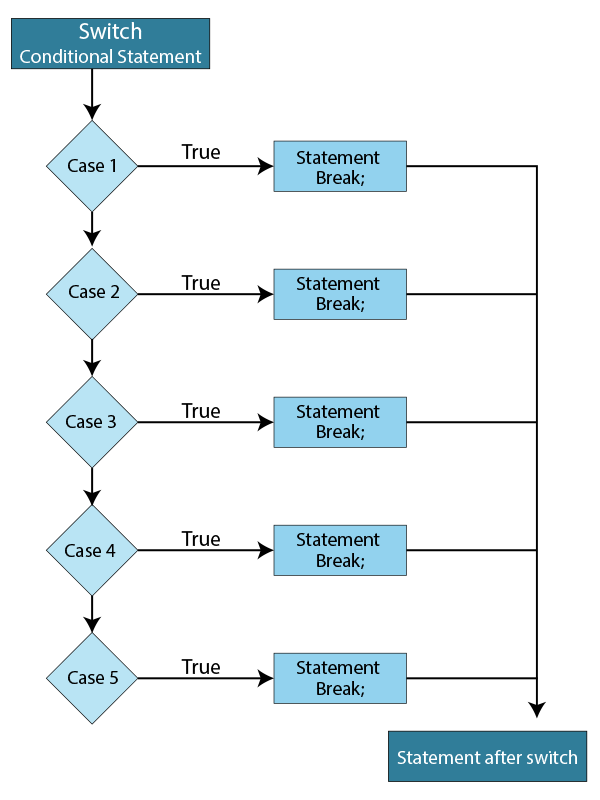
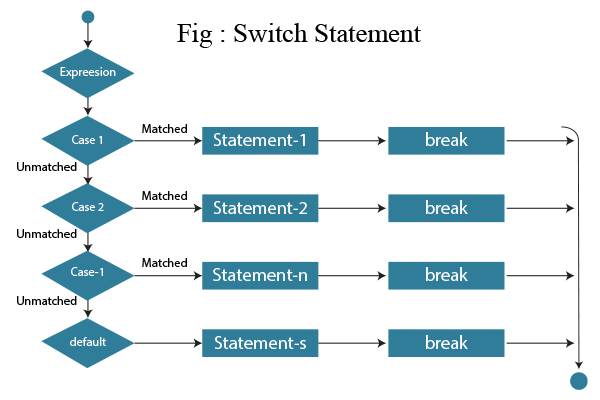
The switch case statement’s basic components are a switch expression and a number of case labels, each of which is linked to a particular code block. The expression’s value is evaluated against the case labels, and the corresponding code block is executed.
The basic structure looks like this:
switch (expression) {
    case constant1:
        // Code to be executed for constant1
        break;
    case constant2:
        // Code to be executed for constant2
        break;
    // ... more cases ...
    default:
        // Code
}
The switch case statement consists of several key components:
- The switch keyword: This keyword signals the beginning of the switch case statement.
- The expression: This is the value that will be evaluated against the case labels. It can be of type int or char.
- Case labels: These are constant values that represent different scenarios. They are enclosed in case statements.
- Code blocks: If the expression meets the case label, the code block that follows it will be run.
- The switch case block is terminated using the break statement when a particular case has been handled.
The break statement is essential within each case block as it prevents the program from “falling through” to subsequent cases. It signals the end of the switch case block and ensures that only the relevant code block is executed.
Efficient Handling of Multiple Cases
Consider a scenario where you’re building a grade classification system based on test scores. With multiple grades to categorize, using individual if-else statements for each case can quickly become cumbersome and less readable. The switch case statement streamlines this process, offering a concise way to handle numerous possible outcomes without sacrificing clarity.
Rules of the Switch Case Statement
When using the switch case statement in C programming, keep these rules in mind for a smooth experience:
- Constant Expressions: Case labels must be constant expressions, allowing efficient code optimization.
- Limited Types: The expression being evaluated must be of type int or char, ensuring straightforward comparison.
- No Floating-Point or Strings: Avoid using floating-point types and string literals as case labels due to potential imprecision and complexity.
- Unique Case Values: Each case label must have a unique value, preventing ambiguity and ensuring accurate code execution.
Important Points About Switch Case Statements
When working with switch case statements, remember these essential guidelines:
- Constant Values: The expression must be evaluatable at compile-time, guaranteeing consistency and optimization for decision-making.
- int or char Types: Stick to int for numerical values and char for character-based decisions, ensuring straightforward comparisons.
- Unique Cases: Each case value should be distinct, preventing ambiguity and enabling the correct code block to execute.
- Nesting for Complexity: For intricate decision trees, nest switch statements to manage complexity step by step, enhancing code organization.
How Switch Case Works
Understanding the inner workings of the switch case statement is key to using it effectively. Let’s walk through the step-by-step process of how this construct operates, from evaluating expressions to executing code blocks based on matched constants.
1. Expression Evaluation:
When you encounter a switch case statement, the first step is to evaluate the given expression. This expression represents the condition that you’re testing against various cases. It could be an integer or character value. The outcome of this evaluation becomes the basis for comparison with the case labels.
2. Comparison with Constants:
Once the expression is evaluated, the program compares its value with the case labels defined within the switch case block. It checks if the expression’s value matches any of the case values. This comparison determines which code block to execute.
3. Branching Behavior:
When a match is found between the expression’s value and a case label, the program enters the corresponding code block. Here, the associated instructions are executed. The break statement following each case ensures that the program exits the switch block after executing the relevant code.
If no match is found, the program proceeds to the default case (if present), where a designated code block is executed. The default case serves as a catch-all for unmatched values, providing a way to handle unexpected scenarios.
Example Scenario:
Let’s consider a scenario where you’re building a day-of-the-week determination program. The user provides an integer input representing a day. The switch case statement evaluates the input and compares it with case labels (1 to 7) for each day. Upon a match, the program executes the corresponding code block, displaying the day’s name.
Nested Switch Case Statement
Nested switch case statements involve placing one switch statement inside another, enabling the handling of intricate decision trees. This technique breaks down complex scenarios into manageable sections, improving code organization and maintainability.
Benefits and Illustration:
Nesting is valuable when dealing with multifaceted scenarios. For instance, in a library system, the outer switch could determine user roles while the inner switch manages access levels. This hierarchy of decisions is elegantly managed through nested switch cases.
Example:
Consider a food ordering app. The outer switch decides meal types (breakfast, lunch, dinner), while the inner switch handles menu and dietary options. This nested approach streamlines decision-making and enhances code structure.
#include <stdio.h>

int main() {
    int activityType, choice;

    printf("Enter activity type: ");
    scanf("%d", &activityType);

    printf("Provide choice: ");
    scanf("%d", &choice);

    switch (activityType) {
        case 1:
            switch (choice) {
                case 1:
                    printf("Displaying sports activity details.\n");
                    break;
                case 2:
                    printf("Providing recommendations for sports enthusiasts.\n");
                    break;
                default:
                    printf("Invalid choice for sports activity.\n");
            }
            break;
        case 2:
            switch (choice) {
                case 1:
                    printf("Exploring leisure activity information.\n");
                    break;
                case 2:
                    printf("Suggesting leisure options for relaxation.\n");
                    break;
                default:
                    printf("Invalid choice for leisure activity.\n");
            }
            break;
        case 3:
            switch (choice) {
                case 1:
                    printf("Discovering adventurous activity details.\n");
                    break;
                case 2:
                    printf("Sharing recommendations for thrill-seekers.\n");
                    break;
                default:
                    printf("Invalid choice for adventurous activity.\n");
            }
            break;
        default:
            printf("Invalid activity type.\n");
    }

    return 0;
}
Output:
Enter activity type: 2
Provide Choice: 2
Suggesting leisure options for relaxation.
Break and Default in Switch Case Statements
Break Significance:
The break statement within a switch case is a key player in maintaining control flow. Its primary purpose is to prevent the fall-through behavior, where the program unintentionally continues to execute subsequent case blocks. When a break statement is encountered, the program immediately exits the switch block, regardless of whether there are more cases to consider.
Default Case:
The default case serves as a safety net for unmatched values. When the expression doesn’t match any of the specified cases, the default case’s code block executes. This prevents unexpected program behavior when dealing with unforeseen or invalid inputs.
#include <stdio.h>

int main() {
    char transaction;

    printf("Enter transaction type: ");
    scanf(" %c", &transaction);

    switch (transaction) {
        case 'D':
            printf("Initiating deposit.\n");
            // Add your deposit code here
            break;
        case 'W':
            printf("Initiating withdrawal.\n");
            // Add your withdrawal code here
            break;
        case 'T':
            printf("Initiating funds transfer.\n");
            // Add your transfer code here
            break;
        default:
            printf("Invalid transaction type.\n");
    }

    return 0;
}
Output:
Enter transaction type: W
Initiating withdrawal
Use Cases and Examples of Switch Case Statements
Example 1: Grade Classification Based on Score:
#include <stdio.h>

int main() {
    int score;

    printf("Enter the test score: ");
    scanf("%d", &score);

    switch (score) {
        case 90 ... 100:
            printf("Grade: A\n");
            break;
        case 80 ... 89:
            printf("Grade: B\n");
            break;
        case 70 ... 79:
            printf("Grade: C\n");
            break;
        case 60 ... 69:
            printf("Grade: D\n");
            break;
        default:
            printf("Grade: F\n");
    }

    return 0;
}
Output:
Enter the test score: 85
Grade: B
Example 2: Day of the Week Determination
#include <stdio.h>

int main() {
    int userInput;

    printf("Provide number for the day: ");
    scanf("%d", &userInput);

    switch (userInput) {
        case 1:
            printf("Sunday\n");
            break;
        case 2:
            printf("Monday\n");
            break;
        case 3:
            printf("Tuesday\n");
            break;
        case 4:
            printf("Wednesday\n");
            break;
        case 5:
            printf("Thursday\n");
            break;
        case 6:
            printf("Friday\n");
            break;
        case 7:
            printf("Saturday\n");
            break;
        default:
            printf("Invalid day\n");
    }

    return 0;
}
Output:
Provide a number for the day: 4
Wednesday
Advantages Over if-else
- Simplicity and Readability: Switch case provides a more compact and intuitive way to handle multiple conditions, resulting in cleaner and easier-to-understand code.
- Efficiency: In scenarios where you have multiple conditions to evaluate against a single expression, switch case can be faster than a series of if-else statements, especially when the number of cases is large.
- Logical Structure: Switch case promotes a logical structure that aligns well with scenarios where there’s a clear mapping between conditions and outcomes.
Limitations and Considerations
- Constant Cases: Switch case requires constant values in case labels, making it unsuitable for scenarios where the conditions are not easily represented as constants.
- Limited Data Types: Switch case works efficiently only with int and char types, which may limit its application in cases requiring more diverse data types.
- Lack of Range Checks: Unlike if-else, the switch case doesn’t directly support range checks for cases, potentially complicating handling of continuous ranges of values.
- Absence of Expressions: Unlike if-else, switch case doesn’t allow arbitrary expressions as conditions, limiting its flexibility.
Best Practices for Using Switch Case
- Maintain Indentation: Consistently indent your switch case blocks to improve readability and make the code structure evident.
- Use Default Sparingly: While the default case handles unmatched values, using it excessively can lead to less predictable code behavior.
- Comment Complex Logic: If your switch case logic is intricate, consider adding comments to explain the decision process for each case.
- Group Related Cases: Group related cases to reduce redundancy and make your code more concise.
Conclusion
In C programming, the switch case statement is a potent tool for handling complex decision-making. Its logical organisation streamlines code by tastefully classifying circumstances according to expressions. In instances like grade categorization and day determination, this idea increases code efficiency and readability. It’s important to be aware of restrictions like constant cases and constrained data types despite the fact that they have advantages over if-else chains. Programmers can use switch cases to write clear, adaptable code that appropriately reacts to various inputs by following best practices. The switch case statement ultimately gives programmers a flexible answer, boosting their ability to deal with difficult situations in software development.