


Job-ready Online Courses: Knowledge Awaits – Click to Access!
Kali Linux is a powerful penetration checking out and moral hacking platform broadly used by protection professionals. One of the important thing elements of undertaking a successful safety exam is producing accurate and significant reviews.
In this text, we will have a look at a whole lot of Kali Linux reporting tools that can help with data analysis and presentation. We will examine their capabilities and specifics and capabilities as well as provide detailed commands on a way to use them efficaciously. We can even go into the ethical and criminal problems surrounding their software.
Reporting tools play an important position in protection exams by consolidating and visualizing data amassed at some point of penetration trying out. These gear facilitate the creation of expert reports that highlight vulnerabilities, encourage countermeasures, and typical threat assessments. In this text, we will undergo loads of Kali Linux reporting equipment, each with unique use cases and capabilities.
Kali Linux Reporting Tools
1. Nessus:
- Uses: Nessus is a complete vulnerability scanner used to become aware of and investigate vulnerabilities throughout networks, systems, and packages.
- Details: Nessus offers a large vulnerability knowledge base, normal updates, and in-intensity reports.
- Features: It supports each faraway and neighborhood vulnerability scanning, compliance auditing, and remediation steerage.
- Basic Commands:
a) nessus -q scan.xml – Runs Nessus in quiet mode and saves the scan results to a file named “scan.xml”.
2. OpenVAS:
- Uses: OpenVAS is an open-source vulnerability scanner that detects and assesses safety vulnerabilities in network infrastructure.
- Details: OpenVAS gives substantial vulnerability scanning capabilities at the side of an internet-based interface for the recording era.
- Features: It gives deep scanning options, comprehensive vulnerability exams, and integration with other protection gear.
- Basic Commands:
a) openvas-start – Starts the OpenVAS vulnerability scanning service.
b) openvas-stop – Stops the OpenVAS vulnerability scanning service.
c) openvasmd -p – Generates a PDF report of the scan results.
3. Nikto:
- Uses: Nikto is a web server scanner that identifies potential vulnerabilities in web applications.
- Details: Nikto scans net servers for old software variations, misconfigurations, and regarded vulnerabilities.
- Features: It supports various sorts of scans, along with SSL, proxy, and CGI vulnerabilities.
- Basic Commands:
a) nikto -h target.com -o scan_results.txt – Performs a scan on the target website and saves the results to a file named “scan_results.txt”.
4. Burp Suite:
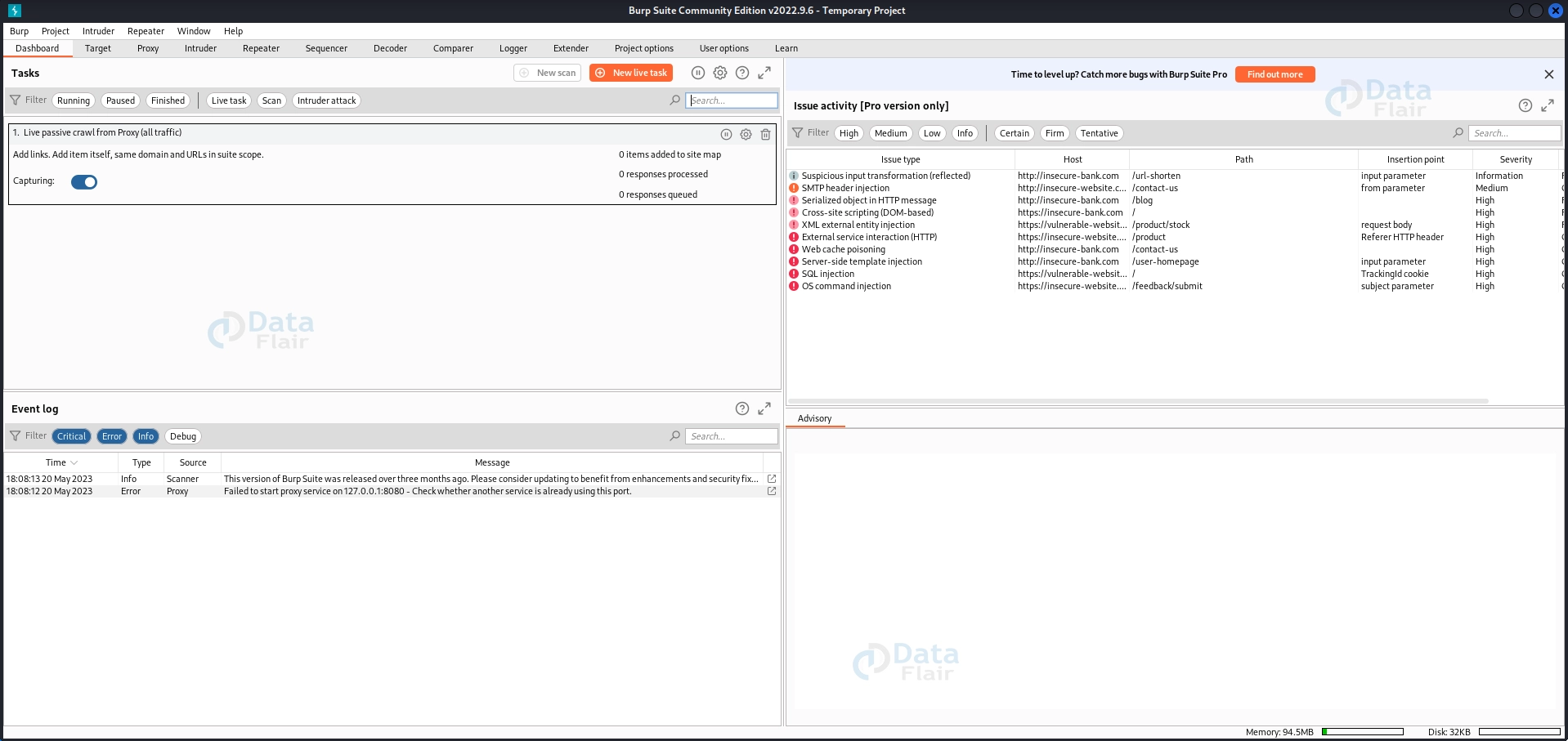
- Uses: Burp Suite is a comprehensive net utility safety testing platform.
- Details: Burp Suite includes an effective scanner that detects vulnerabilities and generates specific reviews.
- Features: It helps guide and automate trying out, consultation managing, and numerous assault payloads.
- Basic Commands:
a) burp – Launches the Burp Suite application.
b) burp-rest-api – Starts the Burp Suite REST API service.
c) burp -r target.com – Performs a scan on the target website.
5. Wireshark:
- Uses: Wireshark is a network protocol analyzer used to seize and analyze network traffic.
- Details: Wireshark presents in-intensity insights into network protocols, facilitating the identification of security troubles.
- Features: It helps live packet capturing, protocol decoding, and effective filtering competencies.
- Basic Commands:
a) wireshark – Launches the Wireshark graphical interface.
b) tshark – Captures and analyzes network traffic from the command line.
c) capinfos – Displays information about a captured network traffic file.

6. Sqlmap:
- Uses: Sqlmap is an automatic SQL injection and database takeover tool.
- Details: Sqlmap detects and exploits SQL injection vulnerabilities to gain unauthorized get rights of entry to databases.
- Features: It helps numerous database management systems, computerized detection of injection points, and data extraction.
- Basic Commands:
a) sqlmap -u “http://target.com/vuln_page.php?id=1” –dump – Performs a SQL injection attack and dumps the database contents.

7. Gobuster:
- Uses: Gobuster is a directory and record brute-forcing tool used to discover hidden paths on web servers.
- Details: Gobuster helps become aware of unprotected documents and directories that may contain touchy records.
- Features: It helps numerous wordlists, multi-threading, and extensions for particular record kinds.
- Basic Commands:
a) gobuster dir -u “http://target.com” -w wordlist.txt – Performs a directory brute-force attack on the target website.
8. Aircrack-ng:
- Uses: Aircrack-ng is a suite of Wi-Fi community safety tools used for taking pictures and analyzing Wi-Fi community visitors.
- Details: Aircrack-ng allows checking the security of Wi-Fi networks through cracking WEP and WPA/WPA2-PSK keys.
- Features: It consists of packet capturing, attacking tools, and a whole lot of methods for password healing.
- Basic Commands:
a) airmon-ng – Lists available wireless network interfaces and puts them into monitor mode.
b) airodump-ng wlan0 – Captures wireless network traffic on the specified interface.

9. Nmap:
- Uses: Nmap is a powerful community exploration and protection auditing device.
- Details: Nmap scans networks and hosts to discover open ports, going for walks services, and capacity vulnerabilities.
- Features: It helps one-of-a-kind test types, OS detection, scriptable interactions, and big port scanning options.
- Basic Commands:
a) nmap – Performs a basic scan on the target host.
b) nmap -sS – Performs a TCP SYN scan to identify open ports.
c) nmap -A – Enables aggressive scanning, including OS detection and version detection.

10. Metasploit Framework:
- Uses: The Metasploit Framework is a complicated exploitation framework used for penetration testing.
- Details: Metasploit gives a wide range of exploits, payloads, and put-up-exploitation modules.
- Features: It supports each guide and automatic exploitation, session managing, and superior submit-exploitation abilities.
- Basic Commands:
a) msfconsole – Launches the Metasploit console.
b) msfvenom – Generates customized payload executables.
c) msfconsole -r – Loads a resource script with predefined commands

11. Maltego:
- Uses: Maltego is a visible hyperlink evaluation device used for amassing and analyzing facts about people, organizations, and networks.
- Details: Maltego offers a graphical illustration of data relationships to perceive patterns and capacity assault vectors.
- Features: It supports various facts supply integrations, entity alterations, and superior statistics visualization.
- Basic Commands:
a) maltego – Launches the Maltego graphical interface.
b) maltegoce – Launches the community edition of Maltego.
12. Skipfish:
- Uses: Skipfish is an internet application protection scanner used for identifying vulnerabilities and ability protection flaws.
- Details: Skipfish crawls net programs and performs in-intensity analysis of the located paths and parameters.
- Features: It offers multi-threaded scanning, customizable scan regulations, and complete vulnerability reviews.
- Basic Commands:
a) skipfish -o output_dir http://target.com – Initiates a web application scan on the specified target.
13. XSSer:
- Uses: XSSer is an automatic XSS (Cross-Site Scripting) vulnerability scanner.
- Details: XSSer facilitates perceiving and exploiting XSS vulnerabilities, which permit attackers to inject malicious scripts into net programs.
- Features: It helps numerous kinds of XSS attacks and evasion strategies and might generate unique reviews.
- Basic Commands:
a) xsser -u “http://target.com/vuln_page.php?param=1”- Performs an XSS vulnerability scan on the specified URL.
14. BeEF:
- Uses: BeEF (Browser Exploitation Framework) is an effective device for assessing the safety of net browsers.
- Details: BeEF leverages client-aspect vulnerabilities to manipulate and manipulate net browsers.
- Features: It gives real-time browser exploitation, command execution, and session control.
- Basic Commands:
a) beef-xss – Starts the BeEF server.
b) beef – Launches the BeEF graphical interface.
15. MagicTree:
- Uses: MagicTree is a visible penetration checking-out record technology device that enables preparation and gift evaluation information.
- Details: MagicTree gives a tree-primarily based interface to shape findings, manipulate evidence, and generate customizable reviews.
- Features: It supports records import/export, custom record templates, and visualization of relationships between findings.
- Basic Commands:
a) magictree – Launches the MagicTree application.
b) magictree -i findings.xml -o report.docx` – Imports findings from the specified XML file and generates a report in DOCX format.
16. Dradis Reporting Tool:
- Uses: Dradis is a collaborative information-sharing and reporting tool designed to be used in penetration trying out and protection checks.
- Details: Dradis enables the enterprise, consolidation, and presentation of findings and notes amassed at some point of safety engagements.
- Features: It supports group collaboration, customizable templates, and integration with famous safety tools.
- Basic Commands:
a) dradis – Runs the Dradis application.
b) dradis-plugins – Lists available plugins for extending Dradis functionality.
c) dradis-import FILENAME – Imports findings from a file into the Dradis workspace
Comparison between MagicTree and Dradis:
| Feature | MagicTree | Dradis Reporting Tool |
| Purpose | Penetration testing report generation | Collaborative information-sharing and reporting |
| tool | tool | |
| Organization | Provides a tree-based interface for | Offers a centralized platform for documenting |
| and Presentation | structuring findings and generating | and reporting findings |
| customizable reports | ||
| Collaboration | Limited support for collaboration | Supports team collaboration |
| Customization | Custom report templates can be created | Customizable report templates |
| Integration | Limited integration with external tools | Integration with popular security tools |
| Import/Export | Offers import/export functionality for | Provides import functionality for findings from |
| findings | various tools/formats | |
| Usability | User-friendly graphical interface | User-friendly graphical interface |
| Availability | Open-source | Open-source |
Steps to Use Reporting Tools in Kali Linux:
1. Scope and Objective: Clearly define the scope and objective of the security evaluation. Identify the goal structures, networks, or internet applications to be able to be examined.
2. Tool Selection: Choose the appropriate reporting gear based on the evaluation requirements. Consider elements such as the form of assessment, goal surroundings, and favored output format.
3. Installation: Install the selected tools using the package deal manager or by way of downloading them from trusted assets. Follow the setup commands furnished with each tool.
4. Familiarize Yourself: Learn the syntax and command structure of the reporting equipment. Read the documentation and explore available tutorials or sources to recognize the competencies and functions of every device.
5. Target Identification: Identify the goal systems or programs to be tested. Determine the IP addresses, URLs, or domain names associated with the goals.
6. Command Execution: Run the reporting equipment with appropriate alternatives, specifying the target and favored output format. Use the simple instructions and syntax provided for each device. For example:
- nessus –q scan.xml
- nikto –h target.com -o scan_results.txt
- go buster dir –u “http://target.com” -w wordlist.txt
7. Analysis and Interpretation: Analyze the generated reviews to identify vulnerabilities, weaknesses, and potential dangers. Interpret the findings in the context of the assessed environment and prioritize them primarily based on their effect and severity.
8. Documentation: Document the findings, endorsed countermeasures, and any essential remediation steps. Include applicable technical info, helping evidence, and screenshots to decorate the clarity and comprehensiveness of the document.
9. Report Generation: Generate a comprehensive report with a government precis, unique technical facts, and supporting evidence. Utilize any built-in record-era features supplied by the reporting gear or use external tools like MagicTree to organize and present the assessment statistics efficiently.
10. Review and Delivery: Review the document for accuracy, readability, and adherence to the evaluation goals. Ensure the document communicates the identified vulnerabilities, associated risks, and endorsed movements. Finally, deliver the record to the ideal stakeholders, following detailed reporting approaches or protocols.
Ethical and Legal Considerations:
1. Obtain Proper Authorization: Obtain proper authorization from the owner or legal representative of the target gadget, community, or web utility before conducting any protection evaluation activities.
2. Respect Privacy and Confidentiality: Adhere to privateness laws, rules, and confidentiality agreements. Handle any sensitive data acquired for the assessment with utmost care and ensure it’s far protected from unauthorized admission or disclosure.
3. Do No Harm: Do not perform any activities that could motivate damage, disruption, or damage to the assessed structures, networks, or network applications. Avoid actions that would negatively affect the goal surroundings’ provision, integrity, or confidentiality.
4. Responsible Disclosure: Follow accountable disclosure practices while reporting vulnerabilities to applicable events. Notify the affected stakeholders in a well-timed and professional way, presenting good enough info to assist in remediation without revealing touchy data to unauthorized individuals.
5. Compliance with Applicable Laws and Regulations: When accomplishing protection exams, ensure that each applicable legal guideline, rule, and industry requirement is accompanied. Familiarize yourself with applicable legal necessities, which include information safety laws, intellectual assets rights, and any restrictions on using specific tools or techniques.
By adhering to those moral and criminal considerations, you can behavior security tests responsibly, protect the rights and privacy of individuals and organizations, and contribute to an extra steady virtual ecosystem.
Conclusion
In the end, Kali Linux’s reporting equipment is a priceless resource for security professionals engaged in penetration trying out and moral hacking. These gear have numerous extraordinary features that permit thorough vulnerability detection, network analysis, and record technology.
You can successfully use this reporting equipment to discover vulnerabilities, produce in-depth reports, and contribute to a safer digital environment by following the tips furnished in this weblog and keeping ethical and criminal concerns in mind. To protect the privacy and safety of people and establishments, ethical hacking and security assessments need to always be done responsibly and with perfect authorization.