


Machine Learning courses with 110+ Real-time projects Start Now!!
Master Python with 70+ Hands-on Projects and Get Job-ready - Learn Python
So far, we’ve been on some kind of journey with Artificial Intelligence using Python. Today, we will delve a little into Reinforcement Learning with Python. Moreover, we will discuss factors, types, and examples of Reinforcement Learning .
Also, we will see a comparison of Reinforcement Learning vs Supervised Learning. At last, we will see the applications of Reinforcement Learning with Python.
So, let’s start Reinforcement Learning with Python Tutorial.
What is Reinforcement Learning?
Python makes it simple to create environments where agents can take actions and learn from the results. For example, you can make a robot learn to walk, or a game player learn to win. RL helps machines improve their behavior over time. The agent tries different things and learns what works best.
With Python, you can easily test and improve RL models. You can see how smart the agent becomes with each round. This is used in robotics, game AI, finance, and self-driving cars. Reinforcement learning with Python is one of the most exciting areas in modern AI, showing machines how to learn like humans from trial and error.
Limitations of reinforcement learning in Python:
- It takes time to find out things, which can be time-consuming and expensive.
- As it learns from its mistakes, it can make dangerous mistakes while correcting the errors.
- It often gets confused while solving difficult real-life problems.
- AI can sometimes find shortcuts to show the work is completed, avoiding doing the actual work.
Factors of Reinforcement Learning in Python
The following parameters factor in Python Reinforcement Learning:
- Input- An initial state from which the model begins
- Output- Multiple possible outputs
- Training- The model trains based on the input, returns a state, and the user decides whether to reward or punish it
- Learning- The model continues to learn
- Best Solution- The maximum reward decides that
Types of Reinforcement Learning in Python
We broadly observe two kinds of reinforcement in Python:
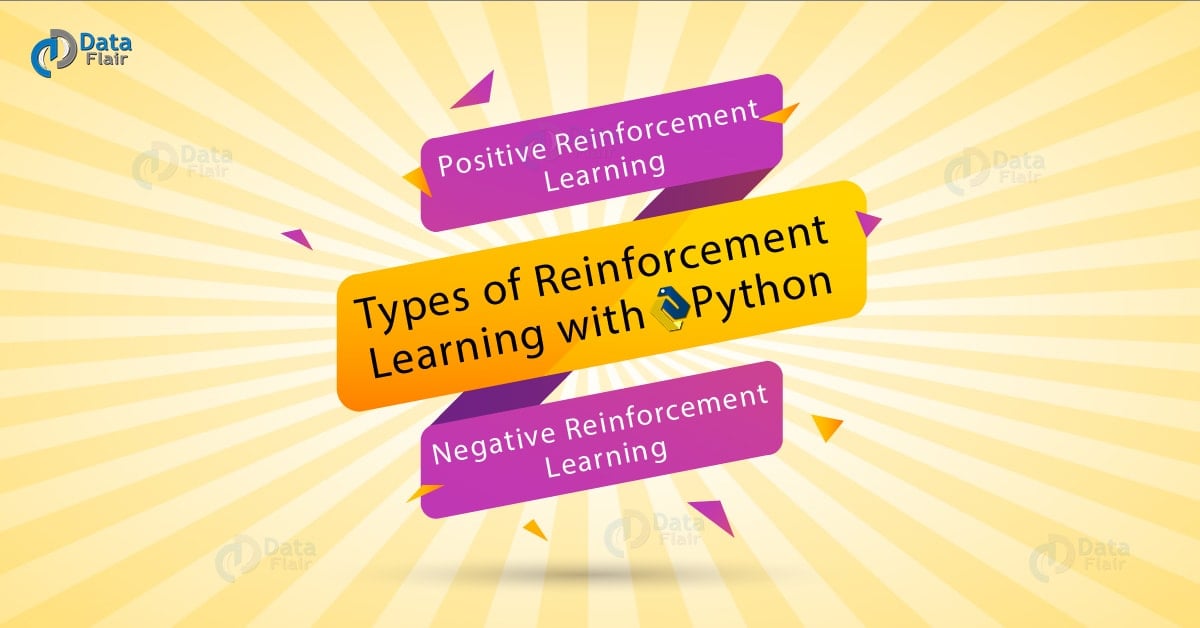
Types of Reinforcement Learning
a. Positive Reinforcement Learning
Whenever certain behavior sets off an event, this strengthens the behavior and reduces its infrequency. Say it affects the behavior positively. This has the following benefits:
- Optimization of performance
- Sustenance of change for long
It also faces an issue:
- Too much reinforcement may overload the state and lead to diminished results
b. Negative Reinforcement Learning
If we stop a negative condition, this strengthens the behavior leading to it. This is negative reinforcement and it has the following advantages:
- Provision of defiance to the minimum performance standard
- Improvement of behavior
And like positive reinforcement learning, this has a disadvantage too:
- There is only enough to meet the minimum expected behavior
Reinforced Learning vs Supervised Learning
We mentioned in section 2 that these are two different things. Now let’s see how.
Reinforced Learning vs Supervised Learning
a. Decision Making
Reinforcement learning is concerned with making decisions sequentially. So, the output depends on the current input and the next input depends on the output of the previous input.
Supervised learning, however, involves making all decisions on the initial input.
b. Dependency and Labels
Decisions depend on each other in reinforcement learning. Hence, we assign labels to sequences of dependent decisions. In supervised learning, decisions are exclusive of each other, which lets us assign labels to each decision.
c. Examples
An example of reinforcement learning can be a game of Chess, and for supervised learning can be object recognition. (See, that’s a cat. Now, look at this picture [of another cat]. Can you guess what this is?)
Applications of Reinforcement Learning
This kind of learning, as you would have guessed by now, finds use in an array of use-cases:
- Robotics– for industrial automation
- Machine Learning– for data processing
- Creation of training systems providing custom instruction and materials according to the requirements of students
In situations where the system must interact with its environment to collect information about it, RL techniques do great.
Reinforcement Learning With Python Example
Before we bid goodbye, we think we should demonstrate a simple learning agent using Python. In the following example, we implement a cartpole using the gym package and watch it learn to balance itself:
>>> import gym
>>> env=gym.make('CartPole-v0')
[33mWARN: gym.spaces.Box autodetected dtype as <class ‘numpy.float32’>. Please provide explicit dtype.[0m
>>> env.reset()
array([ 0.00261226, -0.02941416, 0.01968586, -0.0034146 ])
>>> for _ in range(1000):
env.render()
env.step(env.action_space.sample())
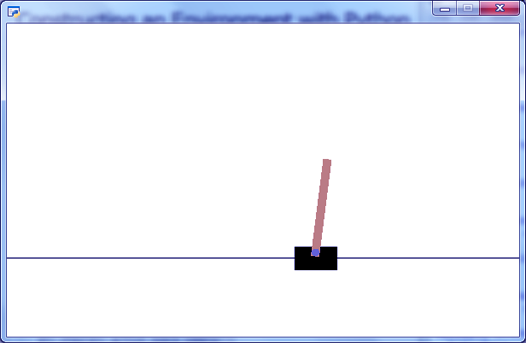
Reinforcement Learning With Python Example
So, this was all in Reinforcement Learning with Python. Hope you like our explanation.
Conclusion
Hence, in this Python AI Tutorial, we discussed the meaning of Reinforcement Learning. Moreover, we saw types and factors of Reinforcement learning with Python. Also, we understood the concept of Reinforcement Learning with Python by an example.
Furthermore, if you feel any confusion regarding Reinforcement Learning Python, ask in the comment tab.