


Master Python with 70+ Hands-on Projects and Get Job-ready - Learn Python
If your mission with Python is to develop for the Web, Python will help you with that with its range of frameworks.
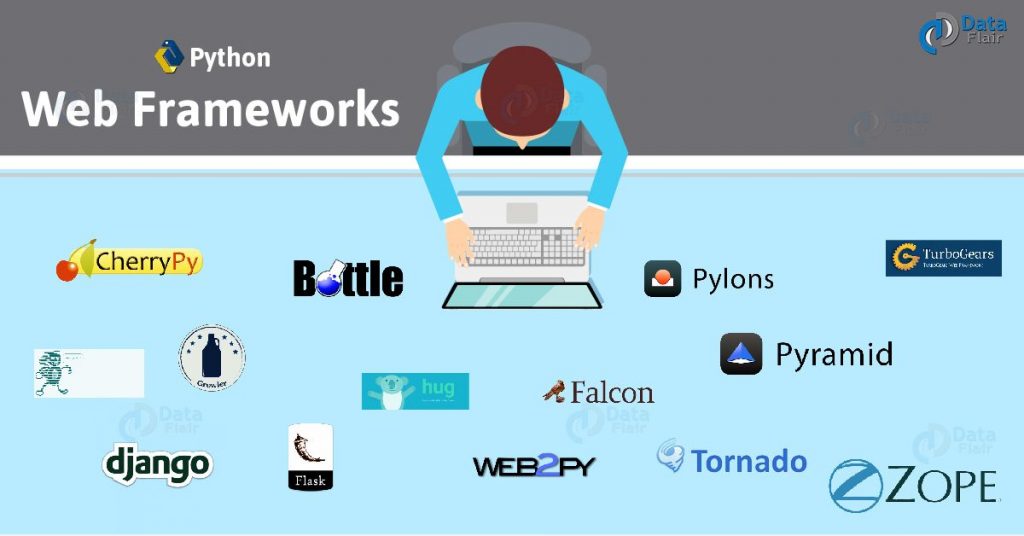
Today in Python Web Framework tutorial, we will briefly discuss Web Frameworks offered by Python Programming Langauge: Full-Stack Frameworks in Python, and Non- Full-Stack Frameworks in Python.
So, let’s talk about Python Web Framework Tutorial.
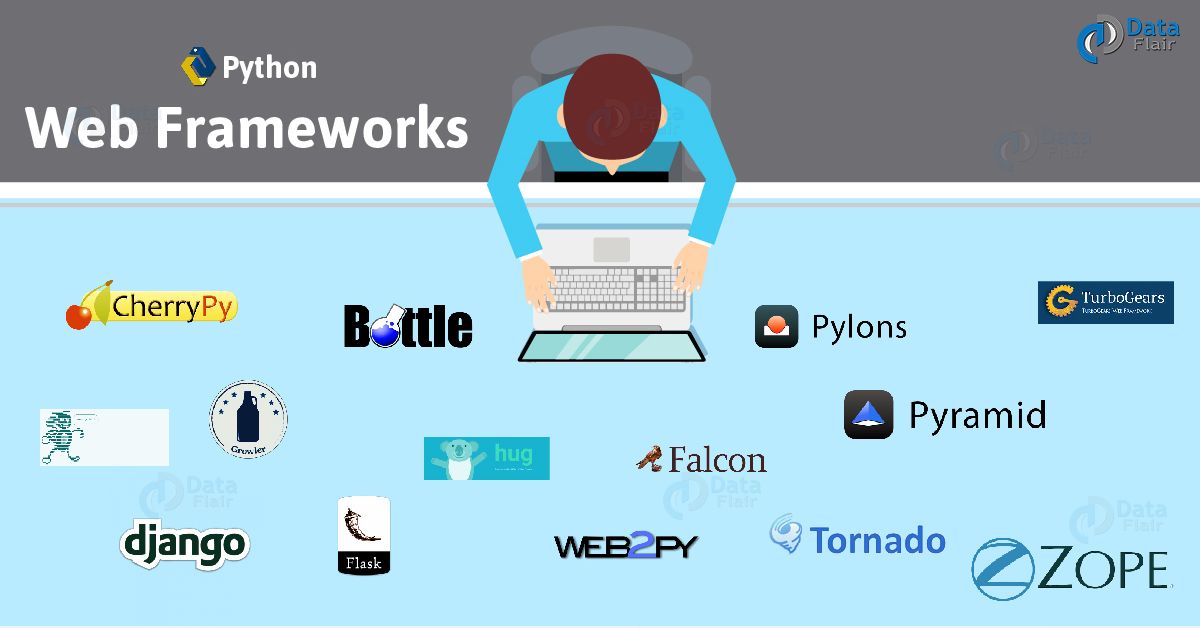
Python Web Framework – A Detailed List of Web Frameworks in Python
What is a Python Web Framework?
A Python Web framework is a collection of packages or modules that allow developers to write Web applications or services.
With it, developers don’t need to handle low-level details like protocols, sockets, or process/thread management.
Python web framework will help you with:
- Interpreting requests (getting form parameters, handling cookies and sessions, etc.)
- Producing responses (presenting data as HTML or in other formats,…)
- Storing data persistently (and other things)
Now, let’s look at the most useful and famous Python web framework to help you with Web development.
Python Full-Stack Frameworks
A full-stack framework in Python attempts to provide a complete solution for applications.
It attempts to supply components for each layer in the stack.
1. Python Django
Django Python is a framework for perfectionists with deadlines. With it, you can build better Web apps in much less time and in less code.
Django is known for how it focuses on automating. It also believes in the DRY (Don’t Repeat Yourself) principle. Django was originally developed for content-management systems, but is now used for many kinds of web applications.
This is because of its templating, automatic database generation, DB access layer, and automatic admin interface generation. It also provides a web server for development use.
Giant companies that use Django Python are- Instagram, Pinterest, Disqus, Mozilla, The Washington Times, and Bitbucket. In fact, when we think of the terms ‘framework’ and ‘Python’, the first thing that comes to our minds is Django.
We will see more on Django in another lesson.
2. TurboGears in Python
Python TurboGears – Python Web Framework
With TurboGears, you can create a database-driven, ready-to-extend application in just a few minutes.
- It is an MVC web framework with ORM, with real multi-database support and support for horizontal data partitioning.
- It also has a widget system to simplify the development of AJAX apps. You may additionally install its template engine Kajiki.
- TurboGears is a microframework and a full-stack solution. Its PyPI package is called tg.devtools.
3. web2py in Python

Python Web Framework – Python web2py
With web2py, you can develop, deploy, debug, test, administer the database, and maintain applications via the provided web interface.
It has no configuration files, and you can even run it off a USB drive.
web2py uses the MVC built-in ticketing system to manage errors.
4. CubicWeb in Python
CubicWeb is a semantic web application framework that features a query language and a selection+view mechanism. It also features multiple databases, security, workflows, and reusable components.
Functions of CubicWeb in the Python framework:
- It supports OWL & RDF.
- Relationship Query Language ( RQL) is used to make data queries easier.
- Migration tool: It fits into agile development.
- The engine sets the best view to make the content fit according to the display of the context.
5. Django-hotsauce in Python
Django-hotsauce is a general-purpose web toolkit that sits on top of Django and other frameworks. It is an interactive Pythonic API that will let you create scalable web applications using the WSGI 1.0 spec.
It also provides native bindings for the Schevo DBMS, Durus, ZODB, and Authkit projects.
6. Giotto in Python
A strict MVC framework that strictly separates Model, View, and Controller elements, Giotto makes sure that designers, Web developers, and sysadmins can work independently.
It also includes controller modules that allow you to build applications on top of the web, IRC, or the command line.
These are all the most popular Python web frameworks.
7. Grok in Python
Grok was built on the existing Zope 3 libraries.
It aims to provide an easier learning curve and a more agile development experience by emphasizing on convention over configuration and DRY (Don’t Repeat Yourself).
8. Pylons in Python
Python Web Framework – Python Pylons
Pylons is a lightweight Web framework aiming at flexibility and rapid development. With the best ideas from Ruby, Python, and Perl, it makes for a structured, but extremely flexible Python Web framework.
With Pylons, Web development is fast, flexible, and easy. Pylons are built on top of Paste. But after being merged with Pyramid to form the Pylons project, it is in maintenance-only status.
9. Reahl in Python
You can use Reahl to develop web applications in pure Python. However, you may use, customize, or compose widgets in usual Python code.
These widgets portray certain server-side and client-side behaviors.
10. wheezy.web in Python
Wheezy is a lightweight, high-performance, and high-concurrency WSGI web framework.
Its key features include routing, model update/validation, authentication/authorization, content caching with dependency, middleware, and more.
With these, we can build a modern, efficient web.
11. Zope2 in Python
Python Web Framework – Python Zope
Zope2 is rightly the granddaddy of Python web frameworks; it has been a family of networks. It is a web framework and a general-purpose application server.
Today, it is primarily used for CMS. We also have Zope3, which is a standalone framework and a collection of related libraries.
12. Tornado in Python

Python Web Framework – Tornado
While Tornado isn’t that famous, it is great with non-blocking I/O. You can scale it to handle tens of thousands of open connections.
It makes for a perfect framework for long polling, WebSockets, and other usages needing a continuous connection.
Officially, Tornado only supports Linux and BSD OS (Windows and Mac OS X- only for development).
Tornado finds its origin in the FriendFeed project, which now belongs to Facebook.
Non-Full-Stack Frameworks in Python
A Python non-full-stack framework will provide the base application server. This either runs as its own independent process, upon Apache, or in other environments.
Let’s look at the most popular ones.
1. Python Bottle
Bottle is a simple and fast microframework that you can use to create small Web applications.
It provides request-dispatching routes with URL-parameter support, templates, key/value databases, and a built-in HTTP server. It also offers adapters for third-party WSGI/HTTP servers and template engines.
This is all in a single file; there are no dependencies except the Python Standard Library.
2. CherryPy in Python
Python Web Framework – Python CherryPy
It is a Pythonic, object-oriented HTTP framework.
A web application powered by CherryPy is a standalone Python application that embeds its own multi-threaded web server.
In a way, CherryPy is a way between the programmer and the problem. It also supports various web servers like Apache, IIS, and so.
CherryPy will let you launch multiple HTTP servers at once.
3. Python Flask
Python Web Framework – Python Flask
Like we’ve said before, Flask is a microframework for Python. It includes a built-in development server and unit-testing support.
It is also fully Unicode-enabled with RESTful request-dispatching and WSGI compliance. Flask will be useful when you want to develop small, simple applications.
With it, you can operate your database however you like- using SQLAlchemy or whatever. A good Flask example is it is used by LinkedIn and Pinterest.
4. Hug in Python
Python Web Framework – Python Hug
Hug is among the fastest web frameworks for Python. With it, you can build APIs. It supports several API versions, automatic API documentation, and annotation-powered validation.
It is built on top of another JSON framework, Falcon.
5. Pyramid in Python
Python Web Framework – pyramid-positive
Unlike a few that we discussed so far, Pyramid is a framework for large applications.
It is flexible; a Pyramid web application starts from a single-file module and evolves into an ambitious project.
You can say that it makes real-world Web application development and deployment more fun, predictable, and productive.
Actually, Pyramid is a Pylons project.
6. Albatross in Python
It is a small, flexible Python toolkit that lets you develop highly stateful Web applications.
Albatross deploys to CGI, FastCGI, and ModPython servers.
7. Circuits in Python
Circuits is much like CherryPy, but it is a highly efficient web framework for developing standalone multiprocess applications.
It supports concurrency, asynchronous I/O components, and is event-driven.
8. Falcon in Python

Python Web Framework – Python Falcon
A microframework for small applications, app backends, and higher-level frameworks, Falcon encourages to follow the concept of REST.
It is among the fastest web frameworks for Python and is used by EMC, Hurricane Electric, OpenStack, Opera Software, Wargaming, and others.
9. Growler in Python
Python Web Framework – Python Growler
Growler is built on top of asyncio and is inspired by Connect and Express frameworks for Node.js.
If you want ORM or templating, you must install it manually. It handles requests by passing through a middleware chain.
10. MorePath in Python
MorePath is a flexible, model-driven web framework. It supports REST and focuses on reusability and extensibility.
11. Pycnic in Python
Pycnic is among the fastest web frameworks for Python for developing JSON APIs. The framework is object-oriented and optimized for JSON APIs.
It only includes tools for creating Web APIs that leave a lighter footprint.
12. Sanic in Python
Python Web Framework – Python Sanic
Sanic is a Flask-like framework, but it is fast. It supports asynchronous request handlers, and makes code non-blocking and speedy
So, this was all about Python Web Framework Tutorial. Hope you like our explanation.
Python Interview Questions on Web Frameworks
- What are Python Web Frameworks?
- How many frameworks are there in Python?
- Why are Python frameworks needed?
- Is PyCharm a framework in Python?
- What are the benefits of using Python frameworks?
Conclusion
So, these are the most famous Python web frameworks for Python Web development.
How do you like the Python web development frameworks? Tell us, which one is your favourite?