


Machine Learning courses with 110+ Real-time projects Start Now!!
Master Python with 70+ Hands-on Projects and Get Job-ready - Learn Python
Today, in this Python AI Tutorial, we will take on an introduction to Artificial Intelligence. Moreover, in this Artificial Intelligence Programming, we will see AI Problems, Tools in AI, and Artificial Intelligence approaches.
Python is one of the best languages to learn for Artificial Intelligence. It is easy to write, understand, and use. That is why many companies and researchers use Python for AI projects. Python comes with many libraries that help in AI tasks like data handling, machine learning, and deep learning. These libraries make it simple to create smart programs that can think and learn.
So, let’s start the Python AI Tutorial.
What is Artificial Intelligence?
Artificial Intelligence, often dubbed AI, is the intelligence a machine demonstrates. With machine intelligence, it is possible to give a device the ability to discern its environment and act to maximize its chances of success in achieving its goals.
In other words, AI is when a machine can mimic cognitive functions like learning and problem-solving.
“AI is whatever hasn’t been done yet.”
As we said, an AI takes in its environment and acts to maximize its chances of success in achieving its goals. A goal can be simple or complex, explicit or implicit. It is also true that many algorithms in AI can learn from data, learn new heuristics to improve, and write other algorithms.
Advantages of Artificial Intelligence:
- AI smoothens the workflow and reduces human mistakes.
- It provides a personalized experience to the users by analysing their user history.
- AI can work continuously without taking a rest and provide the users with 24/7 customer support.
- It has the ability to analyse large datasets, which helps in making data-driven decision-making easier.
Problems in AI
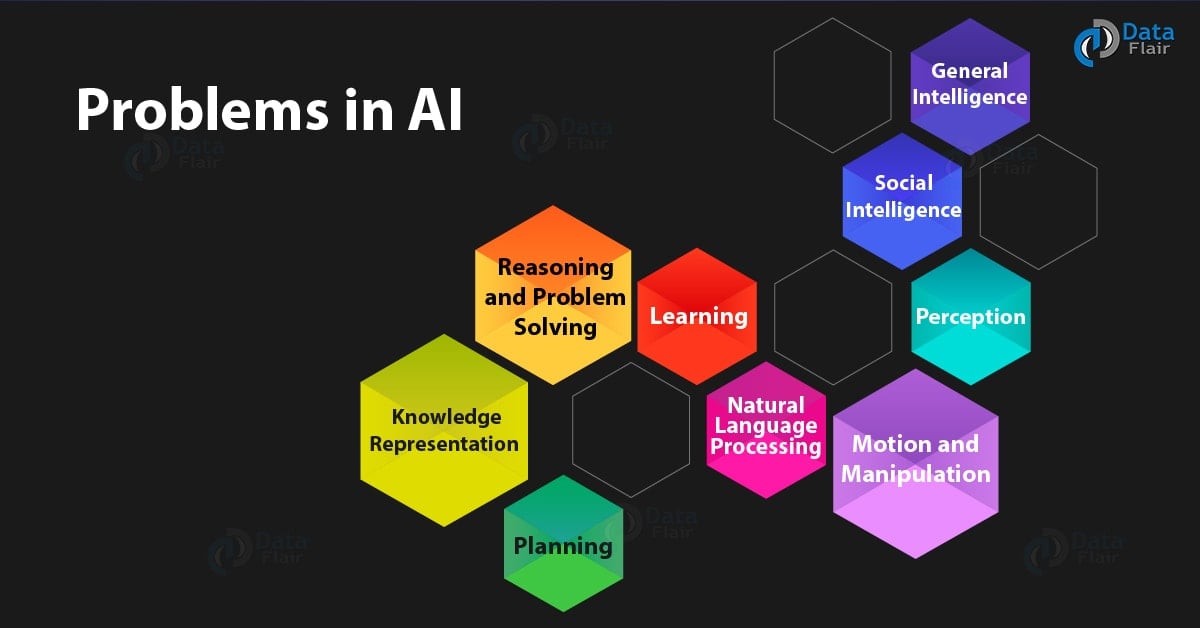
When simulating or creating AI, we may run into problems around the following traits-
Python AI Tutorial – AI Problems
a. Reasoning and Problem Solving
Earlier, algorithms mimicked step-by-step reasoning that humans display. AI research later introduced methods to work with incomplete and uncertain information.
However, as the problems grew larger, these algorithms became exponentially slower. Humans often use fast, intuitive judgments instead of a step-by-step deduction.
b. Knowledge Representation
Some expert systems accumulate esoteric knowledge from experts. A comprehensive commonsense knowledge base holds many things, including objects, properties, categories, relations between objects, situations, events, states, time, causes, effects, knowledge about knowledge, and other domains.
When we talk about ontology, we talk about what exists. Under knowledge representation, we observe the following domains-
- Default reasoning; Qualification problem
- The breadth of commonsense knowledge
- The subsymbolic form of some commonsense knowledge
c. Planning
An intelligent agent should be capable of setting goals, achieving them, and visualizing the future. Assuming it is the only system in the world, an agent can be certain of their actions’ consequences. If there are more actors, the agent should be able to reason under uncertainty.
For this, it should be able to assess its environment, make predictions, evaluate predictions, and adapt according to its assessment. With multi-agent planning, we observe multiple agents cooperate and compete to achieve a goal.
d. Learning
AI is related to Machine Learning in some way. We have often talked about unsupervised learning- the ability to take a stream of input and find patterns in it. This includes classification and numerical regression.
We classify things and produce a function that describes how inputs and outputs relate and change each other. These are function approximators.
e. Natural Language Processing
NLP is an area of Computer Science that gives machines the ability to read human language and understand it. With it, we can retrieve information, mine text, answer questions, and translate using machines. We use strategies like keyword spotting and lexical affinity.
f. Perception
With machine perception, we can take input from sensors like cameras, microphones, and lidar to recognize objects. We can use it for applications like speech recognition, facial recognition, and object recognition. We can also analyze visual input with Computer Vision.
g. Motion and Manipulation
With AI, we can develop advanced robotic arms and more for modern factories. These can use the experience to learn to deal with friction and gear slippage. The term Motion Planning means dividing a task into primitives, like individual joint movements.
h. Social Intelligence
“Should I go to bed, Siri?” I ask as I reach home from a busy day. “I think you should sleep on it”, Siri quips back. Affective Computing, an umbrella term, encompasses systems that can recognize, interpret, process, or simulate human affects/ emotions.
In this domain, we have observed textual sentiment analysis and multimodal affect analysis. The aim is to allow AI to understand others’ motives and emotional states to predict their actions.
It can mimic human emotions and expressions to appear sensitive and interact with humans. A robot with rudimentary social skills is Kismet, developed at MIT by Dr. Cynthia Breazeal.
i. General Intelligence
Lately, many AI researchers have begun working on tractable narrow AI applications such as medical diagnosis. The future could hold machines with Artificial General Intelligence(AGI) that combine such narrow skills. Google’s DeepMind will be an example of this.
Approaches to Artificial Intelligence
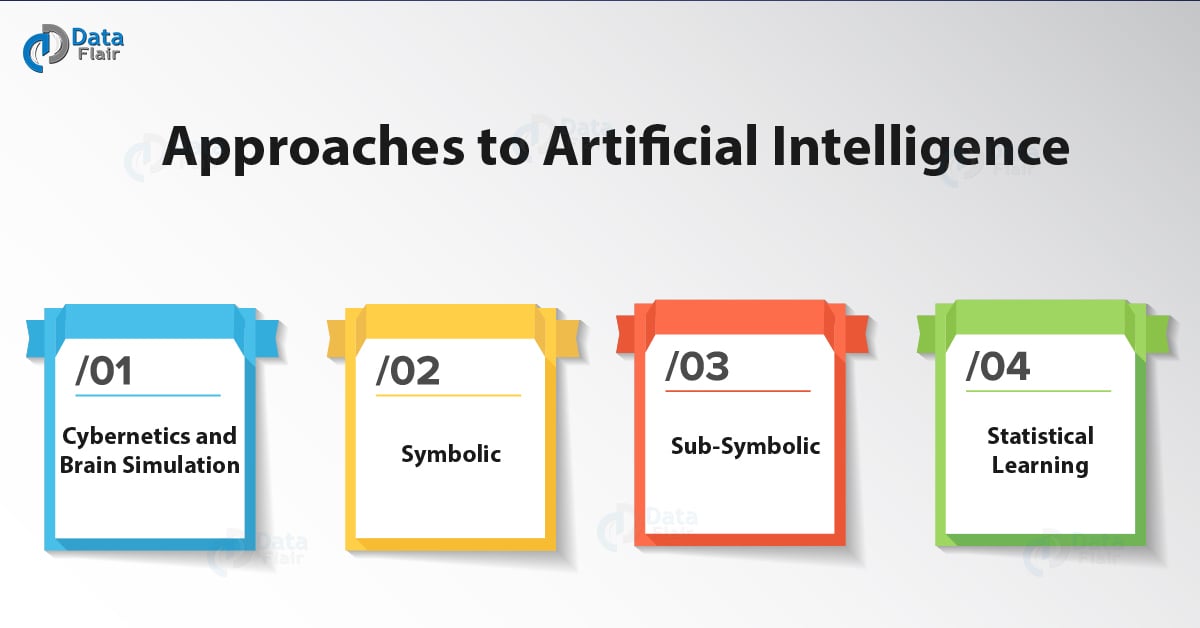
We observe four different approaches to AI-
Python AI Tutorial – Approaches
1. Cybernetics and Brain Simulation
Some machines exist that use electronic networks to display rudimentary intelligence.
2. Symbolic
This approach considers reducing human intelligence to symbolic manipulation. This includes cognitive simulation, logic-based, anti-logic or scruffy, and knowledge-based approaches.
3. Sub-Symbolic
For processes of human cognition like perception, robotics, learning, and pattern recognition, sub-symbolic approaches came into the picture. This includes approaches like embodied intelligence, computational intelligence, and soft computing.
4. Statistical Learning
Statistical learning techniques like HMM and neural networks deliver better accuracy in practical domains like data mining. Limitations of HMM include that it cannot model the infinite possible combinations of natural language.
Artificial Intelligence Tools
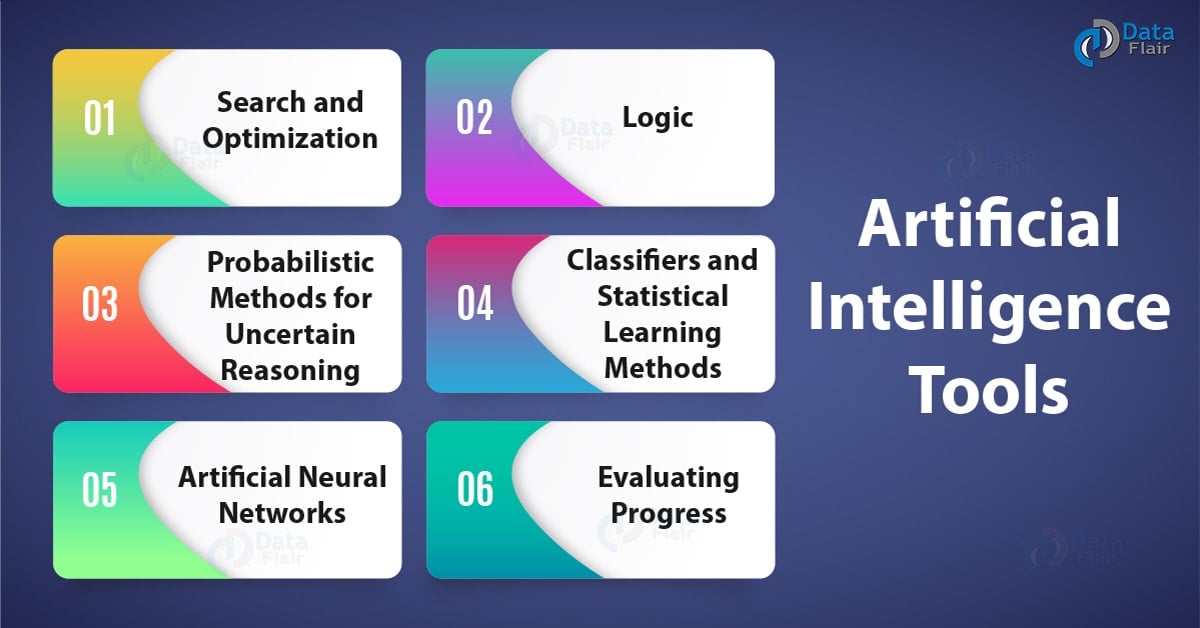
In this section of the Python AI Tutorial, we will study the different tools used in Artificial Intelligence:
Python AI Tutorial – Artificial Intelligence Tools
1. Search and Optimization
To intelligently search through possible solutions and use reasoning to do so is a tool for AI. For real-world problems, simple exhaustive searches rarely suffice.
This is because these have really large search spaces. This leads to a slow search or one that never ends. To get around this, we can use heuristics.
2. Logic
AI research uses different forms of logic. Propositional logics use truth functions like ‘or’ and ‘not’. The fuzzy set theory holds a degree of truth (values between 0 and 1) for vague statements. First-order logic adds quantifiers and predicates. Fuzzy logic helps with control systems to contribute vague rules.
3. Probabilistic Methods for Uncertain Reasoning
We often use tools like Bayesian networks for reasoning, learning, planning, and perception. We can also use probabilistic algorithms to filter, predict, smooth, and explain streams of data.
4. Classifiers and Statistical Learning Methods
Classifiers and controllers work together. Consider an object. If it is shiny, the classifier knows it is a diamond. If it is shiny, the controller picks it up. But before inferring an action, a controller classifies conditions.
As a function, a classifier matches patterns to find the closest match. Supervised learning puts each pattern into a predefined class.
5. Artificial Neural Networks
ANNs are collections of nodes that are interconnected- inspired by the huge network of neurons in the human brain.
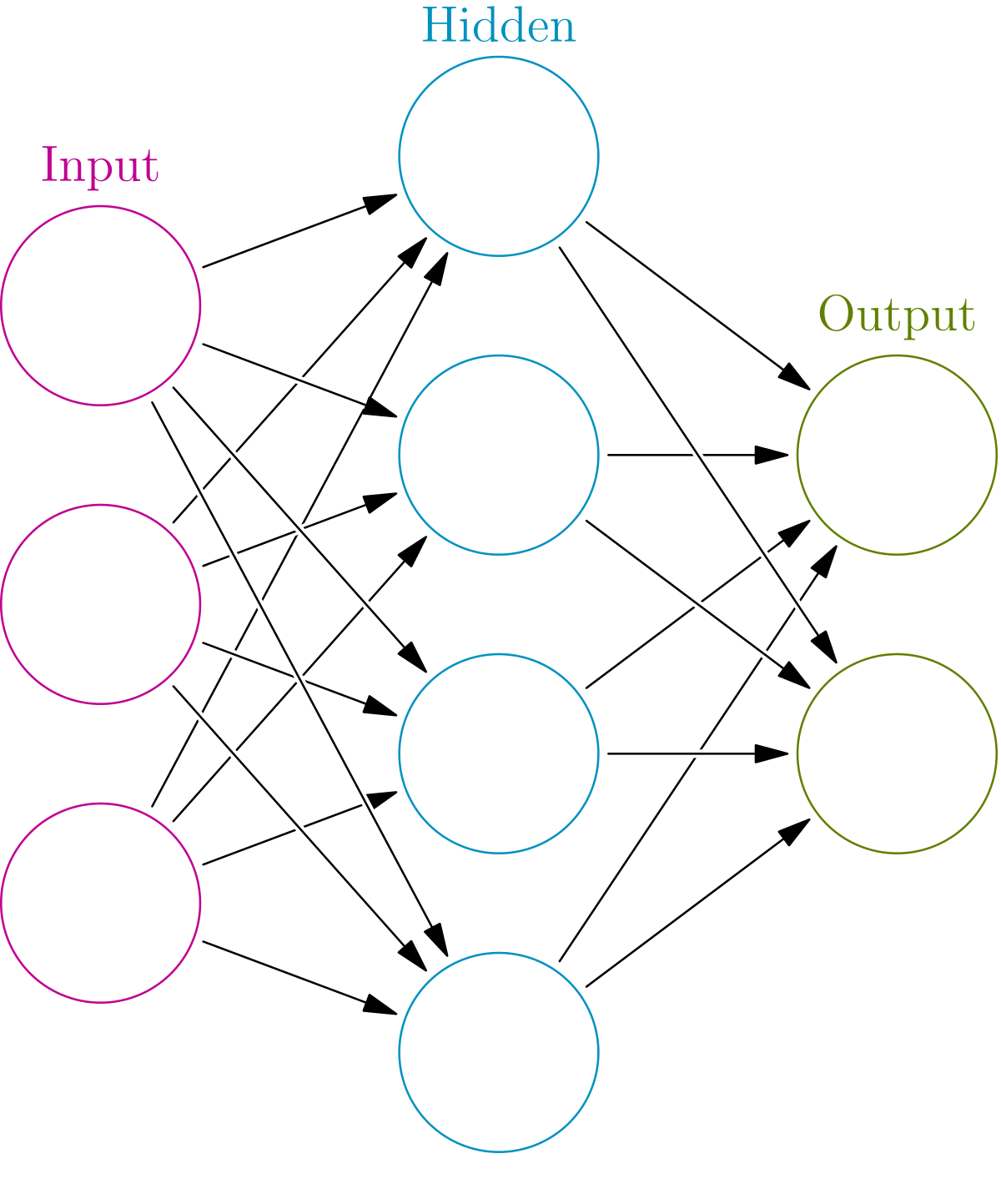
Python AI Tutorial – Artificial Neural Networks
Under these, we have categories like feedforward neural networks and recurrent neural networks. We will take up ANNs as a separate topic in another tutorial.
6. Evaluating Progress
Since AI is general-purpose, there is no way to find out which domains it excels in. Games are a good benchmark to assess progress. Some of these include AlphaGo and StarCraft.
Applications of Artificial Intelligence
As we said, AI is pretty general-purpose. Here are a few domains it finds use in-
- Automotive
- Healthcare
- Video games
- Military
- Finance and Economics
- Art
- Auditing
- Advertising
- Smart Homes
So, this was all in the Python AI Tutorial. Hope you like our explanation.
Conclusion
Hence, in this Python AI Tutorial, we learned about artificial intelligence. We talked about its problems, approaches, tools, and applications. That’s all for today; we’ll be back with more. Tell us about your experience of the Python AI Tutorial in the comments.