


Machine Learning courses with 110+ Real-time projects Start Now!!
Master Python with 70+ Hands-on Projects and Get Job-ready - Learn Python
Today, in our journey of Artificial Intelligence with Python, we will discuss NLP Tutorial, we will discuss the rudiments of Natural Language Processing. We will start our NLP tutorial with NLP definition and a brief introduction.
Then, we will move towards components, libraries, and benefits of natural processing language. Also, we will discuss Natural Language Processing Applications, NLP examples, and tools.
So, let’s start NLP Tutorial.
Introduction to Natural Language Processing
Natural Language Processing (NLP) is a part of AI that helps machines understand human language. Python is very useful in NLP because it has libraries like NLTK, spaCy, and TextBlob. These tools allow your program to read, analyze, and understand text and speech. With Python, you can build applications like chatbots, translators, and search engines that talk like humans.
This faces some challenges like speech recognition, natural language understanding, and natural language generation.
Let’s have a look at the Python AI Tutorial
Well, NLP is all about developing applications and services that can understand human languages.
What is NLP?
In layman terms, NLP is a way for computers to analyze human language and derive useful meaning from it. It lets you organize and structure knowledge to let you perform the following tasks-
- Automatic Summarization
- Translation
- Named Entity Recognition
- Relationship Extraction
- Sentiment Analysis
- Speech Recognition
- Topic Segmentation
NLP analyzes text and allows machines to understand how we speak. It considers the hierarchical structure of language and performs tasks like correcting the grammar, converting speech to text, and translating between languages. In computer science, it is a hard problem.
“What do words mean, how do they link together, and what meaning do they make?”
The greatest challenge to NLP is to accurately judge the intention of words, keeping in mind the ambiguity of the language.
Components of NLP
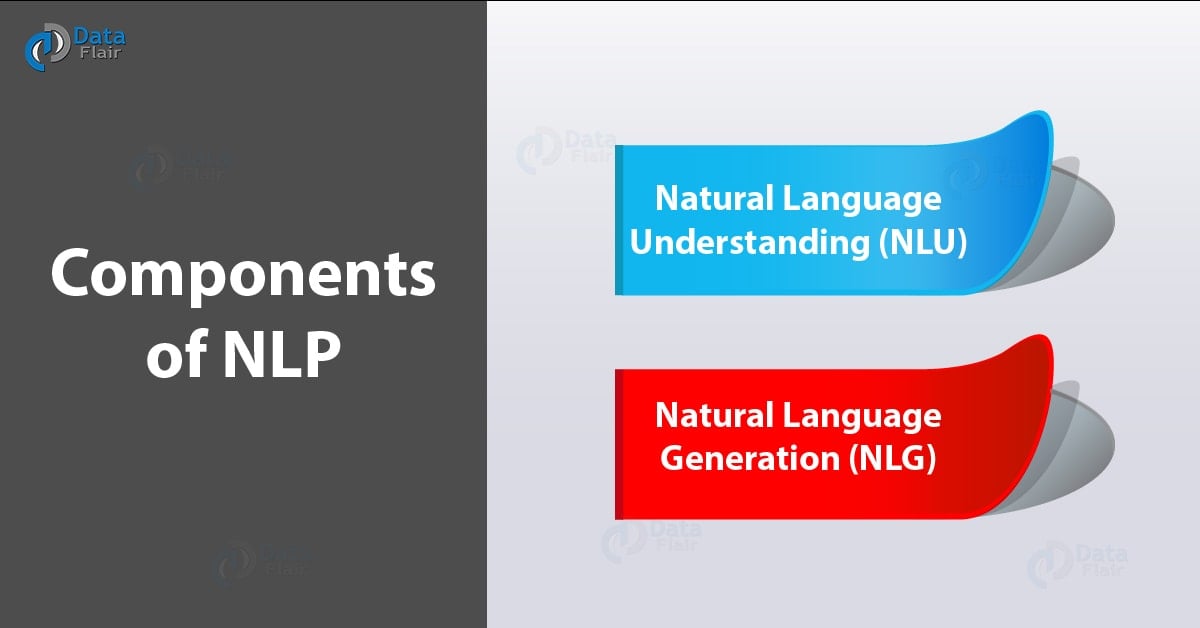
While talking of NLP in this Tutorial, we come across two main Components of NLP-
NLP Tutorial – Components of NLP
a. Natural Language Understanding (NLU)
Natural Language Understanding revolves around machine reading comprehension. This is an AI-hard problem. An NLU system needs the following components-
- Lexicon, Parser, and Grammar rules.
- Semantic theory- to guide comprehension.
b. Natural Language Generation (NLG)
NLG is concerned with generating natural language. It uses a machine representation system like a knowledge base or a logical form. You can think of it as a translator between data and natural language representation; this is the opposite or NLU. This involves three tasks-
- Text Planning- To extract relevant content from the knowledge base.
- Sentence Planning- To choose appropriate words, form meaningful phrases, and set sentence tone.
- Text Realization- To map the sentence plan into sentence structure.
Benefits of NLP in Python
Among the numerous benefits of NLP, here we list out a few-
- To improve the efficiency of the documentation process.
- NLP is used to improve the accuracy of the documentation process.
- To identify pertinent information from large databases.
Together with Machine Learning, we don’t need to hand-code large sets of rules.
Libraries for NLP
Many open-source libraries let us work with Natural Language Programming. Some of those are-
- Natural Language ToolKit (NLTK)- Written in Python; allows modules for processing text, classifying, tokenizing, stemming, parsing, tagging, and more.
- Apache OpenNLP- Machine Learning toolkit; allows for tokenizers, sentence segmentation, part-of-speech tagging, chunking, parsing, named entity extraction, and more.
- Stanford NLP Suite- Tools for part-of-speech tagging, named entity recognizer, sentiment analysis, conference resolution system, and more.
- Gate NLP Library.
- MALLET- Java package for latent dirichlet allocation, clustering, topic modeling, information extraction, document classification, and more.
Glossary in NLP
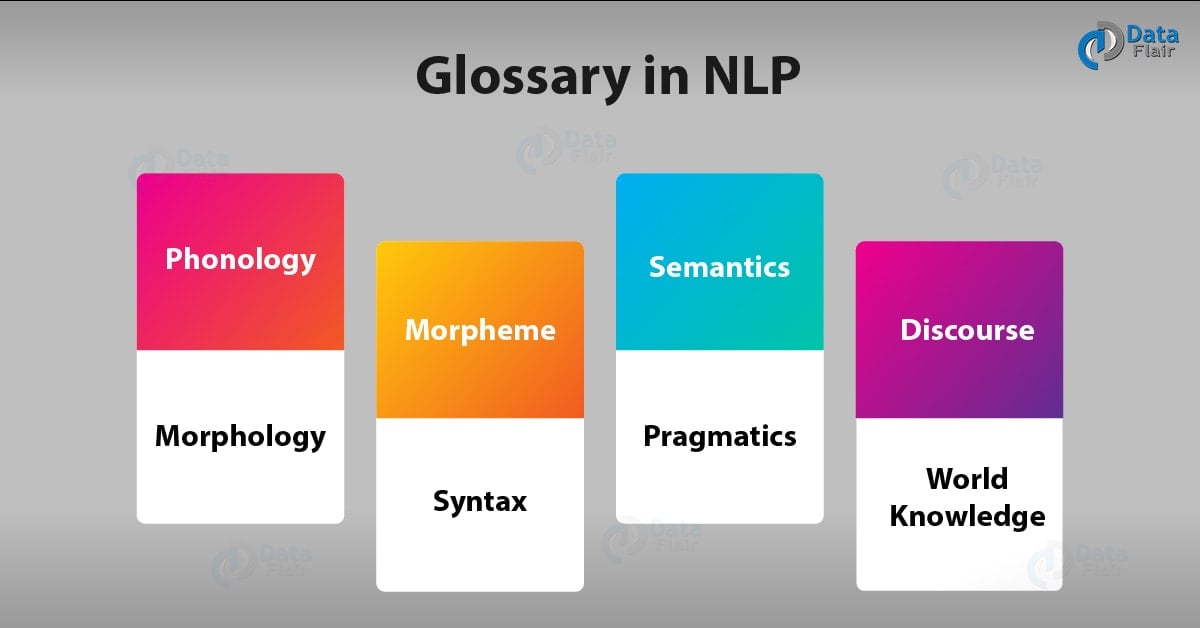
Talking of NLP, we talk:
NLP Tutorial – Glossary in NLP
a. Phonology
Study of organizing sound systematically.
b. Morphology
Study of constructing words from primitive meaningful units.
c. Morpheme
Primitive unit of meaning in a language.
d. Syntax
Arranging words to form a sentence; determining the structural role of words in sentences and phrases.
e. Semantics
Studying the meanings of words and combining them to make meaningful phrases and sentences.
f. Pragmatics
Using and understanding sentences in various situations; determining how this affects sentence interpretation.
g. Discourse
Understanding how a sentence can affect the next.
h. World Knowledge
General knowledge about the world.
Tasks in NLP
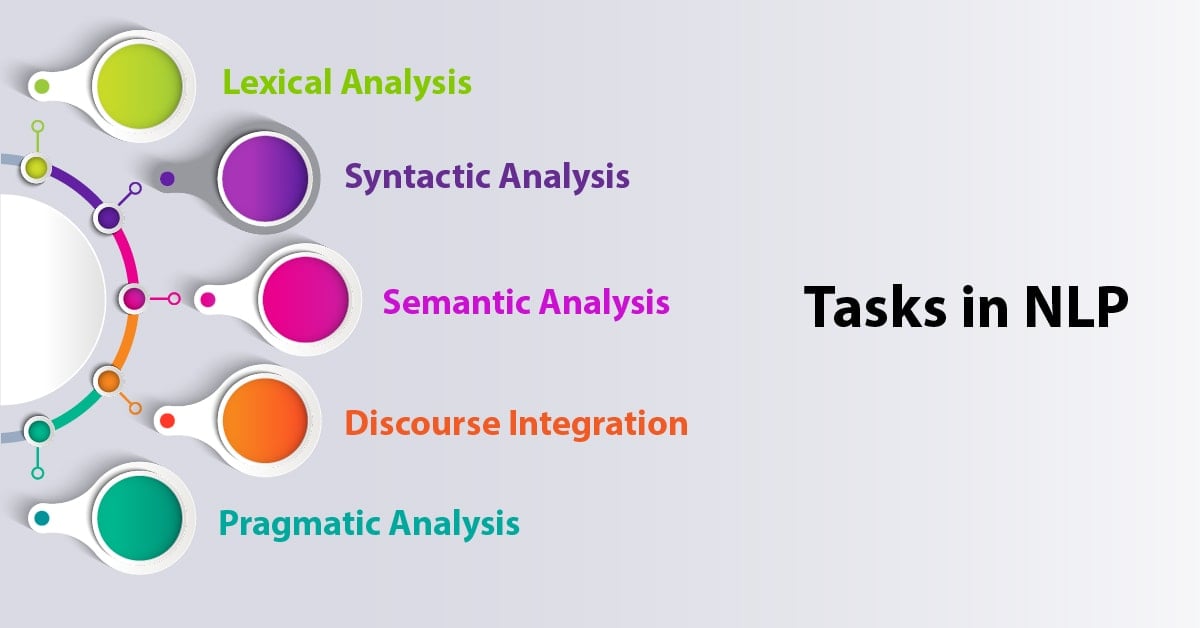
With Natural Language Processing, we carry out five different tasks-
NLP Tutorial – Tasks in NLP
a. Lexical Analysis
Lexical analysis deals with identifying and analyzing word structure. We divide the whole chunk of text into paragraphs, sentences, and words.
b. Syntactic Analysis
Also called parsing, it involves analyzing words in sentences for grammar and rearranging them to determine how they relate to each other. It rejects sentences like “The apple eats the girl”.
c. Semantic Analysis
This deals with extracting the dictionary meanings from text. It also maps syntactic structures and objects in the task domain to check for meaningfulness. It rejects statements like “tall stub”.
d. Discourse Integration
It analyzes the previous sentence to guess the meaning of the current sentence and the one after it.
e. Pragmatic Analysis
This reinterprets the statement to ensure it correctly determines what the statement means. It tries to retrieve aspects of the language that require knowledge of the real world.
NLP in Python Applications
With NLP, we can do the following-
- Summarizing blocks of text.
- Creating chatbots.
- Machine translation.
- Fighting spam.
- Extracting information.
- Automatically generating keyword tags.
- Identifying types of entities extracted.
- Identifying the sentiment of a string with sentiment analysis.
- Reducing words to their roots.
- Summarizing.
- Question-answering.
- Customer service.
- Market analysis.
So, this was all in the NLP Tutorial. Hope you like our explanation of Natural Processing Language.
Conclusion
Text is everywhere, but NLP gives you the ‘superpower’ to analyze thousands of documents in just seconds. By learning these basics, you’re teaching your computers to build a bridge between humans and the machine code.
And with this, we conclude our introduction to Natural Language Processing with Python. In this Natural Language Processing Tutorial, we discussed NLP Definition, AI natural language processing, and examples of NLP.
Moreover, we talked about its fundamentals, components, benefits, libraries, terminologies, tasks, and applications. Next, we will demonstrate the use of NLTK to implement NLP with Python. Still, if any doubt regarding the NLP Tutorial, ask in the comments tab.