


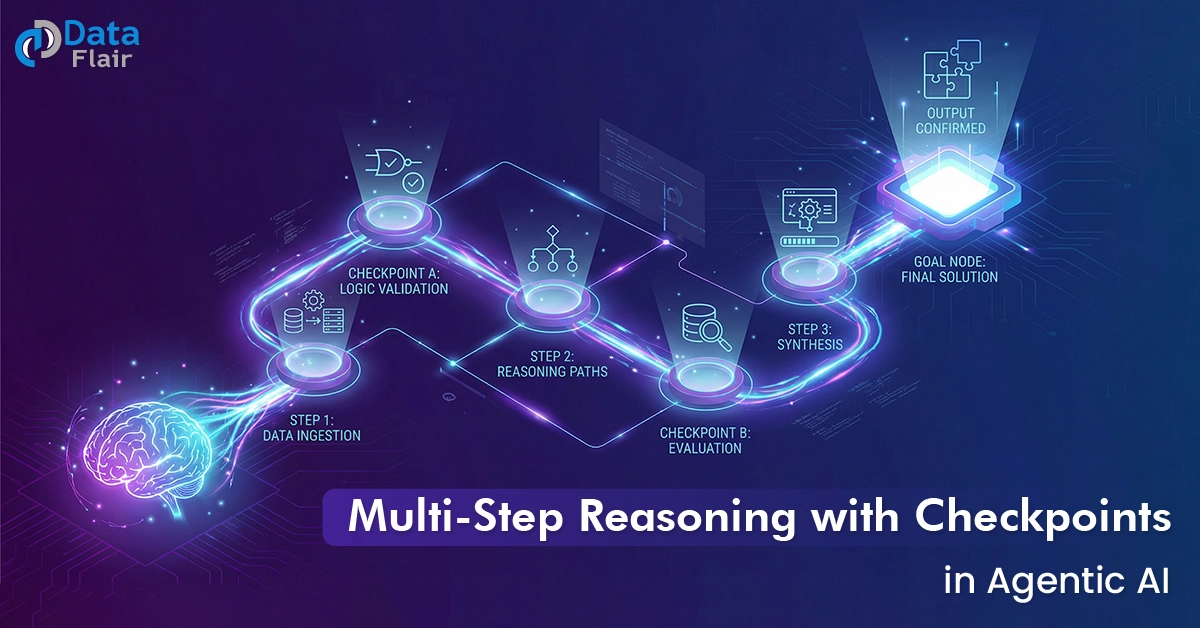
AI agents generally deal with problems that cannot be solved all at once. Whether they’re working on math proofs or planning business strategies, they have to break problems into smaller steps and handle them one at a time.
But here’s the catch: if an error occurs early in the chain, the entire reasoning process may collapse. That’s why checkpoints are essential. Checkpoints in Agentic AI act like save points in reasoning, allowing agents to pause, review, and correct themselves before moving forward.
This method is known as multi-step reasoning with checkpoints in AI — a crucial capability in modern Agentic AI.
What Is Multi-Step Reasoning in Agentic AI?
Multi-step reasoning is when an AI agent solves problems step by step, rather than giving an immediate, direct answer.
- Analogy: Like simplifying a long equation by going through each part carefully and solving it step-by-step.
- Goal: Breaking down complex tasks into smaller, logical steps for better accuracy.
Example
“How much is 12 × (5 + 3)?”
1. Inside parentheses: 5 + 3 = 8
2. Multiply: 12 × 8 = 96
3. Final Answer = 96
Each step builds on the last, ensuring clarity.
What Are Checkpoints in Reasoning for Agentic AI Agents?
Checkpoints are in between stopping points where the agent:
- Analyse what it has done so far.
- Review correctness.
- Choose whether to continue, go back, or make any changes.
Analogy: It’s similar to saving your progress in a video game, so you can restart if something goes wrong.
Goal: Prevent minor errors from derailing the entire reasoning chain.
How AI Multi-Step Reasoning with Checkpoints Works
1. Task Initiation: User gives a complex request.
2. Step Decomposition: Agent breaks it into smaller steps.
3. Checkpoint Review: After completing a step, the agent validates the result.
4. Correction (if needed): If an error is detected, the agent revises before moving forward.
5. Final Integration: The agent assembles verified steps into the final answer.
Example: AI coding assistant writing a function
- Step 1: Define function structure.
- Step 2: Add logic for edge cases.
- Step 3: Test sample inputs. Error found → correction.
- Step 4: Produce final code.
Instead of failing silently, the agent corrects itself mid-process.
Benefits of Checkpoint-Based Reasoning in AI
- Higher Accuracy: Catching mistakes early prevents them from spreading.
- Transparency: Every step can be reviewed and audited.
- Trustworthiness: Users feel confident and assured when AI shows its reasoning checkpoints.
- Efficiency: It prevents a complete restart, saving users time.
- Scalability: Performs really well with complex, multi-agent workflows.
Challenges in Checkpoint-Based Reasoning for Agentic AI
- Slower Execution: Multiple verification measures take longer time.
- Complex Implementation: Creating good checkpoint plans isn’t easy.
- False Confidence: If the checkpoints aren’t done carefully, errors may still pass.
- Resource Costs: Needs additional computing for validations.
Applications of Multi-Step Reasoning in Agentic AI
- Education: AI tutors solve math and science problems one step at a time, checking every step to be sure it’s correct.
- Healthcare: Diagnostic agents review results step by step before making recommendations.
- Finance: Agents running simulations with checkpoints and double-checking at each step to reduce risk.
- Robotics: Multi-step planning with safety checkpoints for navigation.
- Software Development: AI coding assistants, debugging code step by step
Best Practices for Multi-Step Reasoning with Checkpoints
1. Granular Steps: Break tasks into small, verifiable chunks.
2. Self-Verification: Use reflection or secondary checks at each checkpoint.
3. Fallback Paths: Checkpoints let you restart from a safe state if anything goes wrong.
4. User Transparency: Shows every reasoning step when needed to build trust.
5. Hybrid Oversight: Integrate checkpoints with human-in-the-loop for high-stakes tasks.
Conclusion
Multi-step reasoning with checkpoints is a significant advantage for Agentic AI.
- Multi-step reasoning ensures a step-by-step solution for complex problems.
- Checkpoints provide a safety net to catch and fix errors early.
- Together, they make AI agents more accurate, reliable, and trustworthy.
As AI systems grow more complex, checkpoints will be the backbone of safe and dependable multi-agent reasoning — turning agents into problem-solvers that think, verify, and improve along the way.