

The Minerals and Industrial sector in India has a predominant status in Indian geography and economy. This sector serves as the backbone of economic growth and development of the country. The Indian soil records substantially rich mineral contents.
Minerals such as iron core, copper, crude oil, natural gas, coal, and bauxite are worthy of extraction from the Indian terrain.
In other words, India comprises around 95 different minerals within its territorial boundaries. This mineral distribution includes 10 metallic, 23 non-metallic, 4 fuels, 3 atomic, and 55 minor minerals altogether.
This article discusses the distribution of minerals across the country. It also illustrates the importance of the mining sector and the various mining industries located in the Indian subcontinent.
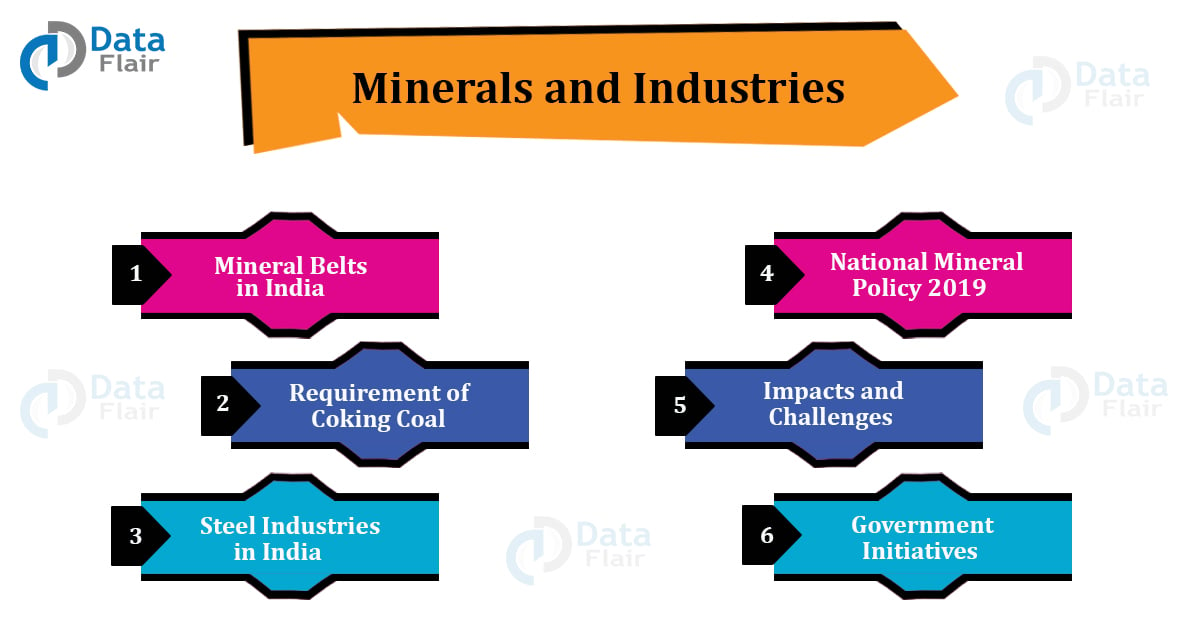
Mineral Belts in India
Overall, India is a hotspot of the following mineral reserves:
- Metallic and non-metallic minerals: iron, chromite, copper, mica, and manganese.
- Energy reserves: coal, petroleum, thorium, and uranium.
1. Chota Nagpur Belt (Northeastern Plateau region)
- Kyanite reserves (100%)
- Iron ore (93%)
- Coal (84%)
- Chromite (70%)
2. The Himalayan Belt
- Generally poor in metallic minerals
3. The Indian Ocean
- Presence Mineral oil and Natural gas in Arabian Sea and Bay of Bengal
- Contains poly-metallic nodules (around 4000 m deep under the ocean)
- Comprises minerals like Phosphate, Manganese, Barium, Silicon, Iron Aluminium, etc.
4. The Midland Belt
- Rich in Manganese, Bauxite, Copper, Graphite, Mica, Lignite, marble, and Limestone.
- Stretch around the states of Jharkhand, Odisha, Madhya Pradesh, Maharashtra, and Andhra Pradesh.
5. The Western Belt
- Constitutes non-ferrous metals
- Spreads around the states of Maharashtra )oil resources and granaries near Mumbai coast), Gujarat and Rajasthan (sandstone, marble, granite, fullers, gypsum, etc)
- Both Gujarat and Rajasthan are rich in salt production.
6. The South-western Belt
- Contains rich deposits of iron ore
- Located in the states of Goa (iron ore deposits), Kerala (thorium, Mozart, and bauxite clay) and Karnataka.
Iron and Coal Industries in India
- Over 97% of the coal reserves surface along the river basins of Godavari, Mahanadi, Son, and Damodar.
- Significant coal mining centers in India are Madhya Pradesh (Singhrauli), Raniganj, Jharia, and Bokaro.
- Singareni collieries are the largest coal-producing firm in India.
There are four types of iron ore:
- Manganite: used in electronic industries (around 70% of iron))
- Hematite: India as the second largest (after Russia) producer of this ore
- Limonite: Used in paint manufacturing industries (around 50% of iron)
- Siderite: Contains a mix of magnesium and manganese
- Most of the iron reserves are found in the states of Maharashtra (Ratnagiri), Jharkhand (Harizabag and Singbum), Chhattisgarh (Bailadila), Odisha, Goa, Karnataka (Bellary and Chitradurga), Andhra Pradesh, Telangana, and Tamil Nadu.
- Kudremukh mines (one of the largest worldwide) in the Western Ghats export iron res to foreign nations.
Deciding Locations for Iron and Coal Industries
Iron and coal industries must be located at the following desirable locations:
Near forests
- The production of iron was on a small scale by the end of the medieval period.
- The production of 5 tons of iron required cutting of around 1 acre of forward for adequate charcoal.
- Thus, the key factor for deciding the location for iron and coal industries was the availability of wood.
- The forests were cleared with the help of smelters.
- Plants like Visvesariya iron plants were initially set up near the forests for wood extraction. Now it has moved to the Saraswati basin for harnessing hydroelectricity.
Near coastal areas
- The iron and coal mines in Europe and U.S.A have begun to deplete by the end of the 20th century.
- Thus, these continents started to export iron and coal from foreign nations
- For these reasons, India moved its iron and coal industries near the coastal belts to curtail the transportation costs.
- For example, steel plants at Visakhapatnam, Ratnagiri, and Mangalore are installed near the sea coasts.
Near coal mines
- Industries were built near coal mines during the Industrial Revolution.
- These industries used charcoal as their primary material of production.
- Iron ore got blended with coal in Britain.
- 1 ton of iron ore required around 8-12 tons of charcoal for processing.
- As Railways were cheaper, it was easier to transport the iron ore for one location to another.
Requirement of Coking Coal
Coking coal is required for the following reasons:
- To remove the oxide part from iron ore.
- For the above process, blend the iron ore with carbon dioxide.
- For this reason, coking coal comprises high carbon density as compared to lignite.
- This variety of coal is suitable for heating.
Petroleum
- Extracted from Sedimentary rocks.
- Digboi in Assam is a major petroleum-producing unit in India.
- Major fields in Ankleshwar, Gujarat, Navagam, Lunej, Kosaniba, etc.
- Also found in basins of rivers Godavari, Krishna, and Kaveri
- There are 22 petroleum refineries in India.
- Other major locations of petroleum deposits include KG basin, Saurashtra shelf, Brahmaputra shelf, and Bengal Bangladesh shelf.
- Out of the 22 refineries, 17 are owned by the public sector. The rest 3 and 2 refineries are private and joint sector refineries respectively.
Natural Gas
- Exercises a wide usage in petrochemical industries as a natural and compressed raw material.
- An environment-friendly resource with low trances of carbon dioxide.
- Generally found around the Govadvari-Krishna basin.
- A cross country gas pipeline of around 1700 km runs between Mumbai High and Bassein in the west and north India respectively.
- In 1984, The Gas Authority of India was set up to monitor the sources of natural gas in the country.
- Ethane, methane, propane, butane and hydrogen sulphide are the key gaseous contributors to natural gas.
- Propane and Butane find wide usage in LPG (liquid Petroleum Gas)
- Tight gas sands are present deep within the sedimentary rocks
- TAPI (Turkmenistan- Afghanistan- Pakistan-India) is a natural gas pipeline stretching across these four countries.
- IPI (Iran- Pakistan- India) is another natural gas pipeline covering these three nations
- The government of India has proposed to install new natural gas pipelines between Iran and India and Russia, Central Asia, and India.
Steel Industries in India
- Jharkhand → Jamshedpur (TISCO), Bokaro
- West Bengal → Durgapur, Burnpur
- Odisha → Rourkela
- Chhattisgarh → Bhilai
- Andhra Pradesh → Visakhapatnam
- Karnataka → Vishveshwarya
- Tamil Nadu → Salem
Nuclear Energy Resources in India
- Sources such as uranium and thorium comprise this category.
- Dhaiwarrocks, Singbhum, Alwar, Jhunjhuru, Bhandara, Kullu, etc are some famous districts that contain these nuclear energy sources.
- Tamil Nadu is the key source of thorium in the country.
- The Atomic Energy Commission (1948) regulates the production of uranium and thorium in the country.
- The major nuclear power plants in India are located in Narora (Uttar Pradesh), Kalpakkam (Tamil Nadu), Kota (Rajasthan) Kakrapar (Gujarat) and Kaiga (Karnataka).
India’s Triple Stage Nuclear Program
- Fission: U-235 is bombarded with elements like barium and krypton. A massive amount of energy is released during this process.
- As per availability, U-235 is 99.3% fertile while U-238 is 0.7% fertle.
The three steps in the nuclear fusion process are mentioned below:
- P.H.W.R use Uranium + D2O ——— From this they obtain plutonium and energy.
- Fast breeder reactors use Plutonium and uranium oxide ———- to obtain U-235 + energy.
- Thorium based reactors use Thorium + U-235 ———- to obtain energy.
Biogas
- Rural areas feature as key consumers of biogas in the country.
- Biogas is elementally composed of human and animal waste, shrubs, and farm waste.
- Gobar gas is a famous source of biogas in India.
- Biogas is a rich source of natural manure.
- Overall, a very efficient source of events for domestic and agricultural uses.
Manganese
- Odisha features like the heart of Manganese production in India (Bonai, Sundargarh, Gangpur, Korput).
- Other Manganese producing states are Karnataka (Dharwad, Bellari, North Canara, Chitradurga, Tumkur, etc.), Jharkhand (Chaibasa), Madhya Pradesh (Bala Ghat), and Maharashtra (Nagpur, Ratnagiri, and Bandra).
- Use to manufacture steel and ferromanganese alloy.
- To produce 1 kg of steel, around 10kg of manganese needs to be processed
- Manganese plants are generally located far from steel plants, adding to their disadvantage.
Copper
- Copper deposits are mostly in the states of Jharkhand, Rajasthan (Jhunjhunu and Alwar districts), Andhra Pradesh (in Guntur),
- Karnataka (in Chitradurga and Hasan) and Madhya Pradesh (Balghat mines).
- Despite the above, India imports most of the premium quality copper (such as ballerina copper) from abroad.
- One ton of copper requires a total of 1400 KW of energy.
- Power plants located at Lonavala and Hyderabad recycle scrap copper
- The overall yield of copper is low in India
- Copper smelting leads to air pollution due to the release of sulphur dioxide gas.
Copper Refineries in India
- Hindustan Copper → Khetri, Jhunjhunu district, Rajasthan
- BALCO → Korba, Chhattisgarh
- Hindalco (Birla) → Dahej, Bharuch district of Gujarat
- Sterlite Industries → Tuticorin, Tamil Nadu
Mica
- Odisha (Koradarma is the largest manganese producer in the world)Extracted
- Andhra Pradesh produces a substantial amount of Mica in India.
- Districts of Jaipur, Udaipur, and Bhilwara are some Mica producing regions in Rajasthan.
- Karnataka and Kerala and West Bengal also produce Mica in large amounts.
- Mica has excellent insulating and resistant properties against high voltage.
- It can be beaten or spread into thin sheets for further use.
- In Jharkhand, the mica belt is about 150 km long and 22 km wide.
- It stretches around the Hazaribagh plateau.
- In Rajasthan, the mica extends around Jaipur and Udaipur.
Bauxite
- The leading producer of bauxite minerals in India is Odisha (34.9% of the country’s total production).
- Other Bauxite producing states are Gujarat (Bhavnagar and Jamnagar), Madhya Pradesh and Jharkhand (Lohardaga)
- Usually found in places with laterite rocks in hills and plateaus.
- Other important locations of rich bauxite deposits are Amarkantak plateau, Lohradaga, Katni-Jabalpur, Kolaba, Thane, Ratnagiri, etc.
- It is useful to manufacture aluminum.
- Generally found where there is a rich concentration of laterite rocks.
Aluminium-Bauxite Refining
- There is an abundance of aluminum on this planet while bauxite can be extracted from specific remote locations.
- Primarily, bauxite is crushed and blended with caustic soda to remove its impurities.
- Further, the above blend is left for drying to remove moisture (alumina is obtained from this mixture).
- This process of conversion also leads to weights loss.
- This subsequently reduces the transportation cost of the final product.
Aluminum Industries in India
- UP → Hindalco (Birla)
- Odisha → Hirakund (Birla), Jharsuguda (Vedanta)
- Chhattisgarh → Korba (Vedanta)
- BALCO → Ratnagiri, Maharashtra
- NALCO → Koratpur, Odisha
- MALCO → Mettur, TN
Lead and Zinc
- These ores are produced and refined through the processes of smelting and electrolysis.
- Ores are mixed with water, oil, and chemicals for processing.
- India doesn’t have sufficient lead and zinc ores and therefore most of these minerals in India imports from other countries.
- Some of the lead in India are in Jharkhand (Toondoo) and Andhra Pradesh (Visakhapatnam).
- Some of the zinc belts in India are in Rajasthan (Debari and Chanderia) and Kerala.
National Mineral Policy 2019 of India
- The Union Cabinet proposed to incorporate the National Mineral
- Policy (NMP) in the year 2019 as a part of promoting the sustainable development of the mining sector.
- This policy aims to collaborate with the public and the private sectors for effective mining activities.
- It also proposes to build dedicated mining corridors to facilitate the transportation of minerals in India.
- It offers to rationalize PSU to foster the opening of certain segments for auction.
- The policy initiates to integrate and synthesis royalty and taxes pertaining to the mining sector.
- It plans to furnish both stability and sustainability in business.
- Finally, it grants the mining sector the status of an industry and not just mere activities.
Impacts and Challenges
Despite a harmonable mining policy, the industry still encounters major impacts and challenges such as:
Impacts
- Inexpensive transportation of minerals across the states in India.
- Helps in improving export revenues.
- Availability of district mineral funds to improve the transmission of minerals in India.
- Educating the local population across the mines to save the environment from mining waste.
- Provision of financing facilities to the mining sectors
- Maintenance of proper databases for entrepreneurs and other stakeholders to access appropriate statistics in order to conduct mining activities.
Challenges
- Environmental depletion
- Displacement of the local population
- Health hazards
- Air and water pollution
- Administrative issues
Government Initiatives
- Mining Surveillance System to check illegal activities related to mining
- The National Mineral Exploration Policy to invite private industries and business
- District Mineral Foundation Fund to aid the displaced population or those drastically affected from mining
- An MoU between the Indian Bureau of Mines and National Remote Sensing Sector (2016) to regulate the mining industry via digital and satellite technologies.
Conclusion
Altogether, the mineral industries in India have flourished since time immemorial. A rapidly growing sector whose demand is on the hike by four to five times against a scarcity of worldwide decreasing resources.
As per estimates, the industry is expected to employ around 6 million people within this sector by 2025. Today, the minerals industry in India contributes a GDP of 47 billion dollars to the Indian economy. And we expect it to contribute around 125 billion dollars by 2025.
The Indian government substantially emphasizes on this sector and has included it in its Make in India policy program. In a nutshell, it addresses this sector and expects it to develop the country’s economy and employment opportunities in the long run.