


Placement-ready Courses: Enroll Now, Thank us Later!
Information gathering is a crucial aspect of any cybersecurity approach. It entails collecting information about ability objectives, including vulnerabilities and weaknesses, to assemble an effective assault.
Kali Linux, a working machine created exclusively for cybersecurity specialists, is one of the best gear for data amassing. In this newsletter, we will discover the diverse facts-collecting tools in Kali Linux and a way to use them efficaciously.
Overview of Kali Linux
Kali Linux is a Debian-based working gadget with over 600 pre-mounted tools for penetration checking, vulnerability assessment, and digital forensics. These equipment are designed for cybersecurity experts, making Kali Linux the cross-to desire for everyone seeking behaviour records-accumulating activities.
Kali Linux’s equipment and abilities for records accumulating encompass port scanning, network mapping, vulnerability scanning, and password cracking. It is a complete toolkit for the surveillance of a capability target and can be custom-designed to match unique wishes.
The fact that Kali Linux is open-source and price-loose to apply is one of the significant blessings of its usage for information amassing. This means everybody can access Kali Linux online, download it, install it on a computer, and immediately start using its tools.
Information Gathering Tools in Kali Linux
Kali Linux comes with a considerable array of information-amassing gear. Some of the most famous ones include:
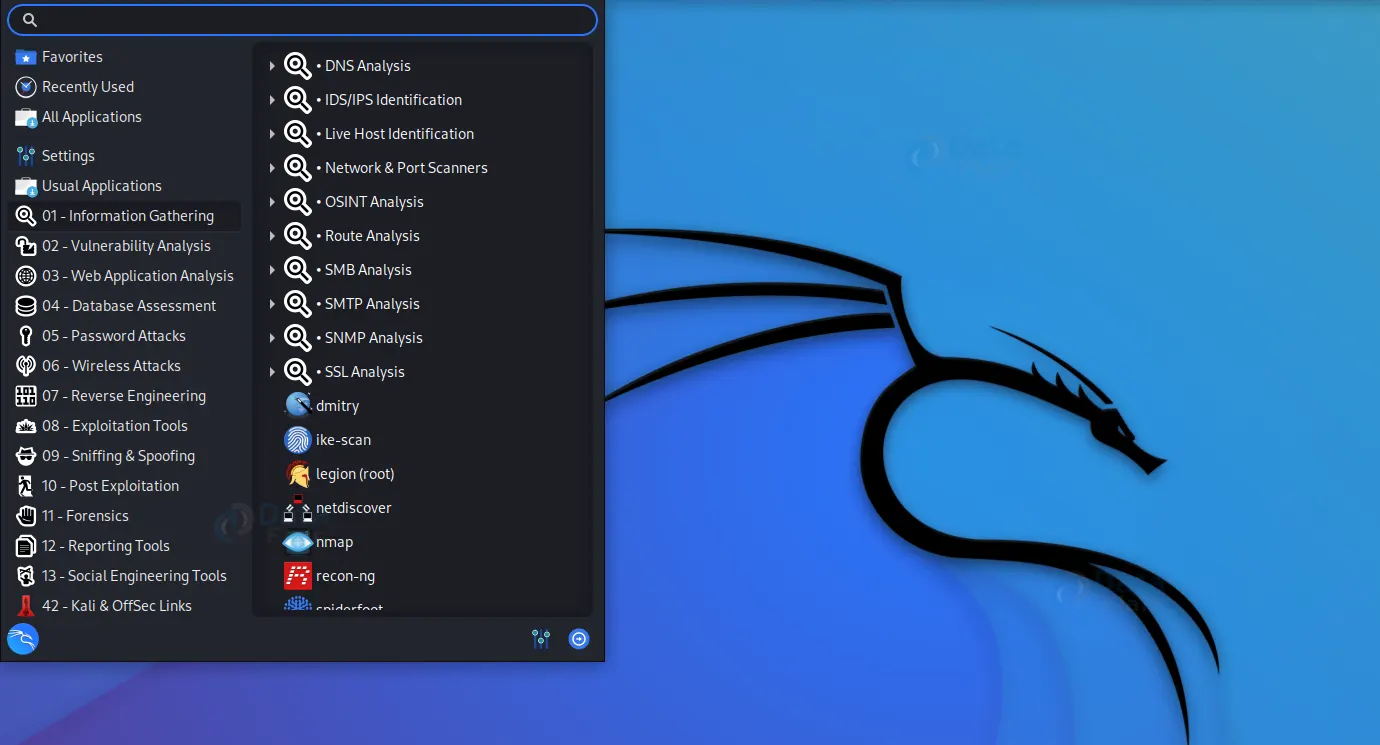
Nmap:

Uses: Nmap is commonly used for community exploration and safety auditing. It allows for perceiving hosts, discovering open ports, and determining the offerings going for walks on a network.
Details: Nmap makes use of numerous scanning strategies, which include TCP, UDP, and SYN scans, to acquire information about community devices. It affords considerable alternatives for carrier and version detection, OS fingerprinting, and scripting abilities for automation.
Features: Nmap offers bendy goal specification, supports multiple output codecs, and permits users to define scan parameters, timing options, and performance optimisations. It is understood for its speed, accuracy, and ability to scan massive networks efficaciously.
Maltego:
Uses: Maltego is an OSINT device used for amassing and studying records approximately individuals, organizations, and their relationships. It assists in reconnaissance, chance intelligence, and investigations.
Details: Maltego visualizes information through graph-based total representations, making it easier to recognize connections and styles. It integrates with numerous information assets, social media systems, public databases, and online services.
Features: Maltego affords a massive range of transforms (information series modules) to accumulate facts and perform automatic analysis. It supports entity mapping, hyperlink analysis, records correlation, and custom rework advent.
TheHarvester:

Uses: the harvester is mainly designed for electronic mail to cope with subdomain reconnaissance. It helps amass intelligence for social engineering, targeted assaults, or increasing the scope of checks.
Details: The harvester scours search engines like Google and Yahoo, widely used social media platforms, and public data sources to search for email addresses and subdomains, retrieving associated details such as names, titles, and contact information.
Features: the harvester supports various search engines like Google and Yahoo, offers customization alternatives for search queries, and affords options to limit the quest to particular domains or assets. It is a command-line tool with bendy output codecs for additional evaluation.
Shodan:
Uses: Shodan is a search engine for net-connected gadgets, permitting customers to find out uncovered structures, offerings, and capability vulnerabilities.
Details: Shodan conducts scans and indexes devices by collecting banners and metadata.
It permits searches primarily based on key phrases, IP addresses, particular ports, and other parameters to become aware of devices with specific traits.
Features: Shodan gives filters to refine search outcomes, supports API to get admission for programmatic usage, and affords data about device vulnerabilities, producer info, and place statistics. It is a precious device for surveillance, IoT security, and vulnerability evaluation.
Recon-ng:

Uses: Recon-ng is a robust reconnaissance framework for information accumulation and OSINT. It streamlines gathering statistics from diverse assets for protection assessments and investigations.
Details: Recon-ng integrates modules and APIs to automate statistics collection from serps, social networks, public databases, and more. It facilitates comprehensive reconnaissance by consolidating information from more than one asset.
Features: Recon-ng gives a modular layout, allowing customers to customize their data collection techniques. It offers computerized records correlation, records mining, and document generation options. Users can expand custom modules and scripts to increase their capability.
Metasploit Framework:

Uses: Metasploit is a widespread penetration checking-out framework comprising modules for statistics accumulating, exploitation, and submit-exploitation sports.
Details: Metasploit presents extensive exploits, payloads, and auxiliary modules to simulate actual global attacks. It aids safety experts in figuring out vulnerabilities, trying out defences, and assessing system weaknesses.
Features: Metasploit Framework offers a person-pleasant console interface, automated exploitation workflows, put-up-exploitation modules for maintaining get entry and superior reporting abilities. It helps each guide and automatic penetration checking out methods.
SpiderFoot:

Uses: SpiderFoot automates the method of amassing statistics from numerous resources to conduct surveillance and intelligence amassing. It helps in identifying relationships, uncovering vulnerabilities, and accomplishing OSINT investigations.
Details: SpiderFoot integrates with numerous facts sources, inclusive search engines like Google, social media platforms, DNS records, hazard intelligence feeds, and more. It aggregates the accrued points and affords comprehensive reports and visualizations.
Features: SpiderFoot offers a wide variety of modules for statistics series, consisting of host facts, domain surveillance, electronic mail dealing with accumulating, and community footprint analysis. It supports customization, scheduling, and automation, making it an effective tool for reconnaissance duties.
DNSenum:
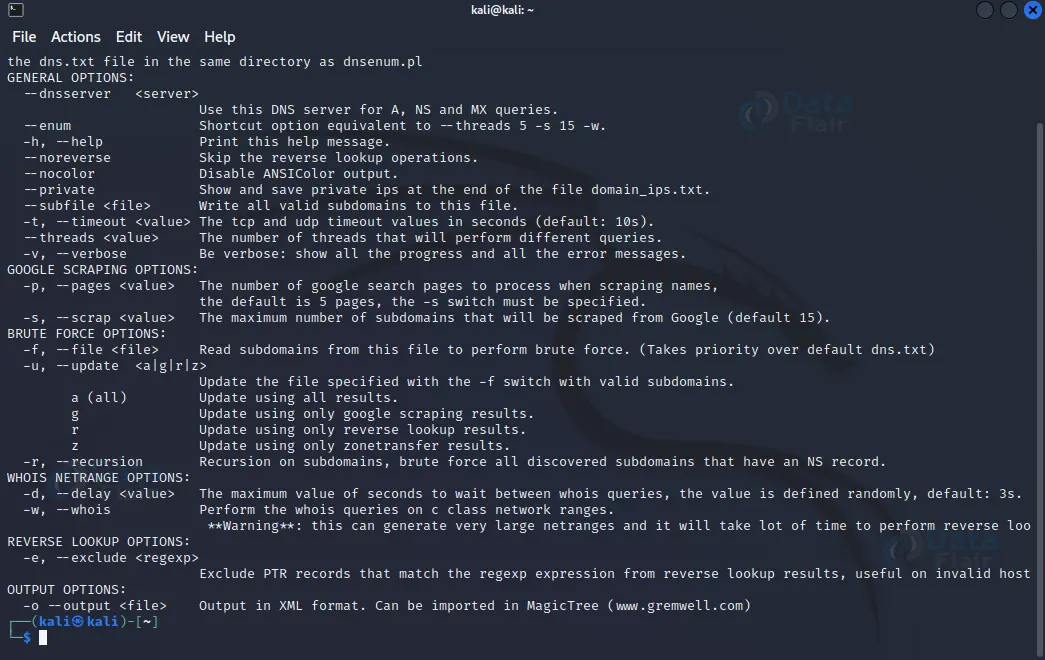
Uses: DNSenum is designed explicitly for amassing DNS-associated information approximately a target. It enables figuring out subdomains, associated IP addresses, mail servers, and other DNS facts.
Details: DNSenum makes use of various techniques, inclusive of brute-forcing, region transfers, and opposite lookups, to enumerate DNS data. It queries DNS servers and plays analysis to offer a complete image of the goal’s DNS infrastructure.
Features: DNSenum offers options for customizing queries, specifying DNS servers, and defining test parameters. It presents specific output, which includes DNS information, related information, and capability misconfigurations.
DMITRY (Deepmagic Information Gathering Tool):
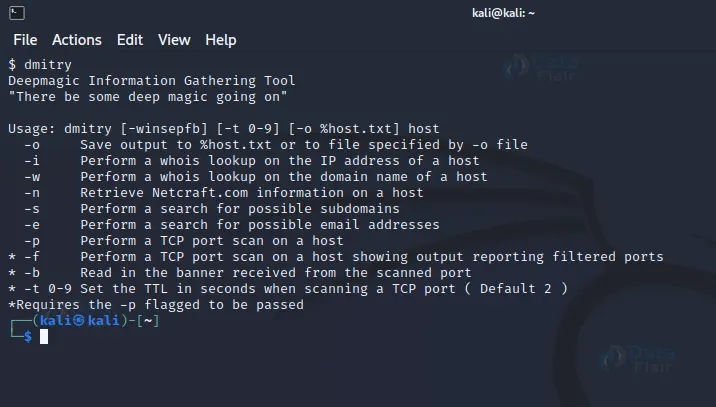
Uses: DMITRY is a command-line tool used for gathering intelligence about a goal by querying public databases, DNS records, whois facts, and different sources. It allows for surveillance and initial statistics collecting.
Details: DMITRY collects information like IP addresses, domains, e-mail addresses, and host-associated facts from diverse assets. It plays queries to retrieve info from public databases, whois statistics, and network-associated facts.
Features: DMITRY provides a straightforward interface, allowing customers to specify the goal and choose the preferred record classes. It offers simple reviews with the accrued statistics, assisting with the preliminary degrees of surveillance.
OSRFramework:
Uses: OSRFramework is a complete OSINT framework that combines multiple equipment and modules for survey, data mining, and statistics gathering. It assists in accumulating and studying data from numerous sources to construct a comprehensive profile of a target.
Details: OSRFramework integrates different modules for social media evaluation, area enumeration, electronic mail harvesting, facts correlation, and more significance. It offers a modular and extensible framework for accomplishing in-intensity OSINT investigations.
Features: OSRFramework offers an extensive range of alternatives and modules, together with information mining from social media platforms, computerized OSINT record technology, and advanced information correlation talents. It offers flexibility and customization for tailor-made reconnaissance operations.
Ghidra:
Uses: Ghidra is a powerful opposite engineering suite used for analyzing and know-how software binaries. It assists in identifying vulnerabilities, studying malware, and exploring the functionalities of software programs.
Details: Ghidra gives a complete set of functions, which include disassembly, decompilation, scripting, and debugging talents. It helps many architectures and file codecs, permitting the analysis of diverse software and firmware.
Features: Ghidra offers a user-friendly interface, advanced evaluation features, and sizable scripting capabilities for automation. It allows customers to navigate through code, annotate capabilities, and collaborate on reverse engineering tasks.
Wireshark:

Uses: Wireshark is a powerful community protocol analyzer for shooting and reading network traffic. It enables identifying capability protection troubles, troubleshooting community issues, and monitoring network hobbies.
Details: Wireshark captures packets from community interfaces or examines from pcap files, presenting a detailed view of community communications. It supports several protocols and allows for in-intensity evaluation of network behavior.
Features: Wireshark offers effective packet filtering, actual-time evaluation, protocol dissection, and the capability to drill down into character packets. It affords a consumer-pleasant interface and supports advanced capabilities like decryption, statistical analysis, and custom protocol improvement.
Nikto:

Uses: Nikto is a web vulnerability scanner designed to discover common vulnerabilities, misconfigurations, and previous software on web servers.
Details: Nikto performs complete scans of web servers, testing for over 6700 potentially dangerous files/CGIs, outdated versions of server software, and known vulnerabilities. It analyzes HTTP reaction headers, assesses for server misconfigurations, and identifies protection risks.
Features: Nikto gives a command-line interface, customization options for test profiles, and significant reporting abilities. It supports SSL/TLS scanning, proxy support, and integration with other security gear.
Dirb:

Uses: Dirb is an internet utility scanner that discovers hidden directories and files on a web server. It enables the identification of capability access factors, sensitive documents, or manuals that aren’t meant to be publicly available.
Details: Dirb performs brute-force directory and reports enumeration via making HTTP requests and studying the responses. It uses a predefined or custom wordlist to systematically test listing and report names.
Features: Dirb supports multi-threading for faster scanning, recursive listing scanning, and the capacity to personalize wordlists. It affords distinct reviews of observed directories and files, aiding in identifying capacity protection risks.
WPScan:

Uses: WPScan is a specialized tool for scanning WordPress websites, detecting vulnerabilities, and acting protection checks.
Details: WPScan performs a variety of checks on WordPress installations, such as version detection, plugin and subject enumeration, and vulnerability scanning. It assesses for outdated software programs, recognized vulnerabilities, vulnerable passwords, and different protection problems unique to WordPress.
Features: WPScan gives a command-line interface, affords particular vulnerability records, and supports brute-forcing of weak credentials. It integrates with WordPress vulnerability databases and affords hints for securing WordPress installations. Additionally, it lets customers enumerate customers, plugins, and subject matters to aid in similar assessments.
These are just a few of the numerous records collection alternatives that are presented via Kali Linux. Each device has a beautiful function and can be used to study diverse information about a goal.
For example, When a target is scanned for open ports with Nmap, the services which can be currently energetic on the target are made visible. With the usage of Wireshark, network visitors can be captured and analyzed, revealing information like usernames and passwords. Metasploit Framework may be used to test for vulnerabilities in a goal and broaden exploits to take advantage of those vulnerabilities.
Steps to Using Information Gathering Tools in Kali Linux
Using facts-accumulating equipment in Kali Linux is extraordinarily truthful. Here are the fundamental steps:
1. Identify the goal – decide the target you want to acquire information about.
2. Choose the ideal tool – pick the excellent and perfect tool for the information you need to gather.
3. Configure the device – configure the tool based on the precise parameters of the goal and the statistics you want to accumulate.
4. Run the device – run the tool and watch for it to complete.
5. Analyze the results – examine the consequences to benefit insights into the target.
It’s crucial to observe that ok records accumulating require greater than, without a doubt, on foot a tool. It also includes expertise in investigating the results and using that fact to devise an assault.
Ethical and Legal Considerations in Kali Linux
It is well worth noting that information logging tools in Kali Linux can enhance moral and crook issues. These gear can be used for superficial and unfair purposes, and applying them responsibly is essential.
Using the gathered records without the person’s consent is illegal and unethical. It is crucial to get permission before starting the meeting.
Considering the capability damage that may result from this tool’s usage is critical. When retrieving touchy or exclusive information, the target might be drastically harmed if it falls into the wrong fingers. All data acquired must be securely saved and, without problems, reachable via suitable employees.
You should also be privy to the relevant legal strategies and records series hints to your jurisdiction. For instance, in many countries, unauthorized right of entry to computer systems or networks is unlawful and can motivate serious issues. It is critical to search for a prison professional’s advice to ensure that every meeting is held in prison. One of Kali Linux’s primary features is that it was created with ethics and laws in mind. The Kali Linux Development Team supports copyright infringement strategies and recommends the honest and responsible use of the equipment. Also, some merchandise included with Kali Linux is open source, and their use is subject to licensing and other violations.
Conclusion
In conclusion, Kali Linux is a valuable resource for facts collecting inside the field of cybersecurity. Professionals wishing to conduct surveillance on viable targets frequently pick it out due to the broad kind of pre-mounted gear and the reality that it’s far open-supply. However, applying those gadgets sensibly and within the bounds of regulation and morality is essential.
To correctly use Kali Linux’s information-gathering tools, it’s critical to have a strong understanding of the target and the form of facts you want to collect. Analyzing the results of this equipment is simply as crucial as going for walks with them, as it presents precious insights into the goal’s vulnerabilities and weaknesses.
It’s essential to keep up with the maximum recent information-gathering methods and tools as the cybersecurity world continues to alternate. Kali Linux affords a stable foundation for conducting powerful information-amassing activities. Studies suggest that future research can preserve construct on this foundation to enhance our capacity to secure virtual property and prevent cyberattacks.