

Hydropower denotes the procedure of harnessing electricity through water. In other words, it refers to the systematic process of accumulating efficient energy from rapidly flowing water. The installation of dams helps in this energy generation and preservation.
Thus, hydropower or hydroelectricity is a technological boon for our planet. India as a developing country invests in hydropower through the construction of dams and hydropower plants on rivers.
Further, it uses this electricity to run tubewells, irrigate and cultivate crops, furnish power in homes and factories, etc.
In fact, India features as the seventh-largest generator of hydroelectricity across the globe.
This article depicts the major hydropower Plants and primary dam constructions in India. In short, it highlights India’s investment in this industrial technology and how it benefits millions of people in this country.
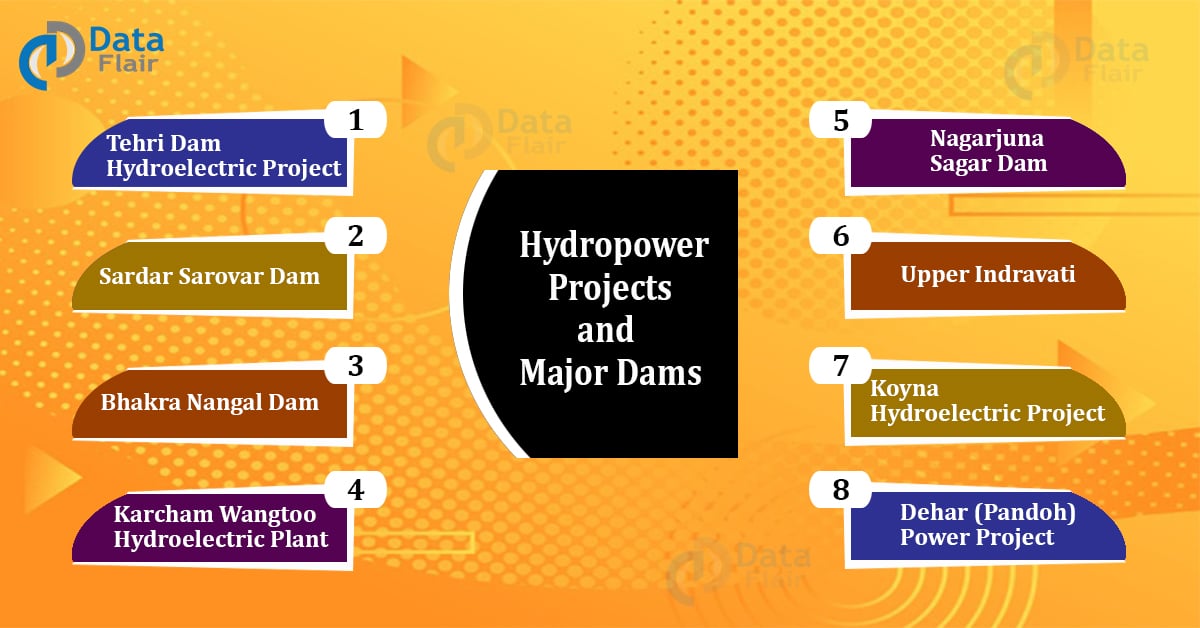
Hydropower Plants and Dams in India
India’s hydropower generation capacity amounts to 1,48,700 MW (MegaWatt). Out of this, around 42,783 are ongoing (about 28.77% of the total) while the remaining 13,616 are still under process.
A detailed explanation of India’s hydroelectric projects and principle dams is as follows:
Tehri Dam Hydroelectric Project in India
- Location: Uttarakhand on Bhagirathi river
- Operator: THDC Limited
- Year of construction: 1978
- Configuration: 2400 MW
- It is the highest dam in India
- USSR collaborated with India for this dam’s construction
Srisailam Hydropower Plant in India
- Location: Andra Pradesh on Krishna river
- Operator: APGENCO
- Year of construction: 1960
- Configuration: 1670 MW
- The dam surfaces on the borderline between Andra Pradesh and Telangana
- It is the second-largest hydropower project in India
Sardar Sarovar Dam in India
- Location: Gujarat on Narmada river
- Operator: Sardar Sarovar Narmada Nigam Limited
- Year of construction: 1987
- Configuration: 1450 MW
- It is the largest dam of Narmada Valley Project
- It is located near Navagam in Gujarat
Shivanasamudra in India
- Location: Karnataka on Kaveri river
- Operator: Mysore State
- Year of construction: 1902
- Configuration: 700 KW
- It is the first hydropower plant of India
Bhakra Nangal Dam in India
- Location: Himachal Pradesh on Satluj river
- Operator: Bhakra Beas Management Board
- Year of construction: 1948
- Configuration: 1325 MW
- Located in Bhakra village, Bilaspur
- Both Himachal Pradesh and Punjab share the electricity generated from this dam
- Both Punjab and Haryana use the outflowing water from this dam
Gerusoppa Dam in India
- Location: Karnataka on Sharavati river
- Operator: Karnataka Power Corporation Limited
- Year of construction: 2002
- Configuration: 1035 MW
- Also known as Linganamakki Reservoir
- The dam is located around 6 km away from Jog Falls
Karcham Wangtoo Hydroelectric Plant in India
- Location: Himachal Pradesh on Satluj river
- Operator: Jaypee Group
- Year of construction: 2005
- Configuration: 1000 MW
- The dam is located in the Kinnaur district of Himachal Pradesh
Nagarjuna Sagar Dam in India
- Location: Andhra Pradesh on Krishna river
- Operator: Andhra Pradesh Power Generation Corporation Limited
- Year of construction: 1967
- Configuration: 960 MW
- The dam stretches along Nalgonda district of Telangana and Guntur district of Andhra Pradesh
Idukki
- Location: Kerala on Periyar river
- Operator: Kerala State Electricity Board
- Year of construction: 1976
- Configuration: 780 MW
- Prime Minister Late Smt. Indira Gandhi commissioned the construction of this dam
- The dam is the largest and the most trusted source of electricity in Kerala
Upper Indravati
- Location: Odisha on Indravati river
- Operator: Odisha Hydropower Corporation
- Year of construction: 1996
- Configuration: 600 MW
Omkareshwar
- Location: Madhya Pradesh on Narmada river
- Operator: Narmada Hydroelectric Development Corporation
- Year of construction: 2003
- Configuration: 520 MW
- The dam is located in Khandwa district
Teesta Dam in India
- Location: Sikkim on Teesta river
- Operator: NHPC Limited
- Year of construction: 2003
- Configuration: 510 MW
- The dam comprises of 3 turbines for hydropower generation
Koyna Hydroelectric Plant in India
- Location: Maharashtra on Koyna river
- Operator: MaharashtraState Power Generation Co. Limited
- Year of construction: 1956
- Configuration: 1960 MW
- It is the largest hydel power project in India
Nathpa Jhakri
- Location: Himachal Pradesh on Satluj river
- Operator: Satluj Jal Vidyut Nigam
- Year of construction: 1993
- Configuration: 1500 MW
- The dam comprises a total of 6 turbines for hydropower generation
Chamera I
- Location: Himachal Pradesh on Ravi river
- Operator: NHPC Limited
- Year of construction: 2012
- Configuration: 1071 MW
- The dam is located in Chamba near Dalhousie hill station
Dehar (Pandoh) Power Project
- Location: Himachal Pradesh on Beas river
- Operator: Bhakra Beas Management Board
- Year of construction: 1977
- Configuration: 990 MW
- The dam is located in district Mandi
Purulia Pass
- Location: West Bengal on Kangsabati river
- Operator: West Bengal Electricity Distribution Company
- Year of construction: 2002
- Configuration: 900 MW
Salal I and II
- Location: Jammu and Kashmir on Chenab river
- Operator: NHPC Limited
- Year of construction: 1970
- Configuration: 690 MW
- The dam was constructed in two stages, stage I and stage II
Ranjit Sagar Dam
- Location: Punjab on Ravi river
- Operator: Punjab State Power Corporation Limited
- Year of construction: 1981
- Configuration: 600 MW
- It is also referred to as the Thein Dam
Balimela Dam
- Location: Odisha on Sileru river
- Operator: Odisha Hydropower Corporation
- Year of construction: 1988
- Configuration: 510 MW
- The dam is located in Malkangiri district
- It features as the joint hydropower project of Odisha and Andhra Pradesh
In addition to the above, here are some other dams located in India. A tabulation of their fundamental features is as follows:
| Name of the dam | Location | River | Capacity MW |
| Bapsa- II | Himachal Pradesh | Bapsa | 300 |
| Pandho | Himachal Pradesh | Beas | 990 |
| Baira Siul | Himachal Pradesh | Ravi | 198 |
| Chamera- I | Himachal Pradesh | Ravi | 540 |
| Chamera II | Himachal Pradesh | Ravi | 300 |
| Pong | Himachal Pradesh | Beas | 396 |
| Uri | Jammu and Kashmir | Jhelum | 480 |
| Dulhasti | Jammu and Kashmir | Chenab | 390 |
| Salal | Jammu and Kashmir | Chenab | 690 |
| Bansagar | Madhya Pradesh | Son | 125 |
| Bargi | Madhya Pradesh | Narmada | 105 |
| Indira Sagar | Madhya Pradesh | Narmada | 1000 |
| Loktak | Manipur | Manipur | 105 |
| Koyna | Maharashtra | Koyna | 1960 |
| Bhira hydropower project | Maharashtra | Mulshi dam | 150 |
| Tanakpur | Uttarakhand | Sharda | 120 |
| Loharinag Pala | Uttarakhand | Bhagirathi | 600 |
| Dhauliganga-I | Uttarakhand | Dhauliganga | 280 |
Conclusion
We have seen major hydropower plants and dams in India. Overall, hydropower is an essential and efficient source of energy at an affordable price for Indians.
Additionally, both central and state governments are taking substantial initiatives to maintain these dams and facilitate agricultural, irrigation, and energy requirements for its population.
In a crux, hydroelectricity is a boon to the Indian society and the world at large. However, it is the duty of every responsible citizen to conserve energy and bring it to sustainable uses.
After all, the preservation of energy shall benefit not only today but shall be a blissful legacy for tomorrow.