


We offer you a brighter future with industry-ready online courses - Start Now!!
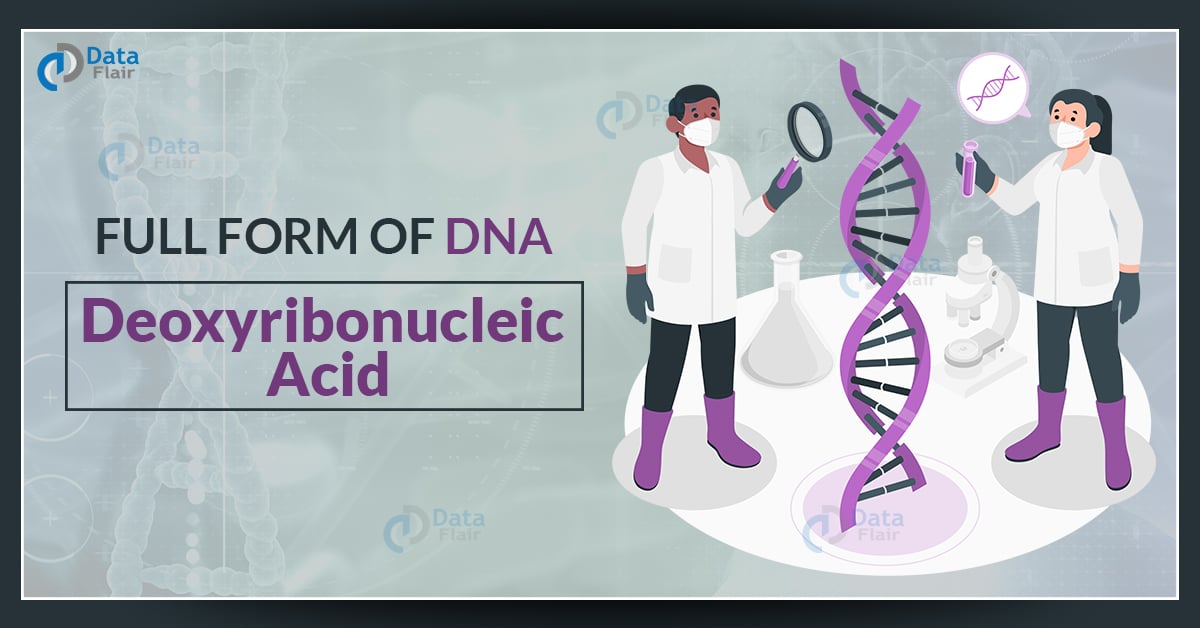
Full form of DNA is Deoxyribonucleic Acid. It is a set of molecules that transmit and carry inherited or genetic instructions from generation to generation. It is an organic compound with a unique molecular structure that can be found in all eukaryotic and prokaryotic cells.
History of DNA
Johannes Friedrich Miescher, a Swiss biologist, recognized DNA when he was working on white blood cells in 1869. Later James Watson and Francis Crick discovered the double-helix structure of DNA molecules using experimental evidence. Finally, it was confirmed that DNA carries a human’s genetic information.
Structure of DNA
A DNA molecule looks like a twisted ladder. This structure is known as a double helix. The basic building blocks of DNA are nucleotides, a carbon-sugar group, a phosphate group, and a nitrogen base. The sugar and phosphate groups are responsible for binding the nucleotides together so that a DNA strand can be formed. The nitrogen base has four forms, namely, Adenine(A), Thymine(T), Guanine(G), and Cytosine(C).
Types of DNA
Following are the three types of DNAs:
A – DNA: This is a right-handed double helix that is similar to B – DNA and forms when DNA is driven to dehydration. It protects DNA under active conditions such as protein binding.
B – DNA: This is the most common DNA conformation, that is similar to A – DNA and also has a right-handed double helix. DNA has this conformation under normal physiological conditions.
Z – DNA: This is a left-handed double helix in a zig-zag pattern that winds to the left. IT is present ahead of a gene’s starting site and thus plays a role in controlling the gene.
Functions of DNA
- Holds all the inherited information coded in the nitrogen base structure.
- Passes genetic information from the parent cell to its daughters i.e., from one generation to another.
- Helps identify a person from their DNA using DNA fingerprinting, since every DNA is unique.
- Influences metabolic reactions of cells with the help of hormones, enzymes, and specific RNAs.
Noncoding DNA
99% of DNA is not made up of protein-coding genes. It is noncoding DNA that does not provide any instructions for protein making. This is important for the functioning of cells, in particular for controlling gene activity. It contains regulatory elements that provide sites for specialized proteins to either attach or activate (or repress) the process by which the information from genes turns into proteins.