


Job-ready Online Courses: Knowledge Awaits – Click to Access!
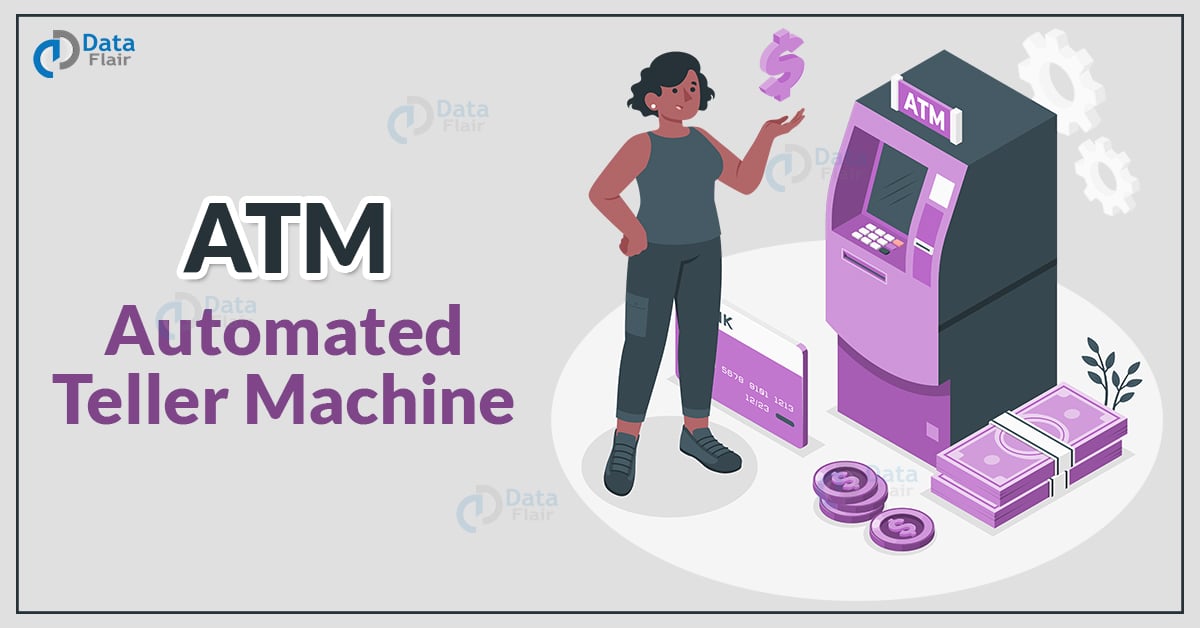
Full form of ATM is Automated Teller Machine. It is an electro-mechanical machine that allows the user to perform smooth transactions without the assistance of another party like a branch representative. ATM transactions are done with the help of a debit or credit card.
It is an automated banking platform that helps the user conduct fast self-service transactions that include cash withdrawals and deposits, bill payments, and account-to-account transfers. In other parts of the world, ATMs are also known as Automated Bank Machines (ABM) or Cash Machines.
History of ATM
Though there are records of a cash dispenser being used in Japan in the mid-1960s, the first ATM was officially set up in London in 1967 at a Barclays Bank branch. In the 1970s cardholders of one bank were able to use their cards at another bank’s ATM. More than 3.5 million ATMs are operational worldwide as of now.
Types of ATM
There are two basic types of ATM:
1. Onsite ATM: This type of ATM is present within the bank premise.
2. Off-site ATM: The type of ATM is present outside the bank premises so that people can easily access the bank’s facilities from anywhere.
There are some other varieties of ATMs too based on labels, they are:
1. White label: There is no bank logo on the ATM machines and the owner of such ATMs is not a bank but someone else. TATA group introduced it for the first time.
2. Brown label: A third party, other than the bank, operates them.
3. Green label: They are for agricultural transactions.
4. Yellow label: They are for E-commerce.
5. Orange label: They are for share transactions.
6. Pink label: They can only be accessed by females.
7. Biometric: This operates on biometric features like an eye or fingerprint scanner.
Parts of ATM

Following is the list of some of the essential output and input devices of an ATM:
1. Card reader: It reads the data stored on the ATM card. This data is stored in the magnetic stripe that is present on the back. It collects the account details and sends them to the server. Based on this information the cash dispenser dispenses the cash and carries out the commands obtained from the user server.
2. Keypad: This helps the user to interact with the machine and request data such as personal ID number, cash amount, receipt, and much more. It sends the PIN to the server in encrypted form.
3. Speaker: It generates audio input.
4. Display Screen: It displays details concerning the transaction and also indicates steps of cash withdrawal. The screen can either be CRT or LCD.
5. Receipt Printer: A receipt holds information about the transaction like the time and date of the transaction, account balance, withdrawal amount, etc.
6. Cash Dispenser: It hands out the requested cash. The highly accurate sensors provided in the ATM allow the cash dispenser to administer the appropriate cash amount as the consumer needs.
Working Principle of ATM
The ATM starts operating once the user inserts (swaps) their ATM card into the allotted slot. These ATM cards have a magnetic stripe on their back that contains account details and other security information which the machine reads when the card is inserted into the slot. After this, the system requests the PIN. Once authenticated, the machine permits cash transactions.
Functions of ATM
- Withdrawing/Diposting cash
- Transferring cash
- Providing account details
- Generating mini statements
- Regular bill payments
- Changing pin code
Advantages of ATM
- Available 24 ✕ 7.
- Reduces work pressure on bank staff.
- Extremely useful for travelers.
- Error-free services.
Interesting facts about ATM
- John Shepherd Barron prepared a 4-digit PIN because it was difficult for his wife to remember a 6-digit PIN number.
- Hongkong and Shanghai Banking Corporation (HSBC) installed the first ATM in India in 1987.
- State Bank of India (Kerala) is the world’s first floating ATM.
- Reg Varney (famous comedy actor) was the first person to withdraw cash from the ATM in India.
- In Romania, a person can withdraw cash without having a bank account.
- Brazil uses Biometric ATMs.
- Nathu-La has the world’s highest ATM (14,300 feet above sea level) operated by the Union Bank of India, mainly for the army personals.