

After Harshavardhan, new realms and traditions developed. There were many landlords and warrior chiefs who rose near the seventh century. The Kings recognized them as Samanthas and got blessings from these Samanthas, who gave the military backing to the kings out of luck.
They regularly proclaimed themselves as ‘maha-Samanthas’ and ‘maha-Mandaleshvara’. For example, the Rashtrakutas in Deccan were subordinated to Chalukyas of Karnataka. In the mid-eighth century, they overtook the land.
There were Brahmin rulers like the Kadamba Mayurasharman in Karnataka and Gurjara-Pratihara Harichandra in Rajasthan. “Tripartite Struggle ” between the Rashtrakutas, Palas, and Gurjara-Pratihara battled to control Kanauj happened towards the end of eighth century AD.
This is the Early Medieval India.
This battle for incomparability among the Palas, Partihars, and Rashtrakutas is significant even after these many years. Generally, the period between 750 AD and 1200 AD is alluded to as the Rajput Period in Early medieval India.
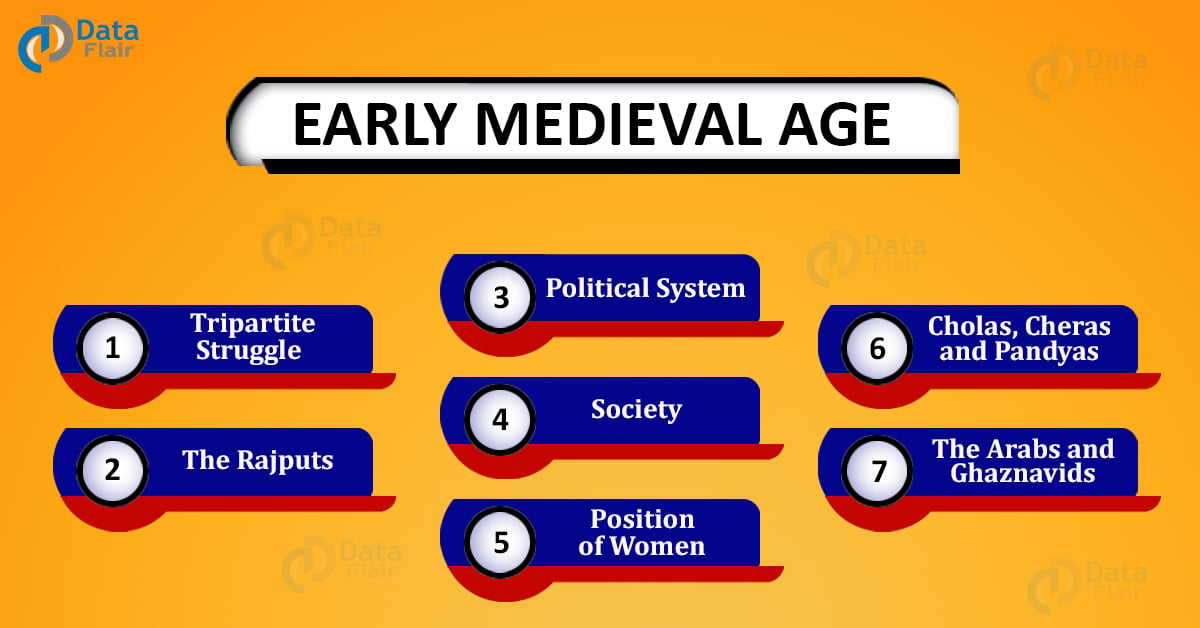
This period has been described by an absence of solidarity in the realms and foreign invasions. We are briefly going to study this Early Medieval India period under these subheadings.
- Tripartite Struggle
- The Rajputs
- Political System
- Society
- Position of Women
- Cholas, Cheras and Pandyas
- The Arabs and Ghaznavids
Tripartite Struggle
The Tripartite battle portrays the period between the eighth century and the tenth century which saw a battle for the assets of the rich Gangetic Doab and the town of Kannauj.
The three realms associated with this battle were – The Pala administration of Bengal, the Gurjara Pratihara line of Malwa, and The Rashtrakutas in the South. Every one of these rulers rose practically together and evaporated at comparative time.
Palas
- The first King was Gopala and he was elected by people
- The capital was at Gauda (N. Bengal)
- The two great rulers were Dharmapala and Devpala
- Dharmapala built Vikramshila. It is a Buddhist Monastery in Bhagalpur (Bihar).
- In Devpala’s period empire expanded from Bengal to Punjab (Kannauj and Ganga Doab)
- Palas were patrons of Buddhism (last political patrons of Buddhism). They sent monks to Tibet.
Gurjara Prathiharas
- They were called Gurjara because they were from Gujarat.
- Pratiharas (Agni Kuleen) claimed to be descendants of Lakshmana, the brother of Ram.
- Some of the important Kings of this dynasty are Nagabhata I, Nagabhatta II, and Mihir Bhoj.
- The last two were two great kings with capital at Jodhpur.
- They also controlled Kannauj and Ganga
Rashtrakutas
- They were rulers of Maharashtra with capital at Manyakheta.
- The important Kings were Dhruva and Govinda III
- Dhruva was the first south India king to come to north and defeat a North Indian King.
- Govinda III defeated Nagabhatta II of Pratiharas and established control of Kannauj and Ganga
- Govinda built Ellora caves (37 caves). Ellora caves are associated with all three religions Hinduism, Buddhism, Jainism, while Ajanta is mainly with Buddhism.
- He also built Kailashnath temple caves.
- Parsis came to India during this period and were given shelter by Rashtrakutas.
The Rajputs
- Rajput is subordinate to a Sanskrit word Raj-Putra which signifies “son of a king”. Rajputs were perceived for their valiance, reliability, and sovereignty. They were the warriors who faced conflicts and dealt with the administering capacities. The Rajputs began from western, eastern, northern India, and from certain pieces of Pakistan. Rajputs made the most of their distinction during the sixth to twelfth hundreds of years. Until the twentieth century, Rajputs controlled the regal conditions of Rajasthan and Saurashtra.
- Rajputs are divided as Vansh and Vamsha. The Vansh is additionally separated as Suryavanshi which means “House of Sun” and they are believed to be originating from Lord Ram. Chandravanshi means “House of Moon” and they are believed to be originating from Lord Krishna. The last one is Agnivanshi which means “House of Fire” and they are believed to be originating from Lord Agni.
- Underneath the Vansh division, there are little developments that are kul or shakh (branch), khamp or khanp (twig), and nak (twig tip). Kul fills in as an essential personality among Rajputs and every last one of them reveres and is ensured by their family goddess known as kuldevi.
- The Suryavanshi tribes are Bais, Chattar, Gaur, Kachwaha, Minhas, Pakhral, Patial, Pundir, Naru, Rathore, and Sisodia. In Chandravanshi we have Bhati, Chandelas, Bhangalia, Chudasama, Jadauns, Jadeja, Jarral, Katoch, Pahore, Som, and Tomaras. Ultimately in Agnivanshi, we have Bhaal, Chauhan, Dodiya, Chavda, Mori, Naga, Paramara, and Solanki.
Political System
- This period is viewed as the time of feudalism in India
- Military officials were a strict and controlled organization, collected taxes, looked after law furthermore, requested, and rebuffed individuals. Since military officials were powerful, war was unavoidable.
- Rajput Kings guaranteed that they had divine forces.
- A ruler was viewed as perfect when he defeated his enemy after Vijayadashami Day, the day on which Lord Rama vanquished Ravana (King was Ram and enemy was Ravana).
- Cause of successive wars: Fertile terrains had been given as gifts to temples and ministers. They needed to battle wars to get more terrains by vanquishing different kings. Wars were much of the time embraced for making also, changing of the realm.
- Also, a king was decided by the number of wars he had won; so extraordinary rulers needed to win numerous wars. A similar hypothesis applied to warriors. Veergatha composed by writers depicted the courage of the officers.
- Martyrs were celebrated by the artists and essayists to urge more individuals to join the armed force.
- Rajputs were informed that they had just two choices; either win in a war or accomplish suffering.
- Those who attempted to escape were beheaded.
- Top posts in the organization were given to upper position Rajputs.
Society
- Society relied upon the economy of the realm. In the Rajput period, art and industry had nearly declined.
- It further prompted a decrease in both outside and interior exchange and business.
- Villages had to become independent and detached. They were not presented to outer situations prompting social universality.
- Professions that were initially their class currently turned into their caste.
- Ceremonies of yagna and penance got well known in this period which was cornered by minister class.
- Temples and training focuses were constrained by ministers
- Brahmins even had the capacity to rebuff individuals in their properties (agrahar land)
Kshatriyas and Rajputs had top posts in the armed forces. - The ruling class, Rajputs, delighted in extraordinary money related benefits.
Position of Women
- Rajput ladies were intended to accomplish family work but at the same time were talented for the war and weren’t timid to go into the battleground if there were less number of guys in the power.
- In any case, if the king and every one of their men died in the war, Rajput ladies would commit suicide rather than being prisoners to different rulers. This ceremonial was known as ‘Johar’
- Conditions of women had deteriorated both socially and politically because of a decline in societal values.
- Women were forced to practice Polygyny, Sati, Child marriage, female infanticide, and the Purdah system.
Cholas, Cheras and Pandyas
1. The Chera Dynasty had existed in two diverse timespans. The first Chera Dynasty had administered in the Sangam Era while the second Chera Dynasty had managed from the ninth century AD onwards. We become acquainted with the first Chera Dynasty through Sangam Text.
The zone managed by Cheras included Cochin, North Travancore, and Southern Malabar. Their capital was Vanchi Muthur in Kizhanthur-Kandallur and Karur Vanchi. The capital of later Cheras was Kulashekarapuram and Mahodayapuram.
The emblem of Cheras was bow and arrow. The coins during their period had a bow and arrow on it.
2. The second Chera Dynasty is the next phase of the chera dynasty.
3. The Cholas resuscitated their capacity in 848 AD and their standard was restored after a long break from the third century AD to ninth Century AD. The most celebrated ruler of early Cholas is Karikala Chola. He was around 270 BC.
He won the battle of Venni in which he conclusively vanquished Pandyas and Cheras and is additionally accepted to have won the entire of Ceylon. Be that as it may, the most significant work which he did as a king was to construct a dam in stone at Kallanai on River Cauvery.
The emblem of the Chola dynasty was Jumping Tiger.The cholas can be classified as
- The medieval Cholas
- Later Cholas
4. The Pandyan Kingdom was situated in Tamil Nadu, South India. It began around the sixth century BC and existed until the fifteenth century AD. Pandyan kingdom reached out during the Sangam age and included the current locale of Madurai, Tirunelveli, Ramnad in Tamil Nadu.
Madurai was the capital city and Korkai the central Port of the realm, which turned into the centres of trade and business. The emblem of the Pandyas was Two Fish. Madhukudumi Peruvazhthi performed numerous penances to praise his triumphs. Accordingly, he was given the title Padagasalai.
The Arabs and Ghaznavids
Arab Attacks on Sindh
- During 711-712 AD, Muhammaed Bin Qasim attacked Sindh on the grounds that Arabs thought Muslim traders were being aggrieved by Indians.
- The ruler around then was Dahir (King of Sindh) of Chacha Dynasty
- This was recorded in Chachnama – History of Sindh which was composed later by Ali Kufi
- Arabs built up a rule in Sindh after the assaults and controlled it for nearly 300 yrs.
- They couldn’t attack different pieces of India fundamentally due to solid kings (Gurjara Pratiharas)
- Turks were a gathering of clans in central Asia. They were not one homogenous gathering.
- The underlying gathering of Turks who attacked India was:
1. Mahmud of Ghazni
2. Shahabuddin Mohammed Ghori
Mahmud of Ghazni
- Ghazni was the ruler of Afghanistan (998-1030 AD).
- He attacked India multiple times, the principal assault was in 1000 AD.
- The most renowned attacks were 1025 A.D. at Somnath Temple.
- The purpose of his attacks was just to loot riches since temples were rich in gold and precious stones those days.
- He earned the title of ‘Butt Shikan’ destroyer of icons.
- Al Beruni, an extraordinary researcher came to India alongside him (eleventh century A.D.) He settled in Varanasi furthermore, learned Sanskrit.
- He composed a book Tahqiq – I – Hind or Kitab-ul-Hind. In this book, he clarified about culture, society, a common arrangement of untouchability.
- This book is known as “Reflection of the eleventh century of India”.
Conclusion
Slowly the power of Rajput declined as there was no match for the supremacy of Mughals. When the British arrived in India, the Rajput states became colonies which in turn ended the reign of Rajputs forever.
After India’s independence (1947), most of the Rajput states in Rajputana were merged to form the state of Rajasthan within the Indian union.