


Traditional AI systems like chatbots or recommendation engines are robust but often limited — they produce outputs but cannot plan, adapt, or learn continuously. Agentic AI changes this by making AI systems act more like intelligent agents.
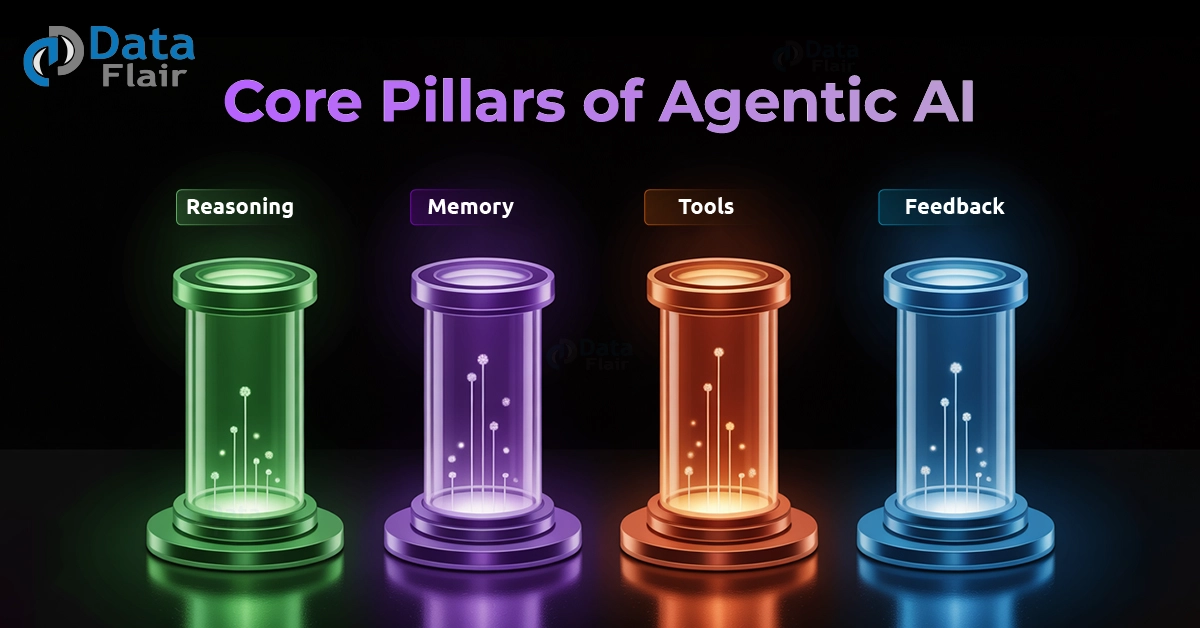
The strength of Agentic AI lies in four core pillars:
1. Reasoning
2. Memory
3. Tools
4. Feedback
Together, these 4 make an AI that is active, autonomous, adaptive, and self-improving. Let’s explore each one in detail.
Reasoning – How Agents Think
Reasoning is the primary function of Agentic AI. Unlike basic AI models that predict answers, agentic systems can analyse problems and plan steps to solve them smoothly, making decisions along the way.
- Chain of Thought (CoT): Splitting problems into logical and practical steps.
- Tree of Thought (ToT): Exploring possible paths before making a decision.
- Goal-Oriented Planning: Choosing actions according to long-term objectives.
Example: A financial AI agent doesn’t just answer “What is the stock price?”. It explains: “If the price is rising, and market sentiment is positive, should I suggest a buy action?”
Why it matters: Reasoning makes AI agents more strategic and problem-solving oriented, not just reactive.
Memory – How Agents Remember
Memory enables agents to retain and use past experiences. Without memory, an agent resets every time — like a chatbot forgetting yesterday’s conversation.
Types of memory in Agentic AI:
- Short-Term Memory: Stores temporary context during a task.
- Long-Term Memory: Remembers previous interactions, facts, and patterns.
- Episodic Memory: Keeps records of past actions and output.
- Semantic Memory: Stores structured information about the world.
Example: A personal AI tutor will save and remember which topics you struggled with last time and adjust for future lessons.
Why it matters: AI learn, adapts, and personalises experiences for users based on their past conversations and format.
Tools – How Agents Act
Tools are essential for Agentic AI. They allow an agent to go beyond reasoning and memory by interacting with external systems.
- APIs & Databases: Access real-time data.
- Software Integration: Send emails, manage tasks or meetings.
- Sensors & Robotics: Perceive and act in the physical world.
Example: A travel planning agent not only suggests destinations but also uses various tools to help you book flights, reserve hotels, and send confirmations.
Why it matters: Tools narrow the gap between thinking and acting, making AI practical and valuable in real-world scenarios.
Feedback – How Agents Improve
Feedback is the auto-correction process of Agentic AI. It ensures that agents properly learn from outcomes.
Forms of feedback include:
- Self-Reflection: Agents check their own reasoning (“Did I make the correct decision?”).
- Human Feedback: Users provide corrections, ratings, or approvals.
- Environmental Feedback: The system observes the results of its actions.
Example: An AI customer support agent suggests a solution. If the customer still raises a ticket, the system learns to refine its future responses.
Why it matters: Feedback enables continuous learning and improvement, reducing errors and increasing trust.
How the Four Pillars Work Together
These four pillars are not separate — they form a unified loop:
1. Reasoning: The agent decides what to do.
2. Memory: It recalls past experiences and context.
3. Tools: It executes actions in the environment.
4. Feedback: It learns from results and refines future actions.
This cycle makes Agentic AI systems adaptive, reliable, and goal-driven.
Real-World Applications of These Pillars
- Healthcare: AI monitors patient data, finds risks, sends alerts, and learns from patient responses.
- Business Operations: Agents optimise workflows using past trends, predict bottlenecks, automate tasks, and refine processes.
- Education: AI tutors adapt lessons, track progress, provide interactive exercises, and refine teaching style based on performance.
Conclusion
The four core pillars of Agentic AI — Reasoning, Memory, Tools, and Feedback — define the difference between traditional AI and intelligent agents.
- Reasoning gives agents the power to plan and decide.
- Memory ensures personalisation and learning.
- Tools allow them to act in the real world.
- Feedback makes them self-improving and trustworthy.
Together, they create AI systems that are not just assistants, but autonomous partners capable of tackling real-world challenges.