


Businesses are increasingly adopting DevOps practices to satisfy the expectations of quick and high-quality application delivery in today’s fast-paced IT environment. The need for DevOps tools and service providers has increased as a result of this. With the help of DevOps tools, development, operations, security, and business teams can effectively share information and technical know-how, assuring transparency, automation, and collaboration along the value stream.
There isn’t a single set of DevOps tools that works for everyone. Different tools address various needs and difficulties encountered when implementing DevOps practices. In this post, we’ll give a thorough review of the many types of DevOps tools and talk about some of the most well-liked products in each category.
Various DevOps Tools
1. Version Control Tools
The most popular version control programme is still Git, which gives programmers a mechanism to keep track of updates and changes to their code. Git is perfect for mission-critical software due to its compatibility with numerous protocols, including HTTP, SSH, and FTP, as well as its ability to allow non-linear shared-repository development. Cloud-hosted code repository services are provided by well-known platforms like GitHub, GitLab, and Bitbucket, further boosting collaboration and version control features.
- GitHub – An extensively used platform for hosting code that offers features like collaborative coding, automation, security, and project management.
- Bitbucket – A platform that aims beyond code management and enables teams to plan projects, work together on code, test their work, and deploy it all from the same location.
- GitLab – An all-encompassing DevOps solution that considers every stage of the software delivery lifecycle, from planning to monitoring and security.
2. Build Tool – Maven
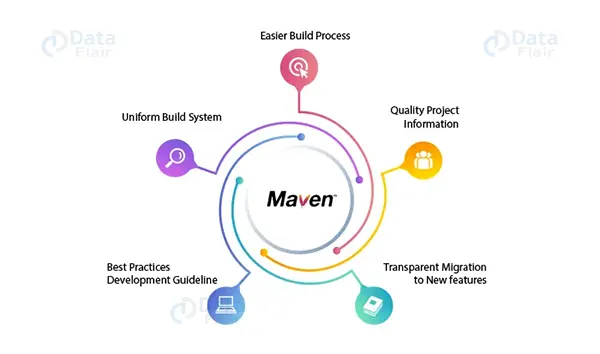
Maven is a crucial DevOps tool for project development since it manages and automates reporting, documentation, distribution, releases, and dependencies. Maven streamlines the build procedure and maintains consistency and speed by supporting a number of languages, including Java, C#, Ruby, and Scala. With popular IDEs like Eclipse, NetBeans, and IntelliJ IDEA, it may be seamlessly integrated because of its huge plugin repository.
3. Container Management Tools
Application deployment has been transformed by containerization, and Docker and Kubernetes are at the forefront of this movement. Docker is compatible with a variety of operating systems and cloud platforms thanks to its automation for the creation, distribution, and maintenance of containerized applications. In order to ensure speed and effectiveness in production, Kubernetes, an automation orchestration platform, automates container configuration, scaling, networking, and more.
- Docker – A compact tool that uses containerization to streamline and speed up numerous operations throughout the software development lifecycle (SDLC).
- Kubernetes – A feature-rich open-source programme used to manage and deploy containerized applications, including automated rollouts, service delivery, and self-healing capabilities.
- Mesos – A distributed systems kernel that supports the start of containers using Docker and AppC images and resource management and scheduling across the data centre and cloud environments.
4. Application Performance Monitoring Tools
For the best user experience, monitoring application performance is essential. Several well-liked tools for app performance monitoring are:
- Prometheus – A strong reporting tool that is open-source and supports container monitoring of performance.
- Dynatrace – A thorough monitoring tool with AI-driven issue detection and resolution, spanning application performance, digital experience, business analytics, and infrastructure monitoring.
- AppDynamics – A piece of equipment that offers real-time analysis of an application’s performance coupled with ongoing monitoring and reporting on the effectiveness of all transactions that pass through it.
5. Cloud Computing and Storage: AWS, Azure, GCP
Cloud services have become essential for scalable and efficient infrastructure and operations. AWS, Microsoft Azure, and Google Cloud Platform (GCP) offer a wide range of services under PaaS, SaaS, and IaaS categories, supporting DevOps teams in developing, storing, and deploying high-quality software.

6. Deployment and Server Monitoring Tools
Application stability and availability depend on effective server monitoring and deployment. The following are some of the most well-liked tools in this category:
- Splunk – A monitoring and analytics tool generally used to troubleshoot problems in a variety of infrastructure environments, including virtual, physical, and cloud.
- Datadog – a SaaS-based platform for monitoring servers and applications that offers complete user experience visibility and business prioritisation.
- Sensu – An open-source tool for monitoring cloud environments, offering a secure, scalable, and integrated observability pipeline.
7. Configuration Management Tools
Throughout the DevOps life cycle, configuration management is essential for keeping big complex systems in a known and consistent state. Ansible, Chef, and Puppet are well-known CM automation frameworks. Both Puppet and Chef are Ruby-based programmes that use declarative programming and the master-agent model, respectively. In contrast, Ansible is a Python-based tool with Playbooks written in YAML that is renowned for its simplicity.
- Chef – An open-source tool for automation and configuration management, allowing infrastructure coding in domain-specific languages and integration with cloud platforms.
- Puppet – A tool for controlling and automating infrastructure and business processes by extracting process information across operating systems and platforms.
- Ansible – A simple IT automation device that specializes in configuration management and orchestration, imparting smooth integration and scalability.
8. Testing Tools: Selenium, Gremlin
Testing automation is essential for delivering high-quality software consistently. Selenium is a popular open-source testing framework for web applications, supporting multiple programming languages and automation test frameworks. Gremlin is a cloud-native framework for running chaos experiments, testing the reliability of cloud infrastructure.
9. CI / Deployment Automation Tools
Automation tools for continuous integration and deployment simplify the software delivery process. Popular equipment in this class includes:
- Bamboo – a tool for practising continuous delivery that enables teams to properly develop, test, and launch software.
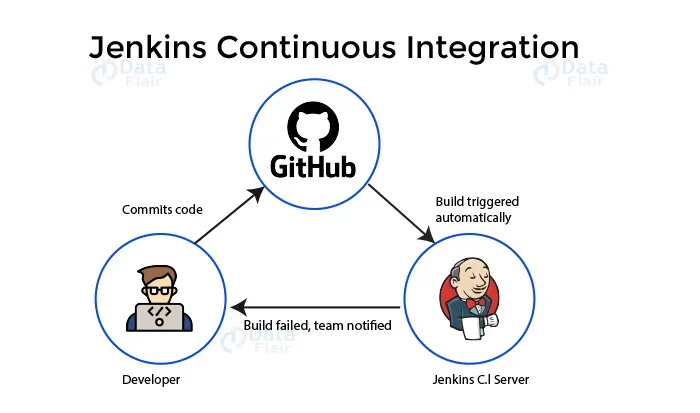
- Jenkins – An open-supply automation server that facilitates constructing, deploying, and automating tasks throughout multiple structures.
- CircleCI – A cloud-based tool for continuous integration and delivery, offering fast and parallelized builds, seamless integration with popular platforms, and scalable workflows.
Conclusion
In conclusion, DevOps technologies are essential for helping businesses to increase collaboration, accelerate time-to-market, and streamline their software delivery processes. Teams can select the tools that best meet their unique needs and requirements from a wide range of tools available across various categories, including version control, container management, application performance monitoring, deployment and server monitoring, configuration management, and CI/deployment automation.
It’s crucial to remember that choosing the right tools is only one factor in the success of a DevOps implementation. It necessitates a culture shift towards cooperation, openness, and ongoing improvement, as well as the implementation of effective procedures and techniques. To fully reap the rewards of these tools, organisations should place a high priority on team alignment, creating clear communication lines, and encouraging a DevOps attitude.
Additionally, as the DevOps landscape develops, new tools and technologies are continuously being developed. It is critical for businesses to keep up with emerging trends, assess new tools in light of their individual requirements, and modify their DevOps toolchain as necessary.
Organisations can speed up software delivery, improve quality, and boost overall efficiency in their development and operations processes by leveraging the right combination of DevOps tools and putting best practices into practice. This will increase customer satisfaction and help businesses succeed in the competitive digital market of today.